Grounding strategy for isolated and none isolated filtered DC-DC converters

Thread Starter

MEY

Joined Oct 9, 2025
4
Hello all,
Below is a schematic of a circuit on which i'm not 100% sure if it is the correct way to reduce best EMI problems.
I'm not sure whether i should tie the return output of the isolated dc-dc converter to the pcb ground to the chassis or to the chassis through a capcitor.

The use case of this circuit is an application on a drone, where i want to be isolated from the battery and provide a clean power rail to my analog cicruits in the PCB. That is why i link the negative output of the common mode and diff. filter to the isolated pcb ground.

For the Battery, I'm not sure if i should leave it floating or tie it to the chassis directly or via high impedance resistor.
Note that i link the PCB groud to the chassis via a 1MegaOhms resistor and a capacitor that becomes low impedance in HF.
I also did not use a filter between the battery and the input of my dc-dc.

Please feel free to critic this circuit and give your input/recommendations/corrections.

Thank you in advance.
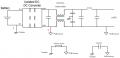
Grounding_DCDC.png
 

Irving

Joined Jan 30, 2016
4,996
If you link PCB Ground to both sides of the filter you might as well remove the filter, similarly if PCB ground is on the supply side of the filter. For a drone, where there is no real 'ground' I'm not sure there is any good reason to connect PCB ground to the chassis/battery -ve at all, unless chassis is a substantial lump of metal which may act as a 'virtual ground' for RF antenna? Note you potentially already have a defacto connection from the centre tapped filter capacitor pair which would be compromised by any other connection.
 
Last edited:

Thread Starter

MEY

Joined Oct 9, 2025
4
Thank you Irving for your response.
“If you link PCB Ground to both sides of the filter you might as well remove the filter, similarly if PCB ground is on the supply side of the filter”: why is that ? I don’t understand that part of your response.
I use the isolated dc dc converter to have an isolated power rale for my signal acquisition circuit. So the whole circuit need a new isolated reference ground plane and that’s what I mean by the PCB ground. I don’t see how the filter will work correctly if its input common and output common are not connected to the same reference.

Yes There Will be a substantial lump of metal (the casing of a the unit controller)

Thanks you in advance for your response
 

Irving

Joined Jan 30, 2016
4,996
I don’t see how the filter will work correctly if its input common and output common are not connected to the same reference.
They are not the same, there is an inductor between them. If you short them together you are compromising the common mode choke. Only the output side needs grounding...
 

Thread Starter

MEY

Joined Oct 9, 2025
4
They are not the same, there is an inductor between them. If you short them together you are compromising the common mode choke. Only the output side needs grounding...
Ah yes you are completely right ! Thank you !
 

MisterBill2

Joined Jan 23, 2018
27,159
Consider the filter NAME!! The sole purpose is to block signals that are present on both lines of the input. THAT is the definition of "Common mode" There are other filter types for blocking non-common mode signals.
IN ADDITION, "Ground" is not an applicable term, exactly as Irving states.
AND, in post #1, if the battery is not feeding anything else, why connect one side of it to all the other common points?? That is just spreading the noise from that terminal of the DC to DC converter.
 

Irving

Joined Jan 30, 2016
4,996
On top of which, most DC-DC converter application notes put the filter on the input side. The output of an isolated converter is generally pretty quiet, but the switching noise back out of the input can be horrendous and a big EMI issue. You don't need a common mode filter on the output, a simple LC or PI filter will suffice if you really need it, which I doubt, as the supply line ripple rejection on most audio ICs is typically >90dB. That assumes a reasonable headroom on the output loading of the converter.

Another aspect to consider is weight.. that filter is going to be relatively heavy with its ferrite core; do you really need to give up that flight time?

What is in your "analog circuits"?
 
Last edited:

MisterBill2

Joined Jan 23, 2018
27,159
IRVING makes many good points!! There is no benefit from the common mode filter on the output side, because that side is already grounded. No need for extra weight on a drone that flies!! The TS needs to understand the application and where noise will be generated, and where that noise could be a problem. THAT is a big part of application design engineering!!
 

Thread Starter

MEY

Joined Oct 9, 2025
4
Thank you all for your responses, very interesting stuff.
To clarify more, when plugging the battery (28 V) to the isolated dc dc converter (outputs 15V at 1.5 Amps ) without a filter, I measured a differential noise of up to 200 mV peak to peak at the switching frequency of the converter plus also the common mode noise (with of course proper probing). The analog circuit after is a Thermocouple and Rtd Pt100 acquisition circuit with a SAR ADC and Spi isolator, and I cannot accept such level of noise to obtain my desired precision. Therefore I added the filter after. The filter greatly reduced the noises (2mV differential and common). I also have an LDO actually after the filter. (Weight and size is not a problem for my application)
Many papers suggests having filters on both sides for low noise applications so I beg to differ on the remark regarding the no need for the filter after the converter. I was mainly inspired by the paper below:
https://emcfastpass.com/wp-content/uploads/2017/04/DC_DC_Converters_Output_Noise.pdf
Regarding the term PCB ground, I use it because this circuit is the power circuit for a separate PCB that connects to a backplane PCB that has the uC and other sensitive electronics that I want to isolate from the external world. Therefore each stack PCB has its own local isolated ground that acts as a local return path for local signals and power (the negative output of the filter)

I hope I answered your questions.

thank you!
 

Irving

Joined Jan 30, 2016
4,996
Fair enough & interesting paper. That sounds a really bad DC-DC converter; what is it and what filter are you using?
 

MisterBill2

Joined Jan 23, 2018
27,159
OK, now what we know is that without that filter choke there is more noise. What we do not know is what the noise level would be with only a filter choke in the not-commoned line. And it seems that there might be other things tied to the battery side of the inverter. So the whole system is a bit more complex than what we see. AND this is evidently not a small, hobby class, drone.
 
Top