Question about Grounding of an IC

Thread Starter

royaaron

Joined Feb 19, 2024
108
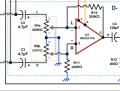
Some of you folks have seen this schematic which I’ve attached a few times.
I believe I’ve corrected the mistakes and hope to start building.

But aside from what errors you might uncover I have a question about grounding as pertains to the three ICs (MC33171N [spec sheet also attached]).

But first the purpose of the device:

  • Produce a center channel (mono) output
  • Produce an output consisting of what is unique to each of the channels of the stereo signal
    and
  • Produce an output consisting of what is common to each of the channels of the stereo signal
In none of the ICs is there a direct grounding. Rather, connection to ground is made through a resistor.
Does this seem right?
 

Attachments

Thread Starter

royaaron

Joined Feb 19, 2024
108
All-in-all I guess I have to take the blame for the schematic.
Certain aspects of it derive from circuits I've seen over the past year. And certain changes were made in response to comments on these boards.
 

Thread Starter

royaaron

Joined Feb 19, 2024
108
Looks much better without the audio transformer. Why did you pick 200 ohms for R12 and R14?
I chose 200 ohms because from what I read on the spec sheet the stated output impedance of the MC33171N is 200 ohms.
As unity gain is satisfactory for IC3 I simply matched them. Am I mistaken? (A poster on another board suggested that it's low.)
 

nsaspook

Joined Aug 27, 2009
16,250
I chose 200 ohms because from what I read on the spec sheet the stated output impedance of the MC33171N is 200 ohms.
As unity gain is satisfactory for IC3 I simply matched them. Am I mistaken? (A poster on another board suggested that it's low.)
There is no need to match (for power) output impedances in this audio circuit input section. All signals are voltage levels (200 ohms will load that voltage level down), not power levels. Impedance matching is important when actual power is being transferred, like from the speaker power module to the speaker (a energy transducer).
 
Last edited:

Thread Starter

royaaron

Joined Feb 19, 2024
108
There is no need to match (for power) output impedances in this audio circuit input section. All signals are voltage levels (200 ohms will load that voltage level down), not power levels. Impedance matching is important when actual power is being transferred, like from the speaker power module to the speaker (a energy transducer).
What values would you suggest?
 

elonthefelon

Joined Mar 16, 2025
3
What do you think will happen to your differential gain when the inputs see different impedances?

Even if both pots halves track exactly the same, which real pots do not, R11 will load down R6b's wiper.


Capture.PNG
 

Thread Starter

royaaron

Joined Feb 19, 2024
108
How did you pick the values for IC1? If that's OK then those values for IC3 should work.
By ignorance, mostly. The IC1 input resistance when the volume pot (R3) is at noon and the IC1 balance pot (R6) is at noon is around 134K. (Being a balance pot R6 is linear, not log-based.) The Vout formula for a diff op amp didn't help because if V1=V2 then Vout is zero which is actually true for a mono signal applied to both the inverting and non-inv inputs. But I didn't know how to calculate Rf for either a unity or slight gain. So I guessed.
All-in-all I am not looking for amplification from any of the three ICs; I just want them to do the transformations.
I'd be grateful if you could offer resistance values for the ICs.
 

nsaspook

Joined Aug 27, 2009
16,250
By ignorance, mostly. The IC1 input resistance when the volume pot (R3) is at noon and the IC1 balance pot (R6) is at noon is around 134K. (Being a balance pot R6 is linear, not log-based.) The Vout formula for a diff op amp didn't help because if V1=V2 then Vout is zero which is actually true for a mono signal applied to both the inverting and non-inv inputs. But I didn't know how to calculate Rf for either a unity or slight gain. So I guessed.
All-in-all I am not looking for amplification from any of the three ICs; I just want them to do the transformations.
I'd be grateful if you could offer resistance values for the ICs.
The nice thing about resistors is that they are easy to change on just about any PCB, through hole or SMD. Use the same values for both and see how it works, You're building a prototype, it's rare that even the best designs in theory are perfect in reality. So always plan for possible variations with test points (even the most professional boards have TP points for adjustments and repair) on the board to check for proper operation and design for changes, they usually will be needed.

Never expect or plan for perfection.
 

Thread Starter

royaaron

Joined Feb 19, 2024
108
The nice thing about resistors is that they are easy to change on just about any PCB, through hole or SMD. Use the same values for both and see how it works, You're building a prototype, it's rare that even the best designs in theory are perfect in reality. So always plan for possible variations with test points (even the most professional boards have TP points for adjustments and repair) on the board to check for proper operation and design for changes, they usually will be needed.

Never expect or plan for perfection.
Okeedoke . . . thank you
 

BobTPH

Joined Jun 5, 2013
11,463
Opamps do not have nor need a ground connection. The inputs, however, are often referenced to ground, sometimes with resistors. This is not a matter of “grounding the IC”, it is simply s voltage reference.
 

AnalogKid

Joined Aug 1, 2013
12,043
To the question - most opamps do not have an explicit ground pin, and some that do on the datasheet, like the ubiquitous LM324 and LM358, have the negative rail pin designated that way for marketing purposes; those opamps are perfectly happy with +/-12 v supplies (for example).

In a circuit like yours, "ground" can be both the reference potential for the signals, and a part of the power delivery system. Because you have bipolar supplies, the opamps have no direct GND connection. The audio power amp does, again common for that type of part. It is designed to work with an input signal that goes below GND even though it does not have a negative voltage power rail. It this case, GND is both a signal reference and a power return.

Some audio parts are weird. Get used to it.

ak
 

Hrehory

Joined Mar 20, 2025
3
Some of you folks have seen this schematic which I’ve attached a few times.
I believe I’ve corrected the mistakes and hope to start building.

But aside from what errors you might uncover I have a question about grounding as pertains to the three ICs (MC33171N [spec sheet also attached]).

But first the purpose of the device:

  • Produce a center channel (mono) output
  • Produce an output consisting of what is unique to each of the channels of the stereo signal
    and
  • Produce an output consisting of what is common to each of the channels of the stereo signal
In none of the ICs is there a direct grounding. Rather, connection to ground is made through a resistor.
Does this seem right?
From what I've seen, all of your circuits produce a mono signal. The switch does nothing. I don't know what you are referring to as grounding. The simple summing of left and right channels would do want you want and make for a far simpler circuit. If you are referring to building this device, I would say this: keep input grounds from a given circuit with that circuit. That is do not borrow a ground from some place that is convenient. (physically) If you have an input connector close to the input circuit, that ground should be connected to that circuit ONLY!
 

Thread Starter

royaaron

Joined Feb 19, 2024
108
From what I've seen, all of your circuits produce a mono signal. The switch does nothing. I don't know what you are referring to as grounding. The simple summing of left and right channels would do want you want and make for a far simpler circuit. If you are referring to building this device, I would say this: keep input grounds from a given circuit with that circuit. That is do not borrow a ground from some place that is convenient. (physically) If you have an input connector close to the input circuit, that ground should be connected to that circuit ONLY!
Yes, they all produce a mono signal but the contents vary by design.
If you are referring to SW2 or SW3 you are mistaken: SW2 outputs a center channel, unique-to-each-input or a common-to-each-input, respectively.
SW3 cuts in a low pass filter targeting ~70Hz.
I will apply your grounding suggestion.
 
Top