Help with analogue grounding - STM32 DAC, bluetooth receiver and audio amplifier

Thread Starter

freeflyer

Joined Sep 9, 2016
148
I am trying to work out how to connect the grounds for an ST MCU (STM32L433RCT6P), bluetooth audio receiver (MH-M18) and audio mono amplifier (LM48100Q).

The MCU has an analogue supply (VDDA and VSSA) and I am using the MCU DAC to send audio to one channel of the amplifier. The bluetooth aduio receiver sends audio to the other channel of the amplifie (both audio sources are mixed when playing).

I have prototyped this using development boards (ST NUCLEO-L433RC-P and MIKROE-2368) but I do hear some backround humming noise.

I am now designing a PCB but want to make sure I get the analogue grounds correct and hoping it could reduce the humming noise.

The issues I have are:
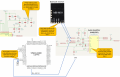
  1. I am not sure how to connect the VSSA (analgue ground) of the STM32
  2. I am not sure what ground the bluetooth receiver should use
  3. I am not sure what ground the audio amplifier should use

1751659466874.png
 

MisterBill2

Joined Jan 23, 2018
27,159
Certainly the TS has a valid concern! This is a very good question. The problem was caused by Lazy Labeling! Some of the connections tagged as "GND" should be tagged as "common" (COM), or "Return" (RET), or "PWR COM".
True "ground " is a MYTHICAL infinite plain of zero resistance and zero potential voltage. What passes for "ground" is a local connection/collection of return points for power, signals, and control voltages, and other inputs, and which might possibly connect to some external "ground."

For this particular system, where Ground Current Loops could be created that would introduce hum and noise into audio signals, The simple. logical fix will be to use a scheme sometimes called a "STAR POINT". That is a single node that separate conductors from each "gnd" terminal are tied to. The concept is that by doing this there will be no conductors sharing current from different sources, and thus no unintended coupling via the dreaded "ground loops"
This scheme is often used in industry, where it usually avoids causing interaction problems.
 
Last edited:

BobTPH

Joined Jun 5, 2013
11,463
Seeing as the bluetooth receiver only as one ground and one power terminal, the common ground has to include the negative of the supply for that board.

Do the devices have separate supplies?
 

Thread Starter

freeflyer

Joined Sep 9, 2016
148
Certainly the TS has a valid concern! This is a very good question. The problem was caused by Lazy Labeling! Some of the connections tagged as "GND" should be tagged as "common" (COM), or "Return" (RET), or "PWR COM".
True "ground " is a MYTHICAL infinite plain of zero resistance and zero potential voltage. What passes for "ground" is a local connection/collection of return points for power, signals, and control voltages, and other inputs, and which might possibly connect to some external "ground."

For this particular system, where Ground Current Loops could be created that would introduce hum and noise into audio signals, The simple. logical fix will be to use a scheme sometimes called a "STAR POINT". That is a single node that separate conductors from each "gnd" terminal are tied to. The concept is that by doing this there will be no conductors sharing current from different sources, and thus no unintended coupling via the dreaded "ground loops"
This scheme is often used in industry, where it usually avoids causing interaction problems.
Thanks misterbill, the pcb is a 4 layer board and I plan to use the two internal layers as GND and 3.3v.

I sort of understand the star point connection method.

Would the star point connection apply to the internal ground plane? Should I connect all the grounds (analogue, digital and power ground) to the internal ground plane using vias ?

Or should I use separate planes for analogue, digital and power ground which then all meet at the battery negative terminal connector ?
 

BobTPH

Joined Jun 5, 2013
11,463
Assuming the DC to DC converters are not isolated:

What you going to connect the AGND to that is different than common GND, which has to be the negative terminal of the battery?
 

MisterBill2

Joined Jan 23, 2018
27,159
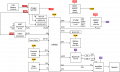
Oh Wow!!! I am more familiar with assemblies made on larger scales. On a single multi-layer PCB there are fewer options available. In that block diagram in post #4, I do not see any grounds or return connections at all. It is a real challenge to evaluate circuit connections not shown. So my suggestion for the "star point" approach would be to have enough copper on the ground plane so that the different loads do not ned to dhare the current paths back to the battery return connection.
 

Thread Starter

freeflyer

Joined Sep 9, 2016
148
Oh Wow!!! I am more familiar with assemblies made on larger scales. On a single multi-layer PCB there are fewer options available. In that block diagram in post #4, I do not see any grounds or return connections at all. It is a real challenge to evaluate circuit connections not shown. So my suggestion for the "star point" approach would be to have enough copper on the ground plane so that the different loads do not ned to dhare the current paths back to the battery return connection.
There are no ground returns on the block diagram because I am unsure of how to connect them etc
 
Top