is Zener diode-based voltage divider a good solution for gate driver supply?

Thread Starter

BrokenPin

Joined Oct 1, 2023
44
Hello,
I have used a Zener diode-based voltage divider to create a negative bias for a gate driver supply but I noticed that the series resistor is getting too hot!!
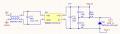
1734870052681.png
This is the process of how I designed this supply:
P = (Freq × Qg × Delta[Vgs] × N ), Where P is the average power, Freq is the switching frequency, Qg is the total gate charge, Vgs(total) is the total gate voltage swing and N is the number of devices in parallel.
P = 150kHz * 90.8nC*24V*1 = 0.324W (This is the power required to drive the SiC device)
let's say the signal driving the Mosfet gate has a 50% duty cycle so I = Freq × Qg = 13.62mA, meaning the positive rail will source 6.81mA during the ON state, and the same for the negative rail.
if Iz=5mA and the gate require 6.81mA, then the total that will go through the series resistor (R36) will be <15mA i.e. 300mW (R36 is a 0.5W 0805 SMD RES) so, it should not get hot! right !? did I miss something?

Is this a good way to make a bipolar supply to drive SiC Mosfets? would adding a linear regulator for one of the rails (positive or negative) make it a better solution?

is it a better solution (robust) to use:
  1. a three-terminal adjustable shunt regulator.
  2. a dual output Isolated DC/DC Converter.
  3. an isolated power supply (with a transformer and rectifier diodes)

Thank you all,
 

Thread Starter

BrokenPin

Joined Oct 1, 2023
44
I don't think so.
Thank you for the answer.. I suspected that haha
I would appreciate more details .. I have seen many reference designs using DC-DC isolated modules with shunt regulators or zener diodes for negative supply so I thought it should work but here we are
 

Alec_t

Joined Sep 17, 2013
15,112
For a switching frequency of 150kHz a dedicated gate-driver IC would be best, able to supply the high current (typically 1A or so) needed to switch the MOSFET rapidly to minimise heating.
 

Thread Starter

BrokenPin

Joined Oct 1, 2023
44
For a switching frequency of 150kHz a dedicated gate-driver IC would be best, able to supply the high current (typically 1A or so) needed to switch the MOSFET rapidly to minimise heating.
I am using a dedicated gate driver (UCC21520A) to drive the MOSFETs but I still need an isolated power supply to supply the power side of the gate driver. (see below image)
1734874317167.png
 

BobTPH

Joined Jun 5, 2013
11,484
Whatever you are trying to do here, it is an odd approach. Tell us how the gate voltage is connected to the larger circuit and I am sure someone will have a better idea.
 

ronsimpson

Joined Oct 7, 2019
4,661
He has the gate driver connected to +20V and -4V.
There is a Zerner from Ground (Source) to -4V.
There is a pull down resistor from +20 to Ground.
The supply makes 24V.
I have done something like this before.
 

ronsimpson

Joined Oct 7, 2019
4,661
Next question, what transistor are you using?
+20V is very high.
I like -4V. Many people cannot make a good 0V and the low gate voltage I see too much bounce in the turn off signal. I am using transistors that turn on at 0.8V and the negative level helps reduce losses at turn off.
 

schmitt trigger

Joined Jul 12, 2010
2,056
Like Ron mentioned, 20 volts appears to be quite high to drive an IGBT.
But if you share its data sheet, we may assist you in reviewing the correct gate drive voltage.
 

Thread Starter

BrokenPin

Joined Oct 1, 2023
44
Next question, what transistor are you using?
+20V is very high.
I like -4V. Many people cannot make a good 0V and the low gate voltage I see too much bounce in the turn off signal. I am using transistors that turn on at 0.8V and the negative level helps reduce losses at turn off.
I am using SiC MOSFETs (CMF20120D), I used +20V and -4V (could be -2V) as it is used in the datasheet for validating MOSFET characteristics.
 

Thread Starter

BrokenPin

Joined Oct 1, 2023
44
You have 20V across 470 ohm resistor. I think that alone is 0.85W. Did I did I miss something?
opss!! I guess the whole solution is a dead-end according to the answers given by the gentlemen.
I will use a 1W resistor just to test the board and I will redo the whole isolated supply in a second revision.
 

ronsimpson

Joined Oct 7, 2019
4,661
I will use a 1W resistor just to test the board and I will redo the whole isolated supply in a second revision.
Will it work with a 1k resistor?

I agree you need +17 to +20V and -2 to -4V of gate drive. Looks like a nice part.
Place the Gate driver IC as close to the transistor as possible. The IC, bypass caps, resistors and power transistor need to have a small loop.
I mount the transistor down on the PCB to reduce lead length. At these speeds every mm counts.
Does CREE make a 4-legged version?
 

Thread Starter

BrokenPin

Joined Oct 1, 2023
44
Will it work with a 1k resistor?

I agree you need +17 to +20V and -2 to -4V of gate drive. Looks like a nice part.
Place the Gate driver IC as close to the transistor as possible. The IC, bypass caps, resistors and power transistor need to have a small loop.
I mount the transistor down on the PCB to reduce lead length. At these speeds every mm counts.
Does CREE make a 4-legged version?
Thanks for the suggestions Ron,
I will try with a higher values and higher power rating resistors..
I did put all the gate driving circuitry in a small loop .. and the dc dc isolated supply on the bottom side..
Yes, CREE does have 4 legged Mosfets (TO-247-4) but not for this part ..
Actually this part is obsolete, we used it before for a project and i just had some pieces laying around so i used it .
 
Top