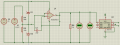
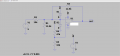
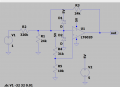
Thank you, I actually found someone posted a circuit similar to the required. This circuit below supposed to measures voltages with -3V to +3V range I am not sure which amplifier is good but I am thinking of using MCP6021, and I would appreciate any advise.
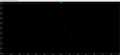
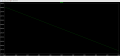
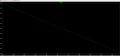
One thing I don't understand is why the curve is shifted around 0.5V to the right!
Remove R4 and R5. Ground the non-inverting input of the opamp. The output should then go from ~+5v to ~0V as the input goes from -2.5V to +2.5V. You need a rail-to-rail opamp.
Hi Sham
If you bias the OPA to give +2.5V output when the input voltage is zero, you could write your Atmega program to measure an input voltage range of +/-2.5V
E
You didn't answer my question about what output you want. so still cannot give you an answer to your post question, other that "yes" you can.
So far, all your statements have been rather vague.
What exactly is the input voltage range you want to measure, and what output voltage do you want for that range?
Sorry for any confusion, as ericgibbs said I want to convert the input voltage to analog 0-5V to use it with ADS1115 and Atmega2560.
The mid point between +ve and -ve range should return 2.5V, while the lowest negative of the range is 5V, and highest positive of the range at 0V.
I want to make two circuits: one with +-3V range, and one +-32V. Both circuits should have accuracy better than +-0.3%..
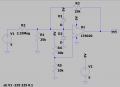
The one I shared before seems working ok for +-3V and for the +-32V the following:
again, you are not providing negative supply for your opamp.
and the way you wired D2, negative voltages will be clamped so you will not see change below some -55V. also Opamp inputs even when rail to rail, cannot go negative. and LT6020 has outputs that can go rail-to-rail but not inputs so you have less than 50% of desired range.
consider different input protection, creating virtual ground or using summing amplifier.
You masked out the opamp model that the simulation is using. Why?
Your 0 V input is resulting in an output voltage that is about 300 mV to high, which means that an extra 24 µA of current is flowing through the feedback resistor. This is very possibly due to the bias current requirements of the opamp. But without knowing the model, there's no way for us to determine if that is reasonable or not.
Sorry for any confusion, as ericgibbs said I want to convert the input voltage to analog 0-5V to use it with ADS1115 and Atmega2560.
The mid point between +ve and -ve range should return 2.5V, while the lowest negative of the range is 5V, and highest positive of the range at 0V.
I want to make two circuits: one with +-3V range, and one +-32V. Both circuits should have accuracy better than +-0.3%..
But your thread title says that you are wanting to measure millivolt signals.
Have you considered the impact of your component tolerances?
Have you considered the impact of supply voltage variation, since your circuits are relying on a voltage divider using the supply? What happens if your supply drifts by, say, 20 mV?

 Facebook
 Google
 GitHub
 Linkedin