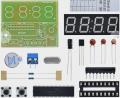
Danko beat me to the suggestion; you can purchase DIY clock kits from Aliexpress or Ebay for less than the cost of the individual components.
If you feel that assembling a kit is a little “cheating” and won’t give you any learning experience, discard the board and passive components, and keep the IC, LED display and crystal.
Then, Study the IC datasheet and design your own circuit.
I did that several years ago, because I wanted -for the novelty, to use red, green, yellow and blue LED displays.
Back then, I used a Silan Semiconductor chip.
The challenge with IC devices is the time base. It is either a crystal oscillator with a large division string, or a mains frequency divider with a much shorter divider string, or some scheme to pick up the actual time broadcasts and decode the time.
Counting the mains frequency is the simplest but usually it needs to plug in and it usually needs a transformer for both power and isolation. The plug-in part can be inconvenient but what is so bad about a transformer???
It can certainly be done, and in fact has been innumerable times. This is all a digital watch is, after all. The issue is always going to be drift. Why are you adamant about code writing? There is canned / example code for arduinos and using something like a Raspberry Pi Zero W makes NTP a snap. It's all but plug-and-play.
Most recently I have been playing with a MECHANICAL digital clock. It was part of a Sony brand clock radio. A one RPM synchronous motor driving a five stage "Veeder counter". And a settable mechanical switch operator. But rather than switching on a radioor a noise maker, the tiny microswitch will control a solid state relay rated at 25 amps/250 volts. That will switch on the lights.And possibly there may be a flasher in the 5 volts control circuit.
Why not an electronic counter?? Because without an adequate backup power supply, the one second power glitches will reset to some wrong time. And backup batteries always go dead eventually. And it is fun to work with some of that really older technology. Veeder counters have been recording car mileage for many decades, and they represent an interesting mechanical design scheme.
A while back, in this same forum, I suggested to a teacher who wanted a class project to create a clock without ICs. I suggested that they use stair-step counters and that worked very well for them. so someplace is that thread with the description of the completed clock. But I have no clue as to how to find the thread. Stair-step counters were widely used in the earlier tube-technology video realm. Much more efficient than tubes, for counting.
It can certainly be done, and in fact has been innumerable times. This is all a digital watch is, after all. The issue is always going to be drift. Why are you adamant about code writing? There is canned / example code for arduinos and using something like a Raspberry Pi Zero W makes NTP a snap. It's all but plug-and-play.
The issue with any scheme that requires writing code is that it is not efficient as far as hardware goes, because much of the system is not used when it is configured as a clock. Of course a bunch of folks will jump up and say that the power wasted is not that much. But in a battery powered timepiece it always matters.

 Facebook
 Google
 GitHub
 Linkedin