IR circuit

BobTPH

Joined Jun 5, 2013
11,515
Have you checked the frequency of the oscillator? I would expect better range than that if you are pumping more than 100mA into the LED.

Bob
 

Thread Starter

optus

Joined Oct 25, 2019
92
If the range is 3.5m when the battery is brand new then the range might be 1m or less when the battery has run down a little.
You did not say what is the value of the series base current-limiting resistor for the PNP, and what is the battery voltage when it is working.
Hi,thank you for your coment
First i measured curent between positive rail and output of IC1(pin 3).I was getting around 17 mA.That measurment was done witouht load(open output) and i know that with load on output 3 curent is less.So for the base resistance i calculated 3-0.75(base-emiter drop)=2.25...I wanted to leave about 2.1-2.2 V for my IC so i droped another 0.05 V across 3 ohm resistor,so the voltage of my IC was 2.1 V
In colector region i calculated 3v-1.3V(IR drop)-0.8V (CE saturation),and remaining 0.9 V i lost on 5 ohm resistor so total curent was about 0.18 A.Since i getting a 117mA i assumed that diference of 180mA and 117 mA is due to load on the output 3.
I must say that base-emiter drop is always around 0.6 V(not desired 0.75 V),and CE saturation is about 1 V
I would be very glad if someone could correct me if i am wrong.
Thank you.
 
Last edited:

Thread Starter

optus

Joined Oct 25, 2019
92
Have you checked the frequency of the oscillator? I would expect better range than that if you are pumping more than 100mA into the LED.

Bob
Thank you for your comment
You must realize that i am not professional and just a small step is a big step for me.Frequency was a bit less than 31 kHZ,but it was changing between 30 kHZ and a bit less than 31 kHZ
 

Audioguru again

Joined Oct 21, 2019
6,826
You connected your current meter to the output of the TLC555 and measured 17mA into the dead short of the meter. You should never short an output like that.
The extremely low value of your series base resistor of only 3 ohms is useless. Instead allow about (3V - 0.7V/2)= 1.15V across the resistor then the typical base current will be 8mA but yours is higher than typical so it will be about 14mA.

A little transistor is saturated when its Vce is less than 0.6V, typically 0.2V. The datasheet for a 2N4403 PNP shows Vce of 0.15 typical or 0.4V max at IC of 150mA and Ib at 15mA.

Your poor range might be because your IR pulses do not meet the requirement of burst length and gap time between bursts since an IR detector IC turns down its sensitivity when they are wrong due to it being caused by interference from a compact fluorescent light working at 38kHz.
 

Bernard

Joined Aug 7, 2008
5,784
Two additions might increase range 6X; on TX add a short focus lens about 3 cm dia. to bring 20 deg. down to 2 deg. & add a cone concentrator for Rx, maybe 2 cm entrance, 3mm exit, & 3 cm long. I use Al tape with thin cardboard backing.
The lens for 10 " Corn Hole boards " came from ACE Hardware , pocket magnifier, 1.2" dia., 2.89" FL @ US $ 2.89.
 
Last edited:

Thread Starter

optus

Joined Oct 25, 2019
92
You connected your current meter to the output of the TLC555 and measured 17mA into the dead short of the meter. You should never short an output like that.
The extremely low value of your series base resistor of only 3 ohms is useless. Instead allow about (3V - 0.7V/2)= 1.15V across the resistor then the typical base current will be 8mA but yours is higher than typical so it will be about 14mA.

A little transistor is saturated when its Vce is less than 0.6V, typically 0.2V. The datasheet for a 2N4403 PNP shows Vce of 0.15 typical or 0.4V max at IC of 150mA and Ib at 15mA.

Your poor range might be because your IR pulses do not meet the requirement of burst length and gap time between bursts since an IR detector IC turns down its sensitivity when they are wrong due to it being caused by interference from a compact fluorescent light working at 38kHz.
Beautiful explanation.I am very thankful!
Can you point me how to measure curent from the output of pin 3 if its possible?
My PNP transistor is BC 328 by the way.The one you wrote its not on my disposal but i can order him.It woukd take few days to reach me...[/QUOTE]
 
Last edited:

Thread Starter

optus

Joined Oct 25, 2019
92
Two additions might increase range 6X; on TX add a short focus lens about 3 cm dia. to bring 20 deg. down to 2 deg. & add a cone concentrator for Rx, maybe 2 cm entrance, 3mm exit, & 3 cm long. I use Al tape with thin cardboard backing.
Thank you!
 

Audioguru again

Joined Oct 21, 2019
6,826
Your European BC328 is almost the same as my American 2N4403 except its pins are the reverse.
Instead of shorting a circuit with a current meter, put in a series resistor, measure the voltage across it then use Ohm's Law to calculate the current.
Do you understand the importance and spec's of using the IR pulses correct burst length and gap time between bursts?
 

Thread Starter

optus

Joined Oct 25, 2019
92
Your European BC328 is almost the same as my American 2N4403 except its pins are the reverse.
Instead of shorting a circuit with a current meter, put in a series resistor, measure the voltage across it then use Ohm's Law to calculate the current.
Do you understand the importance and spec's of using the IR pulses correct burst length and gap time between bursts?
Thank you!!!
Yes,let's say i understand.Since i am using TSOP 1730 as reciever from his datasheet i can observe that minimum burst lenght is 10 cycles/burst foloved by more then 10 burst gap time.Carrier frequency should be as close as posible to reciever frequency.Since my frequency on IC1 is 30 kHZ i menage to create frequency of about 750 HZ on IC2 with D.C. of 60%
 

Thread Starter

optus

Joined Oct 25, 2019
92
The TSOPs are very selective. A frequency of 31KHz would likely reduce the range.

Bob
I agree,but it us quiet impossible to achive a frequency of 30 kHZ even with the variable resistors.I was able to do that,but after 5 min frequency goes up or down a bit.
 

BobTPH

Joined Jun 5, 2013
11,515
I have only used them with a microcontroller with a crystal, so the frequency would be accurate to within a few Hz.

Perhaps you need a crystal oscillator in place of the 555 to get the vest range and reliability.

Bob
 

Thread Starter

optus

Joined Oct 25, 2019
92
I have only used them with a microcontroller with a crystal, so the frequency would be accurate to within a few Hz.

Perhaps you need a crystal oscillator in place of the 555 to get the vest range and reliability.

Bob
Unfortunately i am not familiar with that oscillator.Is there a big difference between these two?
 

BobTPH

Joined Jun 5, 2013
11,515
Crystal oscillator is a generic term referring to any oscillator that uses a quartz crystal to set the frequency. The are accurate to a few parts per million.

There is a chip that contains an oscillator using an external crystal + a divider that lets you accurately produce any frequency. It is often used as a more accurate replacement for a 555. Can’t remember the number, maybe someone else can.

Bb
 

Bernard

Joined Aug 7, 2008
5,784
To show range improvement with a lens I setup on bread board a C555 driving a LTE 2871 IR LED
via 2N3904 as emitter follower driving a 2N3904 as a switch. Output about 80 mA @ 30 % duty cycle, 30 kHz. Receiver is OPL561 driving a red LED. Range about 50 cm with cone on Rx no lens on Tx. With lens on Tx range is 6m. Adjustment is touchy.
 

Thread Starter

optus

Joined Oct 25, 2019
92
To show range improvement with a lens I setup on bread board a C555 driving a LTE 2871 IR LED
via 2N3904 as emitter follower driving a 2N3904 as a switch. Output about 80 mA @ 30 % duty cycle, 30 kHz. Receiver is OPL561 driving a red LED. Range about 50 cm with cone on Rx no lens on Tx. With lens on Tx range is 6m. Adjustment is touchy.
So where i can buy that lens?
 

Bernard

Joined Aug 7, 2008
5,784
Try small folding pocket magnifier, 2 to 3 X magnification. Mine from ACE hardware, or office supply & many found on line.
 

Thread Starter

optus

Joined Oct 25, 2019
92
hi optus,
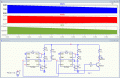
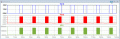
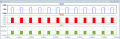
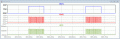
Do these LTS sims represent the results you are expecting.?
General plots from 3V and 2V battery.
Expanded plots, nominal 600Hz and 40kHz
Look them over.
E
View attachment 190359
OMG thank you!!!
You are so expirienced at this.My frequency is 30 kHZ,but your design and graps can help me a lot.Unfortunately today i cannot work on my circuit prior other obligations but when i catch a little bit of free time i will post the results...I am glad that i can study and observe these graphs.Thank you!
 
Top