Facebook
 Google
 GitHub
 Linkedin

Audioguru again
- Joined Oct 21, 2019
- 6,826
Sorry, Eric. A simulation is not real.
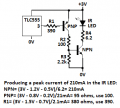
The simulation guesses that the battery is perfect with a very low impedance so that its voltage does not drop with each current pulse like what happens with a real battery. Therefore a supply bypass capacitor should be added to charge and supply current during each current pulse.
The simulation also guesses that the spec's for the IC and transistor are typical but not minimum like real parts could be.
I wonder why the resistor values for the second TLC555 are so low which uses a lot of un-needed current. The datasheet shows a timing graph with resistor values up to 10M ohms.
The simulation guesses that the battery is perfect with a very low impedance so that its voltage does not drop with each current pulse like what happens with a real battery. Therefore a supply bypass capacitor should be added to charge and supply current during each current pulse.
The simulation also guesses that the spec's for the IC and transistor are typical but not minimum like real parts could be.
I wonder why the resistor values for the second TLC555 are so low which uses a lot of un-needed current. The datasheet shows a timing graph with resistor values up to 10M ohms.