Facebook
 Google
 GitHub
 Linkedin

Hi,
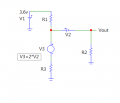
Here is a network where we have to calculate the value of the three resistors, R1, R2, and R3.
There is one main source and two internal sources. V2 is a regular constant voltage source, but it is to be changed manually. For example, if it started out as 1v then we want to go down to maybe 0.1v and up to maybe 10v.
The key point is, no matter what we change V2 voltage to, the output Vout stays constant. If we chose say resistors 1, 2, and 3 for the respective values and Vout somehow came out to 1v (it wont I dont think this is just an off the wall example) then when we change V2 the output voltage Vout must remain at 1v.
V3 is a dependent source, dependent on V2 and it's polarity. The 'gain' is just 2, so when V2 goes from say 1v to 1.1v then V3 goes from 2v to 2.2v because it is just double.
I don't think this is too hard but it's a little tricky. If you feel like trying it, see what you can come up with. There 'could' be more than one solution too but one single solution is good enough.
Here is a network where we have to calculate the value of the three resistors, R1, R2, and R3.
There is one main source and two internal sources. V2 is a regular constant voltage source, but it is to be changed manually. For example, if it started out as 1v then we want to go down to maybe 0.1v and up to maybe 10v.
The key point is, no matter what we change V2 voltage to, the output Vout stays constant. If we chose say resistors 1, 2, and 3 for the respective values and Vout somehow came out to 1v (it wont I dont think this is just an off the wall example) then when we change V2 the output voltage Vout must remain at 1v.
V3 is a dependent source, dependent on V2 and it's polarity. The 'gain' is just 2, so when V2 goes from say 1v to 1.1v then V3 goes from 2v to 2.2v because it is just double.
I don't think this is too hard but it's a little tricky. If you feel like trying it, see what you can come up with. There 'could' be more than one solution too but one single solution is good enough.
Attachments
-
 4.6 KB Views: 37