Inverting Op-Amp

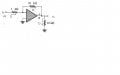
For an ideal op-amp, the voltage at the V+ and V- terminals are equal and the current into the amplifier at terminals V+ and V- is zero.

Knowing the voltage at V+ gives you the voltage at V-. Now you can find the current I1. And so on...
 

Thread Starter

need_help

Joined Sep 7, 2009
23
So Vout= 10K * 1mA = 10V ???

I0 is the current coming out of the op-amp. does it equal to 0V ???

If Vout is 10V, then I3= (10V-0) / 10K = 1 mA ???
 
Getting closer...

Be careful with the direction of the current and the voltage that are derived from it.

HINT: don't forget this is an inverting amplifier...

What is Vo?

Be careful with the sign on the current for I3 as well.
 
Following the convention in the diagram, I1 = I2 and I3 = I2 + I0.

Now, the sign on the calculated currents must be maintained to the same convention for the answer to be correct.
 
Vout does equal -10V.

I1 = (Vin - 0) / 1k = 1mA

I2 = I1 -- since current into a node must equal current out of the node and the opamp draws no current at V- terminal.

V(R2) = 10k * 1mA = 10V

Vout = -10V -- based on defined current from positive to negative voltage, and left side of resistor is at 0V.

Now I3 and I0 are the only things left. Be careful of which way the current is defined in the diagram.
 
Since Vout = -10V

I3 = ((-10V) - 0)/10K = -1 mA -- based on the direction of the current arrow designated in the problem.

I3 = I2 + I0
which is equivalent to :
I0 = I3 - I2

I0 = - 1mA - 1mA = -2 mA

The minus sign on the current indicates that it is in the opposite direction of the arrow, or in this case, being drawn into the amplifier. The amplifier is sinking the current and not sourcing it.
 
Once you draw a current arrow from let's say A pointing to B, make sure you do the current calculation the same way.

I = (V(a) - V(b)) / R

A - sign means the current is in the opposite direction. As long as you keep the same convention throughout the problem, the + and - signs will work themselves out and you don't have to remember which way the current is defined for each part of the problem.

 
Top