hi hoy,
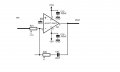
It appears to part of a ramp oscillator loop, whose amplitude is controlled by the feedback loop formed by that lower left INA OPA configuration N4, R32 which controls the current flowing into the PT100 sensor. So keeping the PT100 ramp drive current at the set level by N5.
Ignore resistor R26 for the moment.
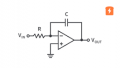
This is a lowpass filter or op amp integrator circuit.
The problem with this ideal integral function is that any DC input will be integrated to infinity. In other words, the op amp output will saturate to the supply rails. You need a resistor in parallel with the capacitor in order to create a “leaky” integrator.
It is an integrator. R26 adds a break frequency at the R26, C63 frequency. The voltage gain decreases as an integrator at a single-pole slope until this frequency is reached, then much above it, C63 is about a short and the gain flattens out to -R26/R21.
The problem with this ideal integral function is that any DC input will be integrated to infinity. In other words, the op amp output will saturate to the supply rails. You need a resistor in parallel with the capacitor in order to create a “leaky” integrator.
When the opamp stage - with either a C or a series R_C in the feedback path - is used as a controller (as mentioned by the TO in his post#3) it is NOT necessary to have an additional resistor in parallel to the feedback capacitor.
No DC problem because of the closed DC loop with negative feedback.
I wrote " When the opamp stage... is used as a controller...."
In this case, C63 will not be fully charged because the whole stage is part of a negative DC-stabilizing feedback loop.
The same applies - for example - when an opamp-based integrator stage is used as one unit within a state-variable filter circuit with overall feedback (KHN or Tow-Thomas)
..... Without the feedback resistor, at 0 Hz (DC) the gain is the open-loop gain of the op-amp and that will cause the output to be unstable - not oscillatory, but amplifying anything at the input that departs from exactly 0 V, including the offset voltage of the op-amp.

 Facebook
 Google
 GitHub
 Linkedin