Intercom challenge

Thread Starter

Torbek

Joined Apr 19, 2019
83
Hi folks, so I revently purchased an old Tandy intercom for a little home project.. I think it's quite a clever design, but I have not fully gotten my head around how it works yet....

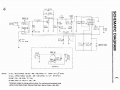
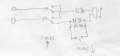
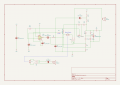
I have reverse-engineered the circuit, so to speak...

What I would like to do, is add a way of muting the remote end... I have thought about various schemes, trouble is they all disable the "call" feature, provided by the little single transistor oscillator, and because the speaker is used as both mic and output, this complicates matters...

Can anyone else work out how I can add a mute button to the remote end without adding a battery?

(tried adding a piezo sounder instead of speaker that could be switched out when muted, and it works, but is too quiet sadly and there is still a level of microphoney in the circuit....
1733059490264.png
 

BobTPH

Joined Jun 5, 2013
11,463
It is not clear to me what you mean. Do you mean the remote speaker should act only as a speaker, or only as a microphone? Or something else?
 

Thread Starter

Torbek

Joined Apr 19, 2019
83
So basically when the unit is powered up, the remote unit is active and effectively always tranmitting voice to the base... I would like the remote unit to be push to talk, but with the ability for the base station to call it.

For clarity, the remote speaker is used as both microphone AND speaker for half-duplex communication
 

sghioto

Joined Dec 31, 2017
8,633
I have reverse-engineered the circuit, so to speak...
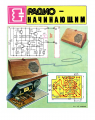
That's looks like a model 43-222A RS intercom.
The master to remote or remote to master call tone is designed to work only when the master station is OFF
Normally the master station is left OFF for that to work and save battery power.
I don't see the need to change the design.
1733069354666.png
 
Last edited:

Thread Starter

Torbek

Joined Apr 19, 2019
83
Becuase it does not offer guarrenteed privacy on the other end. I want the other end to have some control as to whether they are tranmitting their voice or not...

It looks like the simplist way is to build a two way comm unit with independant power supplies
 

sghioto

Joined Dec 31, 2017
8,633
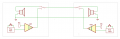
Here's a design I used years ago shown in block diagram with a tone alert added.
Each unit can be battery powered with individual ON/OFF switch.
Using a 3 or 4 wire cable the units can be powered using a single battery or power supply.
Works like a walkie-talkie.
I can draw up a detailed schematic if interested using those same intercom enclosures and components.
1733077675638.png
 
Last edited:

dendad

Joined Feb 20, 2016
4,635
How about trying some series diodes as the voltage of the speaker out as a mic is pretty low but the call tone will be high enough to turn the diodes on.
1733180771574.png
It could be worth a try.
 

sghioto

Joined Dec 31, 2017
8,633
How about trying some series diodes as the voltage of the speaker out as a mic is pretty low but the call tone will be high enough to turn the diodes on.
View attachment 337220
It could be worth a try.
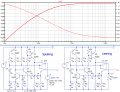
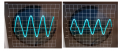
I tried it with schottky and silicon diodes. Works but has crossover distortion and a 35% loss of signal across a 15 ohm resistor
Looking at the output of a LM386 amp
1733187766314.png
 

MisterBill2

Joined Jan 23, 2018
27,178
I was going to suggest the same thing, except just two small signal diodes like the 1N4148, exactly the same arrangement as shown. The reasoning is quite sound, as at low sound levels the diodes will not conduct much, and so it will be close to an open circuit.
But Dendad came up with the same working idea.
Functionally it is a diode switch that is always OFF, except with a call signal. Then the talk switch enables it.
The really cool implementation would be a three position switch, with a spring return from the talk position to the listen position.
 

MisterBill2

Joined Jan 23, 2018
27,178
As Dendad stated in post #12, the diodes are only to provide privacy and MUST BE BYPASSED for both talk and listen. The intercom system is not full duplex, IT DOES require switching between Listen and Talk.
That much is given. AND, that is the intent of the request.
AND, based on the original circuit shown in post #1, with the Talk/Listen switch only allowing DC continuity, It certainly MUST cause a change-over between Listen and Talk, by changing the bias on diode D1 in the base unit. I have not worked out the details, but it is obvious that a non-switching scheme will be more complex.
 
Last edited:

sghioto

Joined Dec 31, 2017
8,633
I don't trust that "reversed engineered" circuit in post #1. The correct circuit is shown in post #5.
D1 has nothing to do with the changeover it's there for the Call function only.
The changeover is controlled by Sw2a and Sw2b at the Master by simply reversing the speaker/microphones from input to output.
The remote has no control over this changeover and hence no privacy is why the request to mute the remote.
With the diodes in place the Master cannot hear the remote but can still send a call signal. The Remote communicates with the base by flipping the Mute switch and from there on is hands free. At the end of the conversation the Mute switch is flipped back on for privacy.
I don't see where a 3 position switch could be added that would make any improvement.
Dendads idea to use the diodes to provide privacy is the only way without a major modification of the remote.
 

MisterBill2

Joined Jan 23, 2018
27,178
OK, The few intercom systems I have worked with had "talk" switches at both ends, or else they were the quite cheap kind. And there was even one full duplex system, several tubes inside, where when either end talked it reduced the gain for the other end. I don't recall all of the details, that was back in 1963.
 
Top