instrumentation amplifier with another layer of buffer amplifier in front comfusion

Thread Starter

nathanbai

Joined Jul 26, 2016
5
Hi,

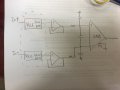
I am trying to design a circuit to acquire analog signal, which is shown as the attached pic. I found one problem that the circuit worked fine with the front-end passive low-pass filter. However, once I remove the low-pass filter part. the system could not read the pulse from function generator. I am suspecting two things that could cause the problem: 1). the unbalanced frond-end low pass filter, and 2) the lacking of return path for the buffer amplifier. However, after the testing, either of them made any differences.

I really need suggestions for trouble shooting and debugging. Any suggestions would be appreciated.

Thanks
 

Attachments

RichardO

Joined May 4, 2013
2,270
I suspect that when you removed the low pass filters you also removed the resistors that were biasing the inputs. Add back some resistors from each input to ground.
 

AnalogKid

Joined Aug 1, 2013
12,173
Agree with Richard. Both voltage followers need some kind of DC path at the input. Depending on the opamp used, this could be a simple as a 1 M resistor to GND.

What is the signal source; specifically, its output impedance?

What is the part number of the INA? There is a good chance its input impedance is so high that you do not need the two voltage followers to drive it.

ak
 

Thread Starter

nathanbai

Joined Jul 26, 2016
5
I suspect that when you removed the low pass filters you also removed the resistors that were biasing the inputs. Add back some resistors from each input to ground.
Hi Richard,

Thank you so much for the reply. I really appreciate that. I have tried to replace the RLC filter directly with a 50M Ohm resistor from the input of op-amp to ground. However, I could not get the signal either. Any insight?

Thanks, Nathan
 

Thread Starter

nathanbai

Joined Jul 26, 2016
5
Agree with Richard. Both voltage followers need some kind of DC path at the input. Depending on the opamp used, this could be a simple as a 1 M resistor to GND.

What is the signal source; specifically, its output impedance?

What is the part number of the INA? There is a good chance its input impedance is so high that you do not need the two voltage followers to drive it.

ak

Hi AnalogKid,

I am testing it with a signal generator. The output impedance is about 200Ohm. The INA part number is AD8429.

Thanks, Nathan
 

Thread Starter

nathanbai

Joined Jul 26, 2016
5
Updates. I added two 20MOhm resistors at the input terminals of INA. In this case, I got the signal for both with and without the RLC filter. However, I got very noisy signal without the filter. And the noise was not thermal noise. It mostly seemed like oscillating noise. Then I remove the capacitors from the RFI filter in front of INA. The oscillating noise disappeared. the two capacitors connecting to the ground is 2.2nF and the one in the middle is 22nF. The serial resistor between the op-amp and INA is 910Ohm.

My question is why the added 20MOhm resistor could cause this oscillating problem.
 

AnalogKid

Joined Aug 1, 2013
12,173
Interesting part. Close to a standard 3-opamp IA, but with a strange input stage. And the internal impedances are surprisingly low, probably necessary to make the noise spec. Why are you external resistors so high in value? 20 M is greater than the surface resistance of pc board fiberglass. Try something like 10 K to 100 K instead. The datasheet states that there must be a DC path to GND for both inputs, and figure 50 shows some common arrangements.

ak
 

Thread Starter

nathanbai

Joined Jul 26, 2016
5
Interesting part. Close to a standard 3-opamp IA, but with a strange input stage. And the internal impedances are surprisingly low, probably necessary to make the noise spec. Why are you external resistors so high in value? 20 M is greater than the surface resistance of pc board fiberglass. Try something like 10 K to 100 K instead. The datasheet states that there must be a DC path to GND for both inputs, and figure 50 shows some common arrangements.

ak
Do I still need the DC bias resistor for the INA even it is driven by the op-amp? I did test with the dc bias current resistor in front of the buffer op-amp. With the resistor connected to the ground, I can detect the signal with and without the filter. However, I am wondering do i really need the buffer amplifier for this?
 

sghioto

Joined Dec 31, 2017
8,634
"However, I am wondering do i really need the buffer amplifier for this?"

The buffer amp is required if you need the low pass filter. Filters work best when the input impedance of the following stage is high. The circuit shows a low pass filter followed by a buffer amp then another low pass filter composed of a resistor and capacitor at the inputs of the INA. The high input impedance of the INA is buffering the second low pass filter. You would not need bias resistors for the INA if driven directly by another op-amp.
Steve G
 
Top