input resistance

MrAl

Joined Jun 17, 2014
13,704
What is gm? It is the small-signal transconductance of the device.

What is the small-signal transconductance of the device? It is the rate of change of the current at one port due to a change in voltage at another port. In other words, di/dv where the i and v are at different ports (otherwise it's not a 'trans' conductance, but merely a conductance.

For a BJT, we focus on

di_E/dv_BE

and we define this to be g_m.

The very notion of the small-signal transconductance stems from a desire to be able to linearize the device's behavior so that we can utilize all of the very powerful analysis and design techniques that we have developed for linear systems. So we choose to operate the device with a (normally constant) large-signal bias and apply a time-varying information signal on top of it that is small enough so that the actual response of the device can be adequately approximated by a straight line passing through the large-signal operating point and having a linear response that matches the slope of the device's actual response at that point.

Therefore, the concept of g_m is completely independent of any particular device -- it is mathematical construct that is defined so as to be useful when applying a particular analysis and design technique.

Now, the actual value of g_m for a given device is very much determined by the constitutive relations for that device, which are in turn dictated by the physics that establish those relations.

But we don't have to know or understand anything about the underlying physics, all we need is a mathematical model for them. That model could (and in some cases has and in others still does) come purely from curve-fitting to empirical data. In the case of the BJT transistor, the work in the 1950s was based on understanding the device physics and, my understanding is that, the exponential Ebers-Moll model arose from that. But today, the device physics of integrated transistors is so complex, and the level of fidelity that we need in our models so great, that we don't even attempt to develop models based on device physics; instead, we simply characterize the bejesus out of them and do tons of high-order and piecewise continuous polynomial curve fitting. Our simulators, however, still simply apply this same notion of the mathematical concept of the small-signal transconductance when it comes time to do any simulation that relies on it (such as transfer function sweeps across a frequency range).
Hello again,

I am not sure what you are saying here. What you have been talking about is a behavioral model, which is modeled after the behavior of the device. A physical model contains information about the physical size of the device inside the package and is considered a closer match to a real device.
Now if you do a physical model we will always have dimensions inside there. I dont see how you can get around that but you can explain if you want to.
As you must know, for a mosfet there is W/L i believe that defines gm. So if you define gm that way you can get around the dimensions but you wont be able to define another gm without knowing W and L for the new device.
 

LvW

Joined Jun 13, 2013
2,027
Yes i know you dont understand the output impedance problem here.
Mmmmh.....wait for my comments below - perhaps you will change your mind.
The problem is, and i think i said this already, is that the transistor circuit has output impedance that is non zero, while your block diagram has output impedance (Vout) of exactly and perfectly zero.
No that is not a problem. As I have explained to you - you must not confuse circuit diagrams with block diagrams which have a complete different function. I have got the impression that you are not familiar with closed-loop control systems and the methods to use functional blocks for deriving input-output relations (including loop gain definition). This is the ONLY task of the block-diagram-based methods.
(See for example how I have derived - based on the shown block diagram - the correct closed-loop gain expression for a common-emitter stage with Re-feedback).
As I have explained to you - it is not the task of block diagrams to give any information on input and output resistances! This can be done on the basis of circuit diagrams only.
So to understand this better, connect an output resistance in series with the last block on the right (Vout) and then add a load to that.
Is this really your recommendation? I cannot believe. So you propose a mixture between block diagram and circuit diagram?
Have you ever seen such a mixture in any book or article?
NOW when we have some decent feedback amount, we will see the output impedance get lower because now the feedback can compensate for the output voltage even with load.
Sorry to say, but this is simply wrong. As I have stated in my earlier post, the output resistance gets larger! It is really not a problem to mentally reproduce this property.*** More than that - as I also have stated earlier - when the feedback signal is derived from an output current (in contrast to the opamp case) the output resistance goes always up (according to system theory).
Keep in mind this is going by your block diagram as is, you may be able to draw a different block diagram that makes your point more clear you can look into that. I'd be interested to see that.
I should make my "point more clear"? Which "point"? My only point was to state that Re provides "true" negative feedback - a fact that can be found in all relevant textbooks (and is confirmed by a set of formulas which show that all relevant circuit properties are modified with a factor (1-loop gain)=(1+gmRe). I cannot understand why you deny this fact (you speak of "pseudo negative feedback ", without any further explaantion).

In a nutshell:
* An emitter resistor provides true current-controlled voltage feedback. A corresponding block diagram shows the closed loop. The correct gain expression can be derived from this block diagram. This expression is identical to the gain formula derived from the circuit diagram.
This prooves the correctness of the block diagram.
* Output and input impedances cannot, of course, derived from a block diagram because its principle is to use functional blocks only without any interference between the blocks. Any internal loading effects, therefore, must be included in the functional description of the individual blocks.
* It is NOT possible (and makes no sense) to add real electronic parts to the block diagram because all quantities within the block diagram (currents, voltages, temperatures, ...) are only state variables and do not follow the rules used for circuit diagrams (Ohms and Kirchhoff's rules).
___________________________________
*** Short explanation: r_out=Rc||r_coll .
A test voltage connected to the collector increases the collector current (and the emitter current). As a consequence, the voltage across Re goes high and Vbe is reduced - causing a certain decrease in current. Thats negative feedback with an increase in r_coll.
 
Last edited:

WBahn

Joined Mar 31, 2012
32,836
I am not sure what you are saying here. What you have been talking about is a behavioral model, which is modeled after the behavior of the device. A physical model contains information about the physical size of the device inside the package and is considered a closer match to a real device.
Then why are current SPICE device models behavioral (everything after BSIM4 are Verilog behavioral models)?

For two reasons: (1) Physical models are not adequate for capturing a plethora of real device effects, and (2) even if such models were available, they would be far too slow to provide acceptable simulation speeds.

Modern simulation models are based on parameter extraction from measured data to which curves are fit. An advantage of using these curves is that the device models are continuous and continuously differentiable, which makes getting the small signal parameters much simpler.

Now if you do a physical model we will always have dimensions inside there. I dont see how you can get around that but you can explain if you want to.
Why do you believe that you have to use a physical model in order to incorporate dimensions. Physical device dimensions (or, rather, layout dimensions, which are not the same thing) are simply parameters in the fitted equations.

As you must know, for a mosfet there is W/L i believe that defines gm. So if you define gm that way you can get around the dimensions but you wont be able to define another gm without knowing W and L for the new device.
Uh... gm is NOT defined as W/L i. Transconductance, gm, is DEFINED as the ratio of the change in output current to the change in input voltage. Look it up.

Besides, we KNOW that W/L i can't be the transconductance because that expression has units of electrical current and transconductance must have units of, well, conductance (e.g. amperes/volt).

The equation you give (even if you gave the correct one) would merely be an approximation of gm for a MOSFET based on a particular mathematical model for the device. It is a model that would be adequate for initial paper designs and possibly good enough for discrete transistors, but would seldom be adequate for most IC circuit design on modern processes, which rely heavily on the behavioral device simulation models. If gm were defined, as you claim, to be W/L i (and, again, even if that were correct), then that would have to be the transconductance value used regardless of how well it actually reflected the ratio of changes in output current to input voltage because it would be the definition. You only get to define something once; all else must flow from that definition.
 

MrAl

Joined Jun 17, 2014
13,704
Then why are current SPICE device models behavioral (everything after BSIM4 are Verilog behavioral models)?

For two reasons: (1) Physical models are not adequate for capturing a plethora of real device effects, and (2) even if such models were available, they would be far too slow to provide acceptable simulation speeds.

Modern simulation models are based on parameter extraction from measured data to which curves are fit. An advantage of using these curves is that the device models are continuous and continuously differentiable, which makes getting the small signal parameters much simpler.


Why do you believe that you have to use a physical model in order to incorporate dimensions. Physical device dimensions (or, rather, layout dimensions, which are not the same thing) are simply parameters in the fitted equations.


Uh... gm is NOT defined as W/L i. Transconductance, gm, is DEFINED as the ratio of the change in output current to the change in input voltage. Look it up.

Besides, we KNOW that W/L i can't be the transconductance because that expression has units of electrical current and transconductance must have units of, well, conductance (e.g. amperes/volt).

The equation you give (even if you gave the correct one) would merely be an approximation of gm for a MOSFET based on a particular mathematical model for the device. It is a model that would be adequate for initial paper designs and possibly good enough for discrete transistors, but would seldom be adequate for most IC circuit design on modern processes, which rely heavily on the behavioral device simulation models. If gm were defined, as you claim, to be W/L i (and, again, even if that were correct), then that would have to be the transconductance value used regardless of how well it actually reflected the ratio of changes in output current to input voltage because it would be the definition. You only get to define something once; all else must flow from that definition.
No W/L helps define gm though.

But see these arguments always amused me. It sounds like an argument of what is better to use, either 'gm' or '1/gm'. Is there really any difference (besides numerical value of course)?
So i ask you what you use for 'gm' then in a transistor circuit. Maybe it's just as nutty as Beta, but you can give an example if that would help.
gm in units of A/V yes, but 1/gm in units of A/V. Who cares which one we use, is there a good reason for choosing one over the other?
 

MrAl

Joined Jun 17, 2014
13,704
Mmmmh.....wait for my comments below - perhaps you will change your mind.

No that is not a problem. As I have explained to you - you must not confuse circuit diagrams with block diagrams which have a complete different function. I have got the impression that you are not familiar with closed-loop control systems and the methods to use functional blocks for deriving input-output relations (including loop gain definition). This is the ONLY task of the block-diagram-based methods.
(See for example how I have derived - based on the shown block diagram - the correct closed-loop gain expression for a common-emitter stage with Re-feedback).
As I have explained to you - it is not the task of block diagrams to give any information on input and output resistances! This can be done on the basis of circuit diagrams only.

Is this really your recommendation? I cannot believe. So you propose a mixture between block diagram and circuit diagram?
Have you ever seen such a mixture in any book or article?

Sorry to say, but this is simply wrong. As I have stated in my earlier post, the output resistance gets larger! It is really not a problem to mentally reproduce this property.*** More than that - as I also have stated earlier - when the feedback signal is derived from an output current (in contrast to the opamp case) the output resistance goes always up (according to system theory).

I should make my "point more clear"? Which "point"? My only point was to state that Re provides "true" negative feedback - a fact that can be found in all relevant textbooks (and is confirmed by a set of formulas which show that all relevant circuit properties are modified with a factor (1-loop gain)=(1+gmRe). I cannot understand why you deny this fact (you speak of "pseudo negative feedback ", without any further explaantion).

In a nutshell:
* An emitter resistor provides true current-controlled voltage feedback. A corresponding block diagram shows the closed loop. The correct gain expression can be derived from this block diagram. This expression is identical to the gain formula derived from the circuit diagram.
This prooves the correctness of the block diagram.
* Output and input impedances cannot, of course, derived from a block diagram because its principle is to use functional blocks only without any interference between the blocks. Any internal loading effects, therefore, must be included in the functional description of the individual blocks.
* It is NOT possible (and makes no sense) to add real electronic parts to the block diagram because all quantities within the block diagram (currents, voltages, temperatures, ...) are only state variables and do not follow the rules used for circuit diagrams (Ohms and Kirchhoff's rules).
___________________________________
*** Short explanation: r_out=Rc||r_coll .
A test voltage connected to the collector increases the collector current (and the emitter current). As a consequence, the voltage across Re goes high and Vbe is reduced - causing a certain decrease in current. Thats negative feedback with an increase in r_coll.
Well you seem to be very convinced that what you believe to be true is true, and i wont say you are wrong just yet i will give you a chance to prove what you say is correct.

Show me how you can get zero output impedance from an NPN common emitter circuit by changing the external RE, and show me with your 'block' diagram. If your block diagram is correct then you can show me how to reduce the output impedance with your negative feedback. Keeping in mind that as you increase RE the negative feedback increases.

Apparently you do not know how to mix real components with block diagrams. That's not my problem sorry. But since you dont like that, then simply dont do that, but you still have to show how you can keep the output voltage constant with an increase of load by using your negative feedback in a common emitter NPN transistor circuit.

You might also explain (and this should be simple and again i wont say you cant just yet maybe you can) how your output block Vout can have a varied output voltage with load since that is surely what happens with a real transistor circuit.

LATER
I took another look at your block diagram and i dont even see a load resistance so how can we evaluate the effect of load resistance? In order to ascertain the effect of feedback on the output voltage with load we at the very least have to have a way to change that load resistance. If there is no load resistance how the heck can we do that. This makes me conclude that the block diagram is incomplete for the purpose of evaluating the effect of such a resistance and how it relates to the feedback of the system.
What this diagram reminds me of is a stage in an amplifier that is before the last stage, like an independent pre amplifier that has no awareness of the output voltage, it's a feed forward system.
 
Last edited:

WBahn

Joined Mar 31, 2012
32,836
No W/L helps define gm though.

But see these arguments always amused me. It sounds like an argument of what is better to use, either 'gm' or '1/gm'. Is there really any difference (besides numerical value of course)?
So i ask you what you use for 'gm' then in a transistor circuit. Maybe it's just as nutty as Beta, but you can give an example if that would help.
gm in units of A/V yes, but 1/gm in units of A/V. Who cares which one we use, is there a good reason for choosing one over the other?
Use gm or 1/gm as appropriate. But your "definition" of gm has units that are neither. Your definition has units of A, period. That's like saying that area is defined as W+L -- you know that this is wrong because area has units of length-squared and this "definition" has units of length. No need to go any further since it can't be right. Since "W/L i" can't have the correct dimensions, you know it can't be correct. This is valuable information since your "definition" claims that the transconductance scales linearly with the DC bias current (assuming that's what your 'i' refers to) while it actually scales with the square-root of the bias current. By noting that your units can't work out, it encourages (or should encourage) you to dig a bit deeper.

As for what I use for gm in a transistor circuit, I use the small-signal transconductance, which is the voltage-rate change of current of the output current. For a MOSFET, the formal definition of the transconductance is

\(
g_m \; = \; \left. \frac{\partial i_D}{\partial v_{GS}} \right\rvert_{v_{GS}=V_{GS}}
\)

where, by nearly universal convention, a lower-case variable with an upper-case subscript represents the total signal, an upper-case variable with upper-case subscript represents the large-signal component, and a lower-case variable with lower-case subscript represents the small signal component.

As for the relationship between gm and a given MOSFET, that depends on the transistor model used. There are a few available, depending on what effects are incorporated into the model. If I'm doing quick hand calculations for an IC design, I will generally use a model that ignores lamba and body effects but incorporates the W/L ratio, since that is a parameter I have control over to get the transconductance I want (or at least something close that can be fine-tuned via simulation).

Now answer me this: Since you keep insisting that the transconductance is defined by W/L, what do YOU use as the W/L ratio when you are using an off-the-shelf discrete transistor? I don't recall ever seeing this information in a data sheet, but it's been a very long time since I've looked at such datasheets since I generally use BJTs when I need a discrete transistor for an amplifier.
 

LvW

Joined Jun 13, 2013
2,027
Show me how you can get zero output impedance from an NPN common emitter circuit by changing the external RE, and show me with your 'block' diagram. If your block diagram is correct then you can show me how to reduce the output impedance with your negative feedback. Keeping in mind that as you increase RE the negative feedback increases.
I don`t know if it makes sense to repeat for a third time that it is not allowed (and makes no sense) to mix block diagrams and circuit diagrams. Why do you continuously ignore this fact? Don`t you understand?

Apparently you do not know how to mix real components with block diagrams. That's not my problem sorry.
Oh yes - it is your problem. Bcause you are wrong.
I am very sorry to repeat: It seems that you are not familiar with the principle of block diagrams.
Of course, that is not a problem - but in this case you shouldn't ignore my arguments and keep repeating the opposite.
Again: The laws of Ohm and Kirchhoff are not valid in block diagrams - and, therefore, we must not add any electronic part (R, L or C) in a block diagram (this would be really crazy).

I took another look at your block diagram and i dont even see a load resistance so how can we evaluate the effect of load resistance?
Must I really repeat for the fourth time that it is not the task of a block diagram to "evaluate the effect of load resistance"?
____________________________________________________________
I propose to end this superfluous and fruitless discussion.
 

MrAl

Joined Jun 17, 2014
13,704
Sorry to say - but I disagree with the above. Let me explain:
A resistor Re provides "Current-controlled negative Voltage feedback" - and the observed behaviour of the circuit fulfills ALL properties of "true" negative feedback:
* Input resistance goes up (feedback signal is voltage)
* Output resistor goes up (control signal is current)
* Linearity improves
* Signal gain reduces
* Bandwidth increases
* Sensitivity of the closed-loop to active parameter tolerances is drastically reduced (reason for including Re).

Comment to the opamp example: System theory requires that the output resistance increases for curent-controlled feedback (present case) whereas it decreases for voltage-controlled feedback (opamp).

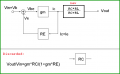
Here is a block diagram which can illustrate the feedback provided by Re. For simplification I have set Ie=Ic (to show the gain reduction caused by the loop gain LG=-gmRe). This closed-loop gain expression is in full accordance with classical feedback theory.


View attachment 278031
Use gm or 1/gm as appropriate. But your "definition" of gm has units that are neither. Your definition has units of A, period. That's like saying that area is defined as W+L -- you know that this is wrong because area has units of length-squared and this "definition" has units of length. No need to go any further since it can't be right. Since "W/L i" can't have the correct dimensions, you know it can't be correct. This is valuable information since your "definition" claims that the transconductance scales linearly with the DC bias current (assuming that's what your 'i' refers to) while it actually scales with the square-root of the bias current. By noting that your units can't work out, it encourages (or should encourage) you to dig a bit deeper.

As for what I use for gm in a transistor circuit, I use the small-signal transconductance, which is the voltage-rate change of current of the output current. For a MOSFET, the formal definition of the transconductance is

\(
g_m \; = \; \left. \frac{\partial i_D}{\partial v_{GS}} \right\rvert_{v_{GS}=V_{GS}}
\)

where, by nearly universal convention, a lower-case variable with an upper-case subscript represents the total signal, an upper-case variable with upper-case subscript represents the large-signal component, and a lower-case variable with lower-case subscript represents the small signal component.

As for the relationship between gm and a given MOSFET, that depends on the transistor model used. There are a few available, depending on what effects are incorporated into the model. If I'm doing quick hand calculations for an IC design, I will generally use a model that ignores lamba and body effects but incorporates the W/L ratio, since that is a parameter I have control over to get the transconductance I want (or at least something close that can be fine-tuned via simulation).

Now answer me this: Since you keep insisting that the transconductance is defined by W/L, what do YOU use as the W/L ratio when you are using an off-the-shelf discrete transistor? I don't recall ever seeing this information in a data sheet, but it's been a very long time since I've looked at such datasheets since I generally use BJTs when I need a discrete transistor for an amplifier.
gm is proportional to W/L. As i said before, W/L 'helps' to calculate gm.

The answer is that a data sheet does not show how solid state physics works. What you seem to be suggesting is that we can publish an article in Scientific America tomorrow notifying the general scientific community that we can now completely ignore solid state physics.
 

MrAl

Joined Jun 17, 2014
13,704
I don`t know if it makes sense to repeat for a third time that it is not allowed (and makes no sense) to mix block diagrams and circuit diagrams. Why do you continuously ignore this fact? Don`t you understand?


Oh yes - it is your problem. Bcause you are wrong.
I am very sorry to repeat: It seems that you are not familiar with the principle of block diagrams.
Of course, that is not a problem - but in this case you shouldn't ignore my arguments and keep repeating the opposite.
Again: The laws of Ohm and Kirchhoff are not valid in block diagrams - and, therefore, we must not add any electronic part (R, L or C) in a block diagram (this would be really crazy).


Must I really repeat for the fourth time that it is not the task of a block diagram to "evaluate the effect of load resistance"?
____________________________________________________________
I propose to end this superfluous and fruitless discussion.
It is not the task of a block diagram to evaluate the effect of load resistance, but since when did this discussion start to be about how to draw block diagrams about what we want to show?
This discussion was about negative feedback, remember?

Since you cant figure out how to combine a block diagram with actual components, then i submit the following diagram to you which is your loved block diagram with added load resistance.

If you cant see how the load resistance plays into negative feedback i cant help you.

YOU MUST SHOW how load resistance affects the circuit if you want to understand how negative feedback works, and in this case either total negative feedback or partial negative feedback which is only what you have shown so far.
You are suggesting that negative feedback that does not measure the output voltage can somehow correct the output voltage when it becomes not what we intended it to be.

If you read some of the threads in this forum you will see that when partial feedback is suggested in an audio amplifier the replies always suggest that is not the right way to do it because partial negative feedback can not correct for all of the errors including non linearity. The replies always show at least one added resistor connected to the output and going back to the input so that the VERY output is measured, not some sub stage voltage. A sub stage voltage measurement can never correct for the last stage errors.

You say you understand control theory but i cant see how you can say that when you dont really understand how true negative feedback works, it's just not possible. Im not saying you are dumb or anything like that, just this one thing you dont seem to have much experience with.

And with that, i give you the corrected block diagram since you dont like mixing parts. See attachment maybe this will clear things up.

BTW, anytime you have drawn an op amp in a circuit you have mixed a block diagram with an actual component like a resistor. If you draw a simple inverting op amp amplifier with two resistors and one load resistance, you've used a block that represents maybe 50 transistors that make up that op amp. If you prefer to draw ALL of the internal transistors because you dont want to mix, be my guest :)

Ok here's the new block diagram and feel free to correct it if you feel the need to i'd be happy to review your changes. In this new block diagram we can get a feel for how the load resistance affects the output and why partial negative feedback can not correct for all the errors.
I can easily add a complete negative feedback block to correct for ALL errors regardless where they come from if you like and that will CLEARLY show the difference, especially with a simple numerical example.

BJT_emitter_feedback-2.png
 

LvW

Joined Jun 13, 2013
2,027
It is not the task of a block diagram to evaluate the effect of load resistance, ....
Even your first sentence is wrong. The subject of discussion was not the "load resistor" (which can simply considered in parallel to Rc in my block diagram) but the output resistance of a circuit with feedback.

This discussion was about negative feedback, remember?
Yes I do. But do YOU remember ? (Because you speak about load and not about feedback).

Since you cant figure out how to combine a block diagram with actual components, then i submit the following diagram to you which is your loved block diagram with added load resistance.
If you cant see how the load resistance plays into negative feedback i cant help you.
Again, a simple load resistor is not the subject of discussion. You totally missed the point.

YOU MUST SHOW how load resistance affects the circuit if you want to understand how negative feedback works, ...
Again the load resistor......No - the question how "negative feedback works" has nothing to do with the question if a resistor is big or small. This can effect the loop gain but not the basic principle of feedback.
Again: The subject of discussion is the increase in the output resistance caused by feedback. Suddenly, you have introduced a load resistor in parallel which the collector resistor - so what? This decreases the resistance which develops the output voltage. Thats all!

You say you understand control theory but i cant see how you can say that when you dont really understand how true negative feedback works, it's just not possible. Im not saying you are dumb or anything like that, just this one thing you dont seem to have much experience with.
No comment. I try to be polite.

And with that, i give you the corrected block diagram since you dont like mixing parts. See attachment maybe this will clear things up.
OK - so I have one simple question to you - and I kindly ask you to answer only this question (without any further foolish discussion):
Are you able to derive the output resistance of the circuit under discussion on the basis of the block diagram ("corrected" by you") ?
Remember: It was your argument that my block diagram would be wrong because it shows not the correct output resistance)

BTW, anytime you have drawn an op amp in a circuit you have mixed a block diagram with an actual component like a resistor.
I can easily add a complete negative feedback block to correct for ALL errors regardless where they come from if you like and that will CLEARLY show the difference, especially with a simple numerical example.
I really try to remain polite - but do you really think that the opamp symbol which is usually used within a circuit diagram (with at least 5 input/output terminals) can be regarded/treated as such a single block (always one input and one output only) which is a part of a block diagram? Ask my students - they can explain to you the differences.
_________________________________________
I really propose to stop this discussion - after you have answered the question above (in bold).
 

MrAl

Joined Jun 17, 2014
13,704
I only have to quote one sentence:

"Even your first sentence is wrong. The subject of discussion was not the "load resistor" (which can simply considered in parallel to Rc in my block diagram) but the output resistance of a circuit with feedback."

That must be the craziest thing i have ever read since first joining this forum.
How on earth can you talk about negative feedback in a common emitter circuit without considering the output voltage vs load resistance. That's got to be the most important point of negative feedback in any amplifier system: to make SURE the output is what we want it to be. That's like cutting off part of the right side of a block diagram if you want to use a block diagram that is. Do you want to see a real block diagram of a transistor circuit straight out of a control systems book? Yes it has a load resistor, why the heck would it not.

Oh i forgot to mention one more little quote:
" I really try to remain polite - but do you really think that the opamp symbol which is usually used within a circuit diagram (with at least 5 input/output terminals) can be regarded/treated as such a single block (always one input and one output only) which is a part of a block diagram? Ask my students - they can explain to you the differences. "
I seriously doubt it :)
An op amp can be drawn in a block diagram very simply, but more to the point we often have some load resistance and that connects to the output of the 'triangle' that we usually use to draw an op amp.
Staying polite amidst opposition is a sign of professionalism.
Unless you believe in sub stage professionalism (just kidding there) :)

In the end if you want to state that sub stage negative feedback is total negative feedback that's up to you, but you will surely never convince me that is a complete statement about a common emitter amplifier.
 

LvW

Joined Jun 13, 2013
2,027
I only have to quote one sentence:

"Even your first sentence is wrong. The subject of discussion was not the "load resistor" (which can simply considered in parallel to Rc in my block diagram) but the output resistance of a circuit with feedback."

That must be the craziest thing i have ever read since first joining this forum.
How on earth can you talk about negative feedback in a common emitter circuit without considering the output voltage vs load resistance. That's got to be the most important point of negative feedback in any amplifier system: to make SURE the output is what we want it to be.
This discussion is becoming foolish (with unobjective personal remarks). I do not want to participate further.
I have said all I can contribute on the subject of Re-caused "true negative feedback" (neither "partial" nor "pseudo"; what is this?), together with a simple closed-loop block diagram to verify the subject and to proove that it works correctly (gain formula for Re-feedback).
If something was wrong, I ask for correction (but, please, with reason/explanation).

Anyone familiar with the principle and meaning of such block diagrams knows that it is not possible to obtain information about input and output resistances in this way. An extension with real electronic parts would be nonsensical and cannot lead to any reasonable result.

Finally, I am very disappointed that you were not able to answer my question (in bold, post#30) - I am still waiting.
 
Last edited:

MrAl

Joined Jun 17, 2014
13,704
This discussion is becoming foolish (with unobjective personal remarks). I do not want to participate further.
I have said all I can contribute on the subject of Re-caused "true negative feedback" (neither "partial" nor "pseudo"; what is this?), together with a simple closed-loop block diagram to verify the subject and to proove that it works correctly (gain formula for Re-feedback).
If something was wrong, I ask for correction (but, please, with reason/explanation).

Anyone familiar with the principle and meaning of such block diagrams knows that it is not possible to obtain information about input and output resistances in this way. An extension with real electronic parts would be nonsensical and cannot lead to any reasonable result.

Finally, I am very disappointed that you were not able to answer my question (in bold, post#30) - I am still waiting.

Well i am sorry if i offended you or something but you are saying things that dont make sense and you seem to be very limited as to what you 'accept' as useful information. Im not trying to mock you out or anything just trying to show the truth in a matter.

I told you you could correct the flow graph i presented didnt i? If you think you can improve it why not, go right ahead. My intention was not to be perfect but also not to calculate the output impedance, only to show that the load resistance changes the output without the feedback knowing anything about it.

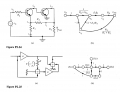
And with that, i'll give you two circuits STRAIGHT out of a book on CONTROL SYSTEMS that was once used at NJIT a prestigious college right here in New Jersey:
https://en.wikipedia.org/wiki/New_Jersey_Institute_of_Technology

Here's some questions to go with the circuits:
Fig P2.24Why the heck does that transistor circuit have a load resistor?
Fig P2.25What the heck are those resistors doing there in that block diagram :)
Amazingly, those two circuits were on the very same page.
Another circuit in same book has a load resistor.
So if you cant accept that then i'll refer you to the author so you can ask him about it.

Also note that P2.24 has your sub stage feedback loop in it but it also has another feedback loop that connects directly after the load resistor which can compensate (or at least partially compensate) for the error in the output voltage. That should at the very least show the point i was making.
Also, the diagram to the right is not really a block diagram it's a signal flow graph which is very similar.

If you cant accept that then i guess we are just not on the same page, so to speak. That happens sometimes.
 

Attachments

LvW

Joined Jun 13, 2013
2,027
I do not want to discuss in this thread new circuits which cannot contribute to the main points of this thread:

Point 1:
Does an emitter resistor Re provides "classical" negative feedback?

* My answer: Yes, of course. Can be prooved by evaluating the loop gain which appears in the well-known formulas for gain, input and output resistances.

* Your answer: "Both RE and re provide a pseudo negative feedback which is a little different than true negative feedback" (post#7)
"...that block diagram does not show the true nature of the circuit"(post#17).
________________________________________________________________________________
My comment: Both of your answers are wrong (in particular as far as "re" is concerned).
Question: Do you know how a block diagram is created? It is nothing else than a visualization of well-known formulas. So - when my block diagram "does not show the true nature of the circuit" these formulas must be wrong and our books have to be rewritten.

Point 2:
Will Re-feedback reduce or increase the output resistance?

* My answer: Yes, of course. Can easily prooved by connecting a test voltage at the collector and evaluate the increased current - and with it the increased emitter voltage across Re. As a consequence, the collector current is reduced (smaller current, larger resistance). This output resistance increase (in fact, not very much due to the small slope of the Ic=f(Vce) function) is in full accordance with system theory.

* Your answer: "For example, negative feedback reduces output impedance" (post#11).

Point 3: Is it allowed to add passive (real) parts to a block diagram?
* My answer: No, of course not. You must not confuse circuit diagrams with block diagrams. This cannot work (and would be crazy) because neither Ohms law nor Kirchhoff`s laws are allowed to be applied.

Your answer: : "So to understand this better, connect an output resistance in series with the last block on the right (Vout) and then add a load to that." (post#20).
_________________________________________________
My comment: Both of your answers (point 2 and 3) are again wrong. A example for your last claim is still missing.

May I add the following:
In this context, it is quite amusing to read what you also wrote:

"Well you seem to be very convinced that what you believe to be true is true, and i wont say you are wrong just yet i will give you a chance to prove what you say is correct." (post#25)

"Apparently you do not know how to mix real components with block diagrams. That's not my problem sorry." (post#25)

" ...you say you understand control theory but i cant see how you can say that when you dont really understand how true negative feedback works"(post#29).

Thank you and Bye-Bye.
 
Last edited:

WBahn

Joined Mar 31, 2012
32,836
gm is proportional to W/L. As i said before, W/L 'helps' to calculate gm.

The answer is that a data sheet does not show how solid state physics works. What you seem to be suggesting is that we can publish an article in Scientific America tomorrow notifying the general scientific community that we can now completely ignore solid state physics.
It's hard to keep track of what you "said before" because it keeps changing. But I do see one misinterpretation I made in reading one of your earlier posts.

As you must know, for a mosfet there is W/L i believe that defines gm. So if you define gm that way you can get around the dimensions but you wont be able to define another gm without knowing W and L for the new device.
I read that too quick and thought you were saying that "W/L i" defines gm, as in the ratio W/L multiplied by a current (the only current being reasonable to us would be the drain-source current). But I now realize that you commonly use "i" not for current, but rather for "I" as in "me". So what you were really saying was "...for a MOSFET, there is W/L. I believe that defines gm."

So, according to that, once you make a MOSFET transistor with a given W/L, then the gm is fixed as a constant dimensionless parameter.

But now, per you, W/L no longer defines gm, but rather merely helps to calculate it. Which is it? Really hard to keep track.

I have never once said anything about ignoring solid state physics. I have merely been very explicit in the difference between how a concept is defined as opposed to how its value is calculated in accordance with that definition.
 

MrAl

Joined Jun 17, 2014
13,704
It's hard to keep track of what you "said before" because it keeps changing. But I do see one misinterpretation I made in reading one of your earlier posts.


I read that too quick and thought you were saying that "W/L i" defines gm, as in the ratio W/L multiplied by a current (the only current being reasonable to us would be the drain-source current). But I now realize that you commonly use "i" not for current, but rather for "I" as in "me". So what you were really saying was "...for a MOSFET, there is W/L. I believe that defines gm."

So, according to that, once you make a MOSFET transistor with a given W/L, then the gm is fixed as a constant dimensionless parameter.

But now, per you, W/L no longer defines gm, but rather merely helps to calculate it. Which is it? Really hard to keep track.

I have never once said anything about ignoring solid state physics. I have merely been very explicit in the difference between how a concept is defined as opposed to how its value is calculated in accordance with that definition.

Ok i follow your reasoning here. the W/L parameter 'helps' calculate gm because that appears in the formula for gm but i'd have to look it up again to find out although i am sure it is on the web. My fault for not being clear on that.

So you are saying that gm is a constant? I guess you are referring to a small signal model then?
 

MrAl

Joined Jun 17, 2014
13,704
I do not want to discuss in this thread new circuits which cannot contribute to the main points of this thread:

Point 1:
Does an emitter resistor Re provides "classical" negative feedback?

* My answer: Yes, of course. Can be prooved by evaluating the loop gain which appears in the well-known formulas for gain, input and output resistances.

* Your answer: "Both RE and re provide a pseudo negative feedback which is a little different than true negative feedback" (post#7)
"...that block diagram does not show the true nature of the circuit"(post#17).
________________________________________________________________________________
My comment: Both of your answers are wrong (in particular as far as "re" is concerned).
Question: Do you know how a block diagram is created? It is nothing else than a visualization of well-known formulas. So - when my block diagram "does not show the true nature of the circuit" these formulas must be wrong and our books have to be rewritten.

Point 2:
Will Re-feedback reduce or increase the output resistance?

* My answer: Yes, of course. Can easily prooved by connecting a test voltage at the collector and evaluate the increased current - and with it the increased emitter voltage across Re. As a consequence, the collector current is reduced (smaller current, larger resistance). This output resistance increase (in fact, not very much due to the small slope of the Ic=f(Vce) function) is in full accordance with system theory.

* Your answer: "For example, negative feedback reduces output impedance" (post#11).

Point 3: Is it allowed to add passive (real) parts to a block diagram?
* My answer: No, of course not. You must not confuse circuit diagrams with block diagrams. This cannot work (and would be crazy) because neither Ohms law nor Kirchhoff`s laws are allowed to be applied.

Your answer: : "So to understand this better, connect an output resistance in series with the last block on the right (Vout) and then add a load to that." (post#20).
_________________________________________________
My comment: Both of your answers (point 2 and 3) are again wrong. A example for your last claim is still missing.

May I add the following:
In this context, it is quite amusing to read what you also wrote:

"Well you seem to be very convinced that what you believe to be true is true, and i wont say you are wrong just yet i will give you a chance to prove what you say is correct." (post#25)

"Apparently you do not know how to mix real components with block diagrams. That's not my problem sorry." (post#25)

" ...you say you understand control theory but i cant see how you can say that when you dont really understand how true negative feedback works"(post#29).

Thank you and Bye-Bye.
Yeah bye-bye is a good idea. You cant seem to read schematics now. Point #3 was illustrated from a book on control systems used in a very well known college and that schematic was made by a very very famous and ground breaking author and it CLEARLY shows resistors mixed with a block diagram.
Sorry but you my friend are too closed minded you just cannot accept anything you have not already learned in the past or maybe you think you know everything there is to know about schematics and block diagrams and so you dont have to learn anything new.

I am very sure you know a lot about these subjects and it has been interesting but you are not open to learning new things, so yes, as you suggest, I think we are done here :)

Thank you for the discussion.
 

WBahn

Joined Mar 31, 2012
32,836
Ok i follow your reasoning here. the W/L parameter 'helps' calculate gm because that appears in the formula for gm but i'd have to look it up again to find out although i am sure it is on the web. My fault for not being clear on that.

So you are saying that gm is a constant? I guess you are referring to a small signal model then?
No, I was saying that YOU were saying that it is a constant since you said that it was defined by W/L which, for a given transistor, is a constant. But, that aside, of course I am referring to a small signal model because gm is, by definition, the small-signal transconductance.

You also claimed that gm is proportional to W/L. It's not. It's proportional to the square root of W/L. It's also not proportional to the DC drain current, but rather to the square root of that as well. Both of these are owing to the fact that a MOSFET is primarily a square-law device.

W/L CAN appear in the formula for gm (for a MOSFET), but does so indirectly and only because it appears in the formula relating the drain current to the gate-source voltage. The value of gm is defined as the derivative of that relationship.

But consider the reverse emitter saturation current for a BJT, I_ES, which is part of the emitter-current vs. base-emitter voltage relationship. We almost never use it in the expression for gm and instead write it in terms of the DC operating point parameters (namely I_E/V_T), we can eliminate the presence of the W/L ratio for a given MOSFET the same way (which is why data sheets don't need to supply that information).

So let's walk through it.

The basic relationship relating drain current to gate-source voltage is:

\(
i_D \; = \; \frac{1}{2} \mu C_{ox} \frac{W}{L} \left( v_{GS} \; - \; V_t \right)^2
\)

If we write the gate source voltage as the superposition of a large- and small-signal component

\(
v_{GS} \; = \; V_{GS} \; + \; v_gs
\)

we get

\(
i_D \; = \; \frac{1}{2} \mu C_{ox} \frac{W}{L} \left( V_{GS} \; + \; v_gs \; - \; V_t \right)^2 \\
i_D \; = \; \frac{1}{2} \mu C_{ox} \frac{W}{L} \left( V_{GS} \; - \; V_t \right)^2
\; + \; \mu C_{ox} \frac{W}{L} \left( V_{GS} \; - \; V_t \right)v_{gs}
\; + \; \frac{1}{2} \mu C_{ox} \frac{W}{L} v_{gs}^2
\)

The last term is problematic as it represents a nonlinear component that not only introduces nonlinear distortion, but also means that we have defeated the whole point of small-signal analysis because the goal is to be able to use linear analysis techniques on the small signal component. So we need this term to be negligible, which in turn means that we need

\(
\frac{1}{2} \mu C_{ox} \frac{W}{L} v_{gs}^2 \ll \mu C_{ox} \frac{W}{L} \left( V_{GS} \; - \; V_t \right)v_{gs} \\
v_{gs} \ll 2 \left( V_{GS} \; - \; V_t \right)
\)

This is the small-signal criterion, just as having v_be << V_T was the small-signal criterion for the BJT.

If the small-signal criterion is met, we can ignore the last term and write the total drain current as

\(
i_D \; = \; \frac{1}{2} \mu C_{ox} \frac{W}{L} \left( V_{GS} \; - \; V_t \right)^2 \; + \; \mu C_{ox} \frac{W}{L} \left( V_{GS} \; - \; V_t \right)v_{gs}
i_D \; = \; I_D \; + \; i_d
\)

The first term is simply the DC operating point drain current, I_D, so the small-signal drain current is

\(
i_d \; = \; \mu C_{ox} \frac{W}{L} \left( V_{GS} \; - \; V_t \right)v_{gs}
\)

The proportionality constant is the small-signal transconductance, gm, so we have

\(
i_d \; = \; g_m v_{gs} \\
g_m \; = \; \mu C_{ox} \frac{W}{L} \left( V_{GS} \; - \; V_t \right)
\)

This makes it LOOK like gm is directly proportional to W/L, but this is only true at constant V_GS. However, we normally bias them to achieve a constant I_D (particularly in IC design, where current mirrors are used for most biasing circuits) and so we need to look at it from that perspective.

While this form explicitly has the W/L ratio, it's only useful if you both happen to know what that ratio is AND know what µ·Cox is for the transistor, which means not only that you need to know the process parameters, but which type of transistor within that process it happens to be (if the process supports multiple types). So let's eliminate them in favor of the DC bias point values

\(
i_D \; = \; \frac{1}{2} \mu C_{ox} \frac{W}{L} \left( V_{GS} \; - \; V_t \right)^2 \\
\mu C_{ox} \frac{W}{L} \left( V_{GS} \; - \; V_t \right) \; = \; 2 \frac{I_D}{\left( V_{GS} \; - \; V_t \right)} \\
\therefore g_m \; = \; 2 \frac{I_D}{\left( V_{GS} \; - \; V_t \right)}
\)

This makes it seem like gm is directly proportional to the DC drain current, but to change I_D, we have to change V_GS (ignoring the ability to change the drain current by changing the drain-source voltage because of some fine print, mentioned in an earlier post, in the definition of gm that allows us to decouple gm from the output resistance).

By solving the DC drain current for (V_GS - V_t), we get

\(
\left( V_{GS} \; - \; V_t \right) \; = \; \sqrt{ \frac{2I_D}{ \mu C_{ox} \frac{W}{L}} }
\)

Substituting this into the equation for gm, we get

\(
g_m \; = \; \sqrt{2\mu C_{ox}} \sqrt{W/L} \sqrt{I_D}
\)

Another thing perhaps worth mentioning in passing. The gm for a BJT is the DC current divided by the thermal voltage, which is a couple dozen millivolts. But the gm for a MOSFET is the DC current divided by half the overdrive voltage, which is typically a couple hundred millivolts to a couple of volts, make the small-signal transconductance of a BJT typically one to two orders of magnitude greater than that of a MOSFET operating at similar bias currents.
 

MrAl

Joined Jun 17, 2014
13,704
No, I was saying that YOU were saying that it is a constant since you said that it was defined by W/L which, for a given transistor, is a constant. But, that aside, of course I am referring to a small signal model because gm is, by definition, the small-signal transconductance.

You also claimed that gm is proportional to W/L. It's not. It's proportional to the square root of W/L. It's also not proportional to the DC drain current, but rather to the square root of that as well. Both of these are owing to the fact that a MOSFET is primarily a square-law device.

W/L CAN appear in the formula for gm (for a MOSFET), but does so indirectly and only because it appears in the formula relating the drain current to the gate-source voltage. The value of gm is defined as the derivative of that relationship.

But consider the reverse emitter saturation current for a BJT, I_ES, which is part of the emitter-current vs. base-emitter voltage relationship. We almost never use it in the expression for gm and instead write it in terms of the DC operating point parameters (namely I_E/V_T), we can eliminate the presence of the W/L ratio for a given MOSFET the same way (which is why data sheets don't need to supply that information).

So let's walk through it.

The basic relationship relating drain current to gate-source voltage is:

\(
i_D \; = \; \frac{1}{2} \mu C_{ox} \frac{W}{L} \left( v_{GS} \; - \; V_t \right)^2
\)

If we write the gate source voltage as the superposition of a large- and small-signal component

\(
v_{GS} \; = \; V_{GS} \; + \; v_gs
\)

we get

\(
i_D \; = \; \frac{1}{2} \mu C_{ox} \frac{W}{L} \left( V_{GS} \; + \; v_gs \; - \; V_t \right)^2 \\
i_D \; = \; \frac{1}{2} \mu C_{ox} \frac{W}{L} \left( V_{GS} \; - \; V_t \right)^2
\; + \; \mu C_{ox} \frac{W}{L} \left( V_{GS} \; - \; V_t \right)v_{gs}
\; + \; \frac{1}{2} \mu C_{ox} \frac{W}{L} v_{gs}^2
\)

The last term is problematic as it represents a nonlinear component that not only introduces nonlinear distortion, but also means that we have defeated the whole point of small-signal analysis because the goal is to be able to use linear analysis techniques on the small signal component. So we need this term to be negligible, which in turn means that we need

\(
\frac{1}{2} \mu C_{ox} \frac{W}{L} v_{gs}^2 \ll \mu C_{ox} \frac{W}{L} \left( V_{GS} \; - \; V_t \right)v_{gs} \\
v_{gs} \ll 2 \left( V_{GS} \; - \; V_t \right)
\)

This is the small-signal criterion, just as having v_be << V_T was the small-signal criterion for the BJT.

If the small-signal criterion is met, we can ignore the last term and write the total drain current as

\(
i_D \; = \; \frac{1}{2} \mu C_{ox} \frac{W}{L} \left( V_{GS} \; - \; V_t \right)^2 \; + \; \mu C_{ox} \frac{W}{L} \left( V_{GS} \; - \; V_t \right)v_{gs}
i_D \; = \; I_D \; + \; i_d
\)

The first term is simply the DC operating point drain current, I_D, so the small-signal drain current is

\(
i_d \; = \; \mu C_{ox} \frac{W}{L} \left( V_{GS} \; - \; V_t \right)v_{gs}
\)

The proportionality constant is the small-signal transconductance, gm, so we have

\(
i_d \; = \; g_m v_{gs} \\
g_m \; = \; \mu C_{ox} \frac{W}{L} \left( V_{GS} \; - \; V_t \right)
\)

This makes it LOOK like gm is directly proportional to W/L, but this is only true at constant V_GS. However, we normally bias them to achieve a constant I_D (particularly in IC design, where current mirrors are used for most biasing circuits) and so we need to look at it from that perspective.

While this form explicitly has the W/L ratio, it's only useful if you both happen to know what that ratio is AND know what µ·Cox is for the transistor, which means not only that you need to know the process parameters, but which type of transistor within that process it happens to be (if the process supports multiple types). So let's eliminate them in favor of the DC bias point values

\(
i_D \; = \; \frac{1}{2} \mu C_{ox} \frac{W}{L} \left( V_{GS} \; - \; V_t \right)^2 \\
\mu C_{ox} \frac{W}{L} \left( V_{GS} \; - \; V_t \right) \; = \; 2 \frac{I_D}{\left( V_{GS} \; - \; V_t \right)} \\
\therefore g_m \; = \; 2 \frac{I_D}{\left( V_{GS} \; - \; V_t \right)}
\)

This makes it seem like gm is directly proportional to the DC drain current, but to change I_D, we have to change V_GS (ignoring the ability to change the drain current by changing the drain-source voltage because of some fine print, mentioned in an earlier post, in the definition of gm that allows us to decouple gm from the output resistance).

By solving the DC drain current for (V_GS - V_t), we get

\(
\left( V_{GS} \; - \; V_t \right) \; = \; \sqrt{ \frac{2I_D}{ \mu C_{ox} \frac{W}{L}} }
\)

Substituting this into the equation for gm, we get

\(
g_m \; = \; \sqrt{2\mu C_{ox}} \sqrt{W/L} \sqrt{I_D}
\)

Another thing perhaps worth mentioning in passing. The gm for a BJT is the DC current divided by the thermal voltage, which is a couple dozen millivolts. But the gm for a MOSFET is the DC current divided by half the overdrive voltage, which is typically a couple hundred millivolts to a couple of volts, make the small-signal transconductance of a BJT typically one to two orders of magnitude greater than that of a MOSFET operating at similar bias currents.
That's a very nice explanation of things all in one place.

So in a bipolar, are you more in favor of using gm in calculations or Beta?
 

WBahn

Joined Mar 31, 2012
32,836
That's a very nice explanation of things all in one place.

So in a bipolar, are you more in favor of using gm in calculations or Beta?
Since gm and ß are two different parameters for two different things, it's not a matter of preferring the use of one over the other. First and foremost, gm is a small-signal parameter and is of no utility in analyzing large-signal behavior. In general, I prefer to not use ß for anything other than back-of-the envelope calculations, or bounding calculations, if I can avoid it because the value of ß varies wildly from transistor to transistor and across operating conditions. A design that is dependent on ß being anything other than above some reasonable floor (or, in some cases, below some reasonable ceiling) is probably a poor design.
 
Top