input resistance

LvW

Joined Jun 13, 2013
2,026
Since gm and ß are two different parameters for two different things, it's not a matter of preferring the use of one over the other. First and foremost, gm is a small-signal parameter and is of no utility in analyzing large-signal behavior.
Yes - I agree to this clarification.
For example, when calculating the most important quantity of a BJT based gain stage - voltage amplification - we must use the transconductance gm (with signal feedback through Re):
A=-gm*Rc/(1+gm*Re)
 

MrAl

Joined Jun 17, 2014
13,704
Since gm and ß are two different parameters for two different things, it's not a matter of preferring the use of one over the other. First and foremost, gm is a small-signal parameter and is of no utility in analyzing large-signal behavior. In general, I prefer to not use ß for anything other than back-of-the envelope calculations, or bounding calculations, if I can avoid it because the value of ß varies wildly from transistor to transistor and across operating conditions. A design that is dependent on ß being anything other than above some reasonable floor (or, in some cases, below some reasonable ceiling) is probably a poor design.
How about using Beta combined with re (internal) in the same calculation?
 

LvW

Joined Jun 13, 2013
2,026
How about using Beta combined with re (internal) in the same calculation?
This question can best be answered when you would present an example for such a calculation.
So - we could discuss about it....
More than that, for clarity (and to avoid misunderstandings) it would be helpful if you would explain the meaning of "re" (since beta is well-known)
 

WBahn

Joined Mar 31, 2012
32,823
How about using Beta combined with re (internal) in the same calculation?
What value would you use for beta?

If I'm calculating what gm is, I can easily set the DC emitter-current to be a specific, known value to within a percent or so. The thermal voltage is also well known to that same level. What value of beta are you going to use that is known to that degree?
 

MrAl

Joined Jun 17, 2014
13,704
This question can best be answered when you would present an example for such a calculation.
So - we could discuss about it....
More than that, for clarity (and to avoid misunderstandings) it would be helpful if you would explain the meaning of "re" (since beta is well-known)
Hello,

Well for a common emitter amplifier, say a single transistor audio amp. Biasing would be an example.
The lower case 're' is usually taken to be the internal emitter resistance not the external RE (upper case).
're' is usually used in the model called the "re transistor model" but there could be other uses.
 

MrAl

Joined Jun 17, 2014
13,704
What value would you use for beta?

If I'm calculating what gm is, I can easily set the DC emitter-current to be a specific, known value to within a percent or so. The thermal voltage is also well known to that same level. What value of beta are you going to use that is known to that degree?
Well i guess i would have to see a quick example of your calculation then i can understand what you are looking for as to what Beta should be and also how you like to calculate gm and other things.
So say we have a common emitter amplifier with some emitter resistance not too large, output taken from the collector. Some single resistor bias would be the simplest. So single base resistor for bias, one external RE resistor, one external RC resistor, output taken from the collector. Bias to 1/2 of Vcc, say Vcc=10v so output DC bias point close to 5v.

I think it's also interesting that most spice models i've seen always include forward Beta so there's got to be some logic to it.
 

WBahn

Joined Mar 31, 2012
32,823
Hello,

Well for a common emitter amplifier, say a single transistor audio amp. Biasing would be an example.
The lower case 're' is usually taken to be the internal emitter resistance not the external RE (upper case).
're' is usually used in the model called the "re transistor model" but there could be other uses.
Of course the RE is used in biasing calculations instead of re, since biasing is a large-signal operation while re is a small-signal component.
 

WBahn

Joined Mar 31, 2012
32,823
Well i guess i would have to see a quick example of your calculation then i can understand what you are looking for as to what Beta should be and also how you like to calculate gm and other things.
So say we have a common emitter amplifier with some emitter resistance not too large, output taken from the collector. Some single resistor bias would be the simplest. So single base resistor for bias, one external RE resistor, one external RC resistor, output taken from the collector. Bias to 1/2 of Vcc, say Vcc=10v so output DC bias point close to 5v.

I think it's also interesting that most spice models i've seen always include forward Beta so there's got to be some logic to it.
What "I'm" looking for? You're the one that keep harping on beta!

Why would I bias the base of a common-emitter amplifier with a single resistor? Unless that resistor is connected to a special bias voltage supply, I would have just invited my circuit to be drawn all over the place depending on the actual beta of the transistor I happen to pick out of the bin. I'm not going to do that just because you don't know how to bias the circuit so that it has little dependence on beta.

Instead, I'm much more likely to use a voltage divider to set the base voltage to be what I want it to be and simply choose values such that the parallel combination of them has a resistance that is significantly smaller that the smallest beta multiplied by the emitter resistance. With the ability to set the DC base voltage at a value of my choosing, I thereby also fix the emitter voltage which allows me to choose a DC emitter current of my choosing, which allows me to establish a small-signal transconductance of my choosing. With an emitter current of my choosing, I can then choose a collector resistor that parks the quiescent output voltage wherever I want it to be. I can do all of this without knowing anything about the actual beta of the transistor, as long as I know a minimum value that I can be confident the actual beta is above.

As for the SPICE models, what's interesting about them including beta? The transistor beta is used for a number of different purposes, particularly large-signal simulation, but also some of the small-signal behaviors. Most transistor models also model how it changes drastically over the operating regime and good Monte Carlo simulations let it vary over a wide range of values as well. These are things that simulators are good at that are difficult to do adequately by hand, so instead we try to design circuits that are largely independent of the specific value of beta as long as it falls within an acceptable range given real-world device variation.
 

WBahn

Joined Mar 31, 2012
32,823
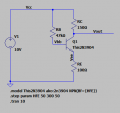
To illustrate what I am talking about, consider the following circuit:

1665815986635.png

I arbitrarily chose the values for RE and RC and then adjusted the value of RB to a value that kept Q1 out of saturation over the range of beta values from 50 to 300.
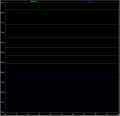
1665816246837.png

As you can see, the base voltage varies from 1.7 V up to 4.2 V and the output voltage varies from 8.6 V down to 4.8 V (where the transistor is starting to saturate).

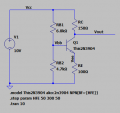
Now let's do a better job using a voltage divider to set Vbb.

If I want Vout to be 5 V, then I want the collector current to be (10 V - 5 V)/(150 Ω) = 33 mA

Even at the minimum beta of 50, this is good enough to assume that Ic = Ie since it's within 2% and my resistors probably aren't that tight (probably 5%). So that will place the emitter voltage at 3.3 V and the base voltage at about 4 V.

With the minimum beta of 50, that means that I want the Thevenin resistance at the base to be less than 5 kΩ, which can be achieved with two 10 kΩ resistors in parallel, so I will choose resistors that are somewhat less than this. If they were available, I'd try 6 kΩ over 4 kΩ. So I'll bump the bottom on up to 4.7 kΩ which would make the top on ideally 7.05 kΩ. I'll go with 6.8 kΩ, which will bias things a bit higher than I would like, but we are interested in stability in the face of beta variation.

1665817173930.png

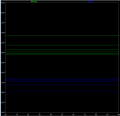
The results show, as expected, much better performance.

1665817225951.png

Now Vbb ranges from 2.9 V to 3.8 V and Vout ranges from 5.5 V to 6.8 V.

If I wanted to nail that down more firmly, I can just make the base resistors smaller -- although doing so stiffens the bias network which can interfere with the signal sources ability to move the base voltage around, depending on what it's output impedance is.

I can also get the Vout closer to the target 5 V just be being a bit more picky about finding resistors with the correct ratio (and taking the actual Vbe drop into account a bit better, which is a bit higher than 0.7 V at 30 mA. Picking 1000 Ω and 750 Ω yields the following:

1665818268516.png

This parks the quiescent output voltage between 4.8 V and 5.0 V for beta from 100 to 300 and 5.25 V for a beta of 50.

Notice that I'm able to nail down the quiescent output voltage as tight as I want because I have two variables to work with, so I can independently choose the Thevenin voltage AND the equivalent resistance seen by the base. With your single-resistor approach, I only have one variable to work with, which means I have to live with a Thevenin voltage of Vcc and now the resistance needed is extremely sensitive to transistor beta -- which is why that approach is notoriously poor.
 

LvW

Joined Jun 13, 2013
2,026
The lower case 're' is usually taken to be the internal emitter resistance not the external RE (upper case).
're' is usually used in the model called the "re transistor model" but there could be other uses.
No - that is not correct.
At first, "re" is not a resistor at all.
It is nothing else than a name for the inverse transconductance re=1/gm=VT/Ic.
This transconductance is the slope of the voltage-control function Ic=f(Vbe).
Therefore, "1/gm" has the unit volts/ampere but it is not a resistance with two "ends".
And, In particular, it must not be assigned to the emitter.
The "internal emitter resistance" is something else - it is the path resistance within the emitter region and is, normally neglected.
 

MrAl

Joined Jun 17, 2014
13,704
No - that is not correct.
At first, "re" is not a resistor at all.
It is nothing else than a name for the inverse transconductance re=1/gm=VT/Ic.
This transconductance is the slope of the voltage-control function Ic=f(Vbe).
Therefore, "1/gm" has the unit volts/ampere but it is not a resistance with two "ends".
And, In particular, it must not be assigned to the emitter.
The "internal emitter resistance" is something else - it is the path resistance within the emitter region and is, normally neglected.
To tell you the truth i really dont care what you want to call it. 're' is usually taken to be a resistance. But in any case, you know what i am talking about so stick to that.

BTW when the 're' transistor model was first made up, someone put all the letters of the alphabet in a hat and had someone pick one out for the first letter of 're' and it just happened to be 'r' because it's not a resistance (har har).

BTW 're' is internal to the transistor i dont know what you are talking about. It's not external right?
Whatever you want to call it, even if it is not 'real', it works in that kind of model as a resistance.
 
Last edited:

MrAl

Joined Jun 17, 2014
13,704
To illustrate what I am talking about, consider the following circuit:

View attachment 278455

I arbitrarily chose the values for RE and RC and then adjusted the value of RB to a value that kept Q1 out of saturation over the range of beta values from 50 to 300.
View attachment 278456

As you can see, the base voltage varies from 1.7 V up to 4.2 V and the output voltage varies from 8.6 V down to 4.8 V (where the transistor is starting to saturate).

Now let's do a better job using a voltage divider to set Vbb.

If I want Vout to be 5 V, then I want the collector current to be (10 V - 5 V)/(150 Ω) = 33 mA

Even at the minimum beta of 50, this is good enough to assume that Ic = Ie since it's within 2% and my resistors probably aren't that tight (probably 5%). So that will place the emitter voltage at 3.3 V and the base voltage at about 4 V.

With the minimum beta of 50, that means that I want the Thevenin resistance at the base to be less than 5 kΩ, which can be achieved with two 10 kΩ resistors in parallel, so I will choose resistors that are somewhat less than this. If they were available, I'd try 6 kΩ over 4 kΩ. So I'll bump the bottom on up to 4.7 kΩ which would make the top on ideally 7.05 kΩ. I'll go with 6.8 kΩ, which will bias things a bit higher than I would like, but we are interested in stability in the face of beta variation.

View attachment 278457

The results show, as expected, much better performance.

View attachment 278458

Now Vbb ranges from 2.9 V to 3.8 V and Vout ranges from 5.5 V to 6.8 V.

If I wanted to nail that down more firmly, I can just make the base resistors smaller -- although doing so stiffens the bias network which can interfere with the signal sources ability to move the base voltage around, depending on what it's output impedance is.

I can also get the Vout closer to the target 5 V just be being a bit more picky about finding resistors with the correct ratio (and taking the actual Vbe drop into account a bit better, which is a bit higher than 0.7 V at 30 mA. Picking 1000 Ω and 750 Ω yields the following:

View attachment 278461

This parks the quiescent output voltage between 4.8 V and 5.0 V for beta from 100 to 300 and 5.25 V for a beta of 50.

Notice that I'm able to nail down the quiescent output voltage as tight as I want because I have two variables to work with, so I can independently choose the Thevenin voltage AND the equivalent resistance seen by the base. With your single-resistor approach, I only have one variable to work with, which means I have to live with a Thevenin voltage of Vcc and now the resistance needed is extremely sensitive to transistor beta -- which is why that approach is notoriously poor.
Hello again,

Thanks for doing that circuit that's very good of you and you may be one of the few that are interested enough in this stuff to actually do that. I've been in it for over 50 years so i've been into it that long or longer.

Ok i understand how Beta varies and how we like to bias the circuit to minimize the effects on the amplifier as Beta changes, but what i was hoping you would do is do a 'gm' example not a beta example, but that's ok now we have that too. I also did not care about the Beta variation too much with a single base resistor for bias i just wanted the ultra simplest circuit so as to discuss other things about the circuit and how 'gm' relates to it.

So if you feel like doing a circuit using 'gm' as a parameter (i think you said you can do it better using gm) that would be good to discuss i think.
 

WBahn

Joined Mar 31, 2012
32,823
Hello again,

Thanks for doing that circuit that's very good of you and you may be one of the few that are interested enough in this stuff to actually do that. I've been in it for over 50 years so i've been into it that long or longer.

Ok i understand how Beta varies and how we like to bias the circuit to minimize the effects on the amplifier as Beta changes, but what i was hoping you would do is do a 'gm' example not a beta example, but that's ok now we have that too. I also did not care about the Beta variation too much with a single base resistor for bias i just wanted the ultra simplest circuit so as to discuss other things about the circuit and how 'gm' relates to it.

So if you feel like doing a circuit using 'gm' as a parameter (i think you said you can do it better using gm) that would be good to discuss i think.
I didn't use gm because you specifically asked for an example in which specific biasing conditions were met. That means large-signal. I don't know how else I can stress this -- gm is a SMALL-SIGNAL parameter and only has meaning when doing SMALL-SIGNAL calculations. Beta, on the other hand (if we assume it is known and constant to sufficient degrees), is BOTH a large signal and a small-signal parameter because it represents a LINEAR relationship between the base current and the collector current. In actuality, since it changes with current, there really is a large-signal beta and a small-signal beta -- and some transistor data sheets give both. But the ranges of them tend to have a lot of overlap and so most designers conveniently ignore the difference unless it really matters for what they are doing.
 

MrAl

Joined Jun 17, 2014
13,704
I didn't use gm because you specifically asked for an example in which specific biasing conditions were met. That means large-signal. I don't know how else I can stress this -- gm is a SMALL-SIGNAL parameter and only has meaning when doing SMALL-SIGNAL calculations. Beta, on the other hand (if we assume it is known and constant to sufficient degrees), is BOTH a large signal and a small-signal parameter because it represents a LINEAR relationship between the base current and the collector current. In actuality, since it changes with current, there really is a large-signal beta and a small-signal beta -- and some transistor data sheets give both. But the ranges of them tend to have a lot of overlap and so most designers conveniently ignore the difference unless it really matters for what they are doing.
Hello again,

Ok so let's take your second circuit in post #49. It is now biased, good enough for now i think with 6.8k and 4.7k and RC is 150 Ohms and RE is 100 Ohms, and let's not worry about the AC gain for now.
What do you calculate gm to be there?

I believe you are taking gm to be a constant because you were told at some point to take it as a constant because it is for a small signal analysis and so we can consider that a small change with not change gm very much so it's ok, but let's not get into that just yet. It's kind of funny though that nobody calls Beta a constant, at least not with the same ideas in mind. We do not keep Beta a constant except for minor acedemics so it's always considered to vary over a range maybe 50 to 300 if not in saturation.
But let's ignore all that for now i'd just like to see what you get for gm in that second circuit.
 

WBahn

Joined Mar 31, 2012
32,823
Ok so let's take your second circuit in post #49. It is now biased, good enough for now i think with 6.8k and 4.7k and RC is 150 Ohms and RE is 100 Ohms, and let's not worry about the AC gain for now.
What do you calculate gm to be there?
If I were doing back-of-the-envelope calculations, I would follow the following path to get a rough estimate:

I sought to establish Vbb = 4.0 V, making Ve = 3.3 V, making Ie = 33 mA. Estimating VT to be 25 mV, that would make

gm = Ie/VT = 33 mA / 25 mV = 1.32 mA/mV

I use 25 mV because 1/(25 mV) is the same as 4/(100 mV), making the computations easy to do in my head.

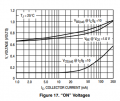
If I were trying to hit it a bit better, I would use the actual values in the voltage divider (ignoring the base current) and get Vbb=4.09 V. Knowing that this is resulting in an emitter current of about 30 mA, I would look at the data sheet to see if it provided Vbe curves as a function of collector current. This one does.

1665873561166.png

We only have a curve for Vce=1.0 V (the other two are in saturation) and we see that we can expect our Vbe to be about 0.75 V at 30 mA. The actual Vbe will be a bit less since our Vce is about 1.7 V. This datasheet doesn't give an Early voltage or other information to quantify this readily, so I'll just use 0.75 V.

This would give me an emitter current of

Ie = (4.09 V - 0.75 V) / (100 Ω) = 33.4 mA

Using the accepted room temperature thermal voltage of 25.9 mV (or 25.85 mV would be better, but three sig figs is good enough), that would give a small-signal transconductance of

gm = 33.4 mA / 25.9 mV = 1.29 mA/mV

If we look at the sim results over beta, we see that the emitter current varies from about 21.5 mA to 30.5 mA. so that still gives us a pretty wide range of gm, from 0.830 mA/mV to 1.178 mA/mV. Still, if we take the average of that (1.004 mA/mV), the range is only ±17%, compared to a range of a factor of six in the value of beta (±71% from the average of 175).

I believe you are taking gm to be a constant because you were told at some point to take it as a constant because it is for a small signal analysis and so we can consider that a small change with not change gm very much so it's ok, but let's not get into that just yet.
I don't know what you are talking about here. What do you mean by me taking gm to be a constant? Do you mean that I think that gm has some value for a given transistor that never changes? If that were the case, it would be in the data sheet. Do you mean that I think that, once it is determined for a given DC operating point that it is somehow fixed and doesn't change? If either of those is the case, then I suggest you actually read what I have posted. I not only said that gm varies with a number of parameters, emitter current and temperature chief among them, but I even showed how small the small-signal input voltage needed to be in order to keep the assumption that gm was a constant in the small-signal model reasonably valid.

It's kind of funny though that nobody calls Beta a constant, at least not with the same ideas in mind. We do not keep Beta a constant except for minor acedemics so it's always considered to vary over a range maybe 50 to 300 if not in saturation.
What's funny about it?

But let's ignore all that for now i'd just like to see what you get for gm in that second circuit.
And perhaps you will finally show what value of beta you would use in doing your single-resistor biasing of the same circuit?
 

LvW

Joined Jun 13, 2013
2,026
To tell you the truth i really dont care what you want to call it. 're' is usually taken to be a resistance. But in any case, you know what i am talking about so stick to that.
Thank you for your kind words.

BTW 're' is internal to the transistor i dont know what you are talking about. It's not external right?
Whatever you want to call it, even if it is not 'real', it works in that kind of model as a resistance.
To prevent misunderstandings in discussions on technical topics, I think it is useful and necessary to give names to the symbols used in these discussions (except perhaps V, I and R).
That's why I asked you what the letter "re" means for you. Just for clarification.
(I remember - recently, in another post , you considered "re" - in combination with the emitter resistor Re - as an external part causing a negative feedback effect).
Regarding your last sentence ("...works...as a resistance"): When you look into the model you will see that it does NOT work like a resistance (and this is the source of many misinterpretations), because the voltage across "re" is the base-emitter voltage v_be, but the current through this part is not the base current i_b (but the emitter current i_e). That means: The quantity we call "re" DOES NOT follow Ohms Law! It is NOT a resistance!

For this reason, I dislike the model and the misleading name "intrinsic emitter resistance". I see absolutely no necessity to use such a model beside the two other models. By the way - I did not use any models for describing and explaining transistor-based circuits to the students. In my view: superfluous.
 
Last edited:

MrAl

Joined Jun 17, 2014
13,704
Thank you for your kind words.


To prevent misunderstandings in discussions on technical topics, I think it is useful and necessary to give names to the symbols used in these discussions (except perhaps V, I and R).
That's why I asked you what the letter "re" means for you. Just for clarification.
(I remember - recently, in another post , you considered "re" - in combination with the emitter resistor Re - as an external part causing a negative feedback effect).
"Thank you..."
Well you make such a big deal out of this stuff but if you think it's important then i guess it is good to mention.
I really like your comical comeback though it's good to get a little levity in with serious discussions i think.

"re..."
Yes 're' is usually considered internal but maybe you were talking about 'rex' perhaps? That's internal too but not that often considered.
 

MrAl

Joined Jun 17, 2014
13,704
If I were doing back-of-the-envelope calculations, I would follow the following path to get a rough estimate:

I sought to establish Vbb = 4.0 V, making Ve = 3.3 V, making Ie = 33 mA. Estimating VT to be 25 mV, that would make

gm = Ie/VT = 33 mA / 25 mV = 1.32 mA/mV

I use 25 mV because 1/(25 mV) is the same as 4/(100 mV), making the computations easy to do in my head.

If I were trying to hit it a bit better, I would use the actual values in the voltage divider (ignoring the base current) and get Vbb=4.09 V. Knowing that this is resulting in an emitter current of about 30 mA, I would look at the data sheet to see if it provided Vbe curves as a function of collector current. This one does.

View attachment 278542

We only have a curve for Vce=1.0 V (the other two are in saturation) and we see that we can expect our Vbe to be about 0.75 V at 30 mA. The actual Vbe will be a bit less since our Vce is about 1.7 V. This datasheet doesn't give an Early voltage or other information to quantify this readily, so I'll just use 0.75 V.

This would give me an emitter current of

Ie = (4.09 V - 0.75 V) / (100 Ω) = 33.4 mA

Using the accepted room temperature thermal voltage of 25.9 mV (or 25.85 mV would be better, but three sig figs is good enough), that would give a small-signal transconductance of

gm = 33.4 mA / 25.9 mV = 1.29 mA/mV

If we look at the sim results over beta, we see that the emitter current varies from about 21.5 mA to 30.5 mA. so that still gives us a pretty wide range of gm, from 0.830 mA/mV to 1.178 mA/mV. Still, if we take the average of that (1.004 mA/mV), the range is only ±17%, compared to a range of a factor of six in the value of beta (±71% from the average of 175).


I don't know what you are talking about here. What do you mean by me taking gm to be a constant? Do you mean that I think that gm has some value for a given transistor that never changes? If that were the case, it would be in the data sheet. Do you mean that I think that, once it is determined for a given DC operating point that it is somehow fixed and doesn't change? If either of those is the case, then I suggest you actually read what I have posted. I not only said that gm varies with a number of parameters, emitter current and temperature chief among them, but I even showed how small the small-signal input voltage needed to be in order to keep the assumption that gm was a constant in the small-signal model reasonably valid.


What's funny about it?


And perhaps you will finally show what value of beta you would use in doing your single-resistor biasing of the same circuit?

Hello again,

It's amazing how much has been written about a single three terminal component in books and on the web.


QUOTE:
gm = Ie/VT = 33 mA / 25 mV = 1.32 mA/mV
I use 25 mV because 1/(25 mV) is the same as 4/(100 mV), making the computations easy to do in my head.
END QUOTE.

But dont you use gm in a small signal analysis? That would mean you keep it constant for that ONE level of dc bias. That's what i was talking about not about the same gm for every circuit no matter what the dc bias is.
Also, so what would be wrong with using 're' then if it is just the inverse of gm. I see people in love with gm but hate re for some reason.

I'm not too worried about single resistor or double resistor biasing in fact i would rather use a voltage divider too as i said i just wanted to use the single resistor to keep things simpler, but in fact it's not that much more of a bother to use the voltage divider so i can stick to that.

The Beta varies and so does gm, but gm is usually taken to be constant for one bias point for SS analysis.

I'll show some calculations soon.
 

LvW

Joined Jun 13, 2013
2,026
"Thank you..."
Well you make such a big deal out of this stuff but if you think it's important then i guess it is good to mention.
I really like your comical comeback though it's good to get a little levity in with serious discussions i think.

"re..."
Yes 're' is usually considered internal but maybe you were talking about 'rex' perhaps? That's internal too but not that often considered.
I think this reaction does not need to be commented.
 

WBahn

Joined Mar 31, 2012
32,823
It's amazing how much has been written about a single three terminal component in books and on the web.
What's so amazing about it?

But dont you use gm in a small signal analysis? That would mean you keep it constant for that ONE level of dc bias. That's what i was talking about not about the same gm for every circuit no matter what the dc bias is.
So? What is your point? You are acting like a troll.

Also, so what would be wrong with using 're' then if it is just the inverse of gm. I see people in love with gm but hate re for some reason.
Who's in love with gm but hates re?

Both are simply components in slightly different, but equivalent, versions of the T-model BJT small-signal equivalent circuit.

I'm not too worried about single resistor or double resistor biasing in fact i would rather use a voltage divider too as i said i just wanted to use the single resistor to keep things simpler, but in fact it's not that much more of a bother to use the voltage divider so i can stick to that.
By all means, PLEASE show how you would design your single resistor biasing circuit for the base in order to park the quiescent output voltage near the 5 V goal you specified.

The Beta varies and so does gm, but gm is usually taken to be constant for one bias point for SS analysis.
You still don't seem to be able to grasp the huge difference between these two situations. It appears that you think that assuming that gm is constant at a particular bias point is no different that assuming that beta is constant at a particular bias point. Fine. Let's make both of those assumptions (both of which are quite reasonable).

Here's the difference. Please. Try to follow this. It's important.

Give me a bias point and I can give you a value for gm and re that varies only modestly from the calculated values regardless of which transistor you pull out of a bag. Pull out a 2n3904 manufactured a year ago, or a 2n2222 manufactured twenty years ago, or a BC847 manufactured a decade ago it doesn't matter. The actual gm (or re) for that transistor will be reasonably close to that value.

But what value are you going to use for beta? Even if we stipulate that the value for a given transistor operating at a given bias point is reasonably constant, what is that value? Is that value going to be reasonably close to the actual value regardless of which transistor you pull out of that bag?

I'll show some calculations soon.
That would be a refreshing change.
 
Top