input resistance

LvW

Joined Jun 13, 2013
2,027
What is wrong? Not sure i know what you mean here.
I never make such statements without sufficient reasoning.
I have explained "what is wrong" and why in the first 3 sentences in my post#77.

If the circuit is sitting there in steady state and Beta changes, the collector current changes. How can that be wrong?
Vbe is part of what changes also because as the current increases Vbe increases, and that's because Vbe is measured externally not internally.
My recommendation: Make some measurements or do a simulation for two such common-emitter stages having the same DC bias point (Ic, Vce) - but different B-values. You will notice, that the transconductance is the same - independent on B.
(In contrast to your statement: If you start from some bias point you have a particular gm. But that involves a fixed Beta because if you change the Beta the bias point must change, and that changes the collector current.")

This means the the drop across re is part of Vbe.
Do you realize what you are saying? The voltage drop across a differential small-signal quantity is "part of Vbe" (Vbe is a DC voltage!).
I repeat again: The quantity "re" has the unit "V/A" but is NOT a resistor and, therefore, cannot produce any "voltage drop".

Let me be frank: I guess your understanding of how a BJT really works is not yet quite complete.
In short: The BJT is a voltage-controlled element (exponential relation Ic=f(Vbe)) - and the base current Ib is an unwanted but unavoidable byproduct (a kind of "parasitic" quantity); in this context, the great late Barrie Gilbert has used the words "nuisance" and "defect".
And, therfore, the quantity you call "re" is the inverse of the slope of the curve showing this relationship Ic=f(Vbe).

Regarding the last paragraph of your last post I must admit that I do not understand the content and the meaning of your statements. But this is surely my fault - and, therefore I kindly ask you to enlighten me and give an example for the formulas you are referring to.
Thank you.
 
Last edited:

WBahn

Joined Mar 31, 2012
32,829
Ok if i can get to that i will, but not exactly sure what you mean by what does Vload look like.
Uhmmm... I don't know what is confusing about that. You have a 10 mV sine wave at 10 kHz with a 50 Ω output impedance. What does the voltage across the load (i.e., the voltage on node Vload) look like? What the the various options that you are thinking it could mean? I'll try to tell you which one it is.

I was mainly concerned with the DC bias point for now, but you seem to say that gm does not matter for the DC bias point. To be clear though, i used 're' not 'gm', but i assumed that since they were simply related that it would not matter which i mentioned, but just to be clear i did use 're'.
You're right, it doesn't matter because you still did the same thing. You took something that is DEFINED as a small-signal parameter and artificially inverted it to create an impression that the the DC bias point depended on it instead of the other way around. NONE of the small-signal parameters have ANY influence on the DC bias point. Their values are established BY the DC bias point. The only linkage is that if I WANT to achieve a certain value for those parameters, then that tells me what I want to set the DC bias point at, but I cannot USE those parameters to actually DO it.

As you probably know, 're' is considered part of the transistor and it doesnt go away just because we are forming the bias of the network. It could be significant or less but in any case it does not just disappear, so i would think 'gm' also does not simply go away for the biasing part of the calculation. Am i wrong?
You are wrong. As has been stated several times, r_e is a small-signal parameter. As with many things, there are different, but equivalent, ways to define it (you pick one and the others follow from it). For this discussion, the most appropriate one is probably

\(
r_e \; \equiv \; \left. \frac{ \partial v_{BE}(t) }{ \partial i_E(t) } \right|_{v_{CE}=V_{CE}}
\)

It is a mathematical model of the small-signal behavior -- the linearized approximation, over a limited region, of, in the case of a BJT, an exponential voltage-current relationship. There is NO physical resistance inside a transistor that is r_e. There IS physical resistance associated with the emitter of the transistor (due to the doping in the emitter region, the shape and size of the emitter region, the bond wire connections and bond wire resistance, the package lead resistance, and so forth), but that is NOT r_e, it is the emitter parasitic resistance. This parasitic resistance is usually so small that data sheets for many transistors don't even mention it. For high frequency and power applications, it can become more important. High frequency, such as RF transistors have a lot more characterization of various parasitic effects, including capacitance and inductance, for all three terminals.

I dont see how but if you think so tell me why. What i think is the reason someone might say that is because they dont use it for the biasing, they only use it for the AC again or something. I doubt you are alone in that too and i know there may be a good reason for that but that reason is probably to simplify the process of design certainly not for more accuracy even if just theoretical, and after all it's hard to get a super accurate calculation with the number of inaccessible factors that go into a circuit like this such as Vbe selection and as you know with the Beta variation we have to check at least a few different points.

In fact, i seem to remember a design procedure that calculated re during the biasing phase, then recalculated re after, then recalculated it another time (three times i think it was) in order to be sure the biasing point was correct.
Now i could see it if it was 0.1 Ohm and RE was 100 Ohms or maybe even 10 Ohms, but if it turned out to be 25 Ohms that would affect the bias point as well as the AC gain. Note i use the units of Ohms because that's the typical way to describe this 'resistor' when some would rather we say "volts per amp" or something like that.
Why would they recalculate something another time after recalculating it and not making any changes?

As stated before, the reason that they would do anything with r_e before biasing is to tell them what they want the bias current to be. But once armed with that information, they do NOT use it in the biasing calculations themselves (as YOU noted, if you do, it cancels out).

You still seem to be under this delusion that r_e is a physical resistance that the bias current is flowing through. IT'S NOT! It is a mathematical model relating how the emitter current CHANGES as the base-emitter voltage CHANGES.

EDIT: Corrected r_e definition.
 
Last edited:

WBahn

Joined Mar 31, 2012
32,829
Hello again,

Here is what i think was one of the formulas that came out of this. I just have to figure out if i modified it later this was taken from older notes, but it looks right. This is for the direct calculation of re.

re=(2*Rc*B*VT)/(Vcc*(B+1))

where Rc is the collector resistance, VT the thermal voltage (i use 0.026), Vcc is the supply voltage, B is Beta.
One of the assumptions is that Vout is 1/2 of Vcc (DC bias point).
That's a pretty big assumption there!

The only way you can make that assumption is to require that the transistor be biased to a very specific condition.

You shouldn't have to be referring to any notes at all to get this result.

If Vout is half of Vcc, then the voltage across Rc is Vcc/2, which means that Ic = Vcc/(2·Rc).

Which them means that Ie = [(ß+1)/ß][Vcc/(2·Rc)]

re = VT / I_E = VT / [(ß+1)/ß][Vcc/(2·Rc)]

re = VT / I_E = 2·Rc·ß·VT / [(ß+1)·Vcc]

But that's only valid IF the transistor is biased to Vcc/2. That is frequently not the case. First, it doesn't result in the maximum voltage swing since the output can swing up to the Vcc but can only swing down until the transistor goes into saturation, so it is not uncommon to bias the output to the midpoint between these two values. Second, targeting a specific DC output voltage (which means a fixed voltage drop across Rc) also has the effect of setting the small-signal gain achieved with R_E bypassed with a capacitor in the passband. If you want to set the this gain to be a certain value, you have to live with a different voltage drop across Rc.

EDIT: Removed the original last sentence, which was actually from the post I was replying to and not something I wrote.
 
Last edited:

LvW

Joined Jun 13, 2013
2,027
[QUOTE="WBahn, post: 1771520, member: 161605
Not sure if this is relevant but the bias network is the voltage divider not the single resistor. It could be that it works with the single resistor too though as it doesnt seem to matter, but i didnt check that because nobody really does that.
[/QUOTE]

Yes - I agree with the last sentence.
From the practical point of view, the expression
re = VT / I_E = 2·Rc·ß·VT / [(ß+1)·Vcc]
is totally meaningless, because nobody uses it.

The classical and logical design sequence starts with the desired DC current Ic - knowing that a certain transconductance gm is connected with this current, which together with Rc is gain relevant). That`s all.
The quantities B (resp Ib) come into play only when the bias circuitry for the selected DC operational point is designed.

(A small comment to post#82: In the given definition for r_e numerator and denominator are swapped)
 

WBahn

Joined Mar 31, 2012
32,829
(A small comment to post#82: In the given definition for r_e numerator and denominator are swapped)
You are absolutely correct (and I would have caught that -- and usually do -- because the units are messed up). I'm so used to working with transconductance that my fingers went on autopilot. I'll correct that immediately. Thanks.
 

MrAl

Joined Jun 17, 2014
13,704
I never make such statements without sufficient reasoning.
I have explained "what is wrong" and why in the first 3 sentences in my post#77.


My recommendation: Make some measurements or do a simulation for two such common-emitter stages having the same DC bias point (Ic, Vce) - but different B-values. You will notice, that the transconductance is the same - independent on B.
(In contrast to your statement: If you start from some bias point you have a particular gm. But that involves a fixed Beta because if you change the Beta the bias point must change, and that changes the collector current.")


Do you realize what you are saying? The voltage drop across a differential small-signal quantity is "part of Vbe" (Vbe is a DC voltage!).
I repeat again: The quantity "re" has the unit "V/A" but is NOT a resistor and, therefore, cannot produce any "voltage drop".

Let me be frank: I guess your understanding of how a BJT really works is not yet quite complete.
In short: The BJT is a voltage-controlled element (exponential relation Ic=f(Vbe)) - and the base current Ib is an unwanted but unavoidable byproduct (a kind of "parasitic" quantity); in this context, the great late Barrie Gilbert has used the words "nuisance" and "defect".
And, therfore, the quantity you call "re" is the inverse of the slope of the curve showing this relationship Ic=f(Vbe).

Regarding the last paragraph of your last post I must admit that I do not understand the content and the meaning of your statements. But this is surely my fault - and, therefore I kindly ask you to enlighten me and give an example for the formulas you are referring to.
Thank you.
Hello again,

I think you are referring to old documents that should probably be considered outdated. Things change, improvements are made, this happens all the time.
With respect to 're', there is a reason the original design concepts came into being. 're' did not just magically appear one day. It is part of the transistor, and helps to explain the exponential part without actually using the exponential part, even if just in theory. It is part of a voltage drop and if you do a full analysis you will find that it helps explain that. You also seem to be repeating the complaint about re not being a resistance. Then what do you call it and what does it do in your view of this?

I'll repeat what i had said in another post here because i think this is the root cause of the misunderstanding.

Once you understand how that parameter (re) came into being, i think this will make more sense to you. By defining it as dY/dX or VT/ic or VT/ie is not the definition it's a mathematical construct that can be used to calculate "it". The real question then is what exactly is "it" and i think when you look into this it will make much more sense.
 
Last edited:

MrAl

Joined Jun 17, 2014
13,704
Uhmmm... I don't know what is confusing about that. You have a 10 mV sine wave at 10 kHz with a 50 Ω output impedance. What does the voltage across the load (i.e., the voltage on node Vload) look like? What the the various options that you are thinking it could mean? I'll try to tell you which one it is.


You're right, it doesn't matter because you still did the same thing. You took something that is DEFINED as a small-signal parameter and artificially inverted it to create an impression that the the DC bias point depended on it instead of the other way around. NONE of the small-signal parameters have ANY influence on the DC bias point. Their values are established BY the DC bias point. The only linkage is that if I WANT to achieve a certain value for those parameters, then that tells me what I want to set the DC bias point at, but I cannot USE those parameters to actually DO it.


You are wrong. As has been stated several times, r_e is a small-signal parameter. As with many things, there are different, but equivalent, ways to define it (you pick one and the others follow from it). For this discussion, the most appropriate one is probably

\(
r_e \; \equiv \; \left. \frac{ \partial v_{BE}(t) }{ \partial i_E(t) } \right|_{v_{CE}=V_{CE}}
\)

It is a mathematical model of the small-signal behavior -- the linearized approximation, over a limited region, of, in the case of a BJT, an exponential voltage-current relationship. There is NO physical resistance inside a transistor that is r_e. There IS physical resistance associated with the emitter of the transistor (due to the doping in the emitter region, the shape and size of the emitter region, the bond wire connections and bond wire resistance, the package lead resistance, and so forth), but that is NOT r_e, it is the emitter parasitic resistance. This parasitic resistance is usually so small that data sheets for many transistors don't even mention it. For high frequency and power applications, it can become more important. High frequency, such as RF transistors have a lot more characterization of various parasitic effects, including capacitance and inductance, for all three terminals.


Why would they recalculate something another time after recalculating it and not making any changes?

As stated before, the reason that they would do anything with r_e before biasing is to tell them what they want the bias current to be. But once armed with that information, they do NOT use it in the biasing calculations themselves (as YOU noted, if you do, it cancels out).

You still seem to be under this delusion that r_e is a physical resistance that the bias current is flowing through. IT'S NOT! It is a mathematical model relating how the emitter current CHANGES as the base-emitter voltage CHANGES.

EDIT: Corrected r_e definition.
Yes as i said before you are stuck on assuming that 're' is a small signal parameter and only that. As far as i am concerned that is an outdated concept, or at least an over simplification. You can still use it of course, but then you will never be able to grasp the concept of using it in other ways. Perhaps you should look into the origin of where the concept of 're' came from. Why do you think it was used in the first place. By that i mean, why do you think it was decided to be used in small signal analysis. It did not just appear out of nowhere, there was a reason it was decided to be used, and that reason is the same as for any other type of simplification analysis. I think if you look into the *physical* reason for where 're' came from you will see that it has a physical meaning not JUST a mathematical trick to make things simpler. It is not JUST a thing that we calculate for the heck of it to make things simpler to design, or should i say seemingly simpler. There is a good reason for the 'invention' of using 're' in the design process. Once you understand how that parameter came into being, i think this will make more sense to you. By defining it as dY/dX or VT/ic or VT/ie is not the definition it's a mathematical construct that can be used to calculate "it". The real question then is what exactly is "it" and i think when you look into this it will make much more sense.
 

LvW

Joined Jun 13, 2013
2,027
Hello again,
I think you are referring to old documents that should probably be considered outdated. Things change, improvements are made, this happens all the time.
I really do not know which "old documents" you are referring to. In order to understand your sentences it would be very helpful to be more specific.
With respect to 're', there is a reason the original design concepts came into being. 're' did not just magically appear one day. It is part of the transistor, and helps to explain the exponential part without actually using the exponential part, even if just in theory. It is part of a voltage drop and if you do a full analysis you will find that it helps explain that.
Please, could YOU provide this help and explain what you mean with "...is part of a voltage drop". Any formula could help to understand what you mean.
You also seem to be repeating the complaint about re not being a resistance. Then what do you call it and what does it do in your view of this?
I think, this is basic knowledge which can be found in all relevant textbooks.
But for your convinience, I'm happy to repeat that again - it's quite simple:
The key for computing the voltage gain of a transistor stage (BJT as well as FET) is the transconductance gm .
Here is the formula for a common emitter stage (with emitter feedback Re):
A=-gm*Rc/(1+gm*Re)=Rc/[(1/gm)+Re].
The transconductance gm is the slope of the Ic=f(Vbe) characteristic (in A/V).

In the past, some people (authors, theorists) thought it useful to consider the quantity gm as the reciprocal r_e=1/gm (in V/A).
Of course, this can be done - however, for which purpose ?
Does this improve our understanding how the BJT works?
I don`t think so - in contrary:
I think, this gives rise to many misunderstandings - as we can see in this discussion (you still think r_e is a "real" resistor that could cause a voltage drop).
To answer your question - we can say that "r_e" is a "transresistance" (remember: There is a certain type of integrated amplifier called "Transimpedance amplifier" with current_in and voltage_out).
However - and this is the big disadvantage of using r_e instead of gm - a quantity with (formallly) "current-in" and "voltage-out" does not represent the real transistor function (voltage-controlled current source). Using r-e instead of 1/gm is just a mathematical manipulation within formulas without any physical relevance.
For this reason I never have used this method of writing and explaining formulas (I think it is essential to UNDERSTAND the contents of formulas).
The same applies to the so-called T-form for a small-signal equivalent circuit diagram (which contains r-e as a differential quantity for connecting input and output signals).
There is absolutely no necessity to have a third small-signal representation (in addition to the well known two diagrams) - even if it works (when applied correctly !). The problem of this diagram and the reason of some misinterpretations is simply the fact that it contains a quantity (r_e) which does not correspond to the physical reality of the BJT.
The biggest problem is that some people use the term "inherent emitter resistance" for the quantity r_e.
This is totally wrong and misleading, because (1) it is not a real resistance and (2) it is not part of the emitter region.

Did I answer all your questions?
 
Last edited:

MrAl

Joined Jun 17, 2014
13,704
I really do not know which "old documents" you are referring to. In order to understand your sentences it would be very helpful to be more specific.

Please, could YOU provide this help and explain what you mean with "...is part of a voltage drop". Any formula could help to understand what you mean.

I think, this is basic knowledge which can be found in all relevant textbooks.
But for your convinience, I'm happy to repeat that again - it's quite simple:
The key for computing the voltage gain of a transistor stage (BJT as well as FET) is the transconductance gm .
Here is the formula for a common emitter stage (with emitter feedback Re):
A=-gm*Rc/(1+gm*Re)=Rc/[(1/gm)+Re].
The transconductance gm is the slope of the Ic=f(Vbe) characteristic (in A/V).

In the past, some people (authors, theorists) thought it useful to consider the quantity gm as the reciprocal r_e=1/gm (in V/A).
Of course, this can be done - however, for which purpose ?
Does this improve our understanding how the BJT works?
I don`t think so - in contrary:
I think, this gives rise to many misunderstandings - as we can see in this discussion (you still think r_e is a "real" resistor that could cause a voltage drop).
To answer your question - we can say that "r_e" is a "transresistance" (remember: There is a certain type of integrated amplifier called "Transimpedance amplifier" with current_in and voltage_out).
However - and this is the big disadvantage of using r_e instead of gm - a quantity with (formallly) "current-in" and "voltage-out" does not represent the real transistor function (voltage-controlled current source). Using r-e instead of 1/gm is just a mathematical manipulation within formulas without any physical relevance.
For this reason I never have used this method of writing and explaining formulas (I think it is essential to UNDERSTAND the contents of formulas).
The same applies to the so-called T-form for a small-signal equivalent circuit diagram (which contains r-e as a differential quantity for connecting input and output signals).
There is absolutely no necessity to have a third small-signal representation (in addition to the well known two diagrams) - even if it works (when applied correctly !). The problem of this diagram and the reason of some misinterpretations is simply the fact that it contains a quantity (r_e) which does not correspond to the physical reality of the BJT.
The biggest problem is that some people use the term "inherent emitter resistance" for the quantity r_e.
This is totally wrong and misleading, because (1) it is not a real resistance and (2) it is not part of the emitter region.

Did I answer all your questions?

Hi,

I think maybe we should talk about one aspect at a time so that we can go over that first and come to some agreement (or not ha ha) for that one issue first, then move on if needed to another issue. We talked about several things in one post and so it's a little hard to address all that in one writing, at least for me.

Let me start with "is part of the voltage drop".
I am not sure if you are aware of this or not, but re can be used to mimic part of the voltage drop within the transistor. The reason for this is because if we were to move re outside of the transistor, we would see re in series with RE (the real external resistor RE). This must be evident from the formulas it appears in.
The thing is though, when we measure Vbe we must put one probe on the base and one on the emitter, and now with re external that means that we must place the other probe on the 'top' of RE, and the other end of RE would of course connect to ground in the simple circuit we are talking about (and no capacitors yet).
So re can be viewed as being internal to the transistor and 'drops' a voltage according to the emitter current, the same way that RE drops a voltage based on the emitter current. So lets look at some values.
I calculated around 0.8 Ohms for re in one circuit and maybe 100 Ohms for RE in the circuit by design. Now if the emitter current was 10ma, the drop across RE would (of course) be 100*0.01 which is 1 volt, but since re is in series with RE that means the 'drop' across re would be 0.01*0.8 which would be of course 0.008 volts.
The thing is though, the voltage measurement from the base to the actual emitter would then have to be 1.008 volts although in the simplified view it may only be 1.000 volts due to the idea of making the design process simpler. So it may be hard to distinguish sometimes between what is happening with re.
What i found out though was if you dont use re in this manner the gain calculation does not come out right. Now that may work the same or similar with gm, but i did not use gm i used re.
Also, the concept of re comes from VT/ie and that is because VT is inside the transistor (obviously) and so defining the quantity as VT/ie seems to work both in the biasing phase and in the calculation of the gain.

I seem to remember calculating a gain for a circuit as being approximately 10, but with re the gain has to be set to 10.7 (or something like that) to get the actual circuit gain to be 10. This means a certain value of RE and RC. That means that if we try to set the AC gain to 10 we'd have to set RC to a certain value that would not allow an actual AC gain of 10, it would be slightly less than 10. Setting RC to the right value we get a gain of 10 at least in theory.

I think the reason re may be left out in the biasing phase is because it is relatively insignificant in relation to the external RE so RE dominates the current response. To get the biasing even more 'accurate' though including re does the trick, and i see some design procedures saying that to get it right we have to redo the design calculation a few times not just once. If re is made a function though, it automatically becomes the right value. It should not matter if you view it as 'real' or not as long as it works.
 
Last edited:

LvW

Joined Jun 13, 2013
2,027
Hi,

I think maybe we should talk about one aspect at a time so that we can go over that first and come to some agreement (or not ha ha) for that one issue first, then move on if needed to another issue. We talked about several things in one post and so it's a little hard to address all that in one writing, at least for me.

Let me start with "is part of the voltage drop".
I am not sure if you are aware of this or not, but re can be used to mimic part of the voltage drop within the transistor. The reason for this is because if we were to move re outside of the transistor, we would see re in series with RE (the real external resistor RE). This must be evident from the formulas it appears in.
The thing is though, when we measure Vbe we must put one probe on the base and one on the emitter, and now with re external that means that we must place the other probe on the 'top' of RE, and the other end of RE would of course connect to ground in the simple circuit we are talking about (and no capacitors yet).
So re can be viewed as being internal to the transistor and 'drops' a voltage according to the emitter current, the same way that RE drops a voltage based on the emitter current. So lets look at some values.
............................
............................
What i found out though was if you dont use re in this manner the gain calculation does not come out right. Now that may work the same or similar with gm, but i did not use gm i used re.
Also, the concept of re comes from VT/ie and that is because VT is inside the transistor (obviously) and so defining the quantity as VT/ie seems to work both in the biasing phase and in the calculation of the gain.

I seem to remember calculating a gain for a circuit as being approximately 10, but with re the gain has to be set to 10.7 (or something like that) to get the actual circuit gain to be 10. This means a certain value of RE and RC. That means that if we try to set the AC gain to 10 we'd have to set RC to a certain value that would not allow an actual AC gain of 10, it would be slightly less than 10. Setting RC to the right value we get a gain of 10 at least in theory.

I think the reason re may be left out in the biasing phase is because it is relatively insignificant in relation to the external RE so RE dominates the current response. To get the biasing even more 'accurate' though including re does the trick, and i see some design procedures saying that to get it right we have to redo the design calculation a few times not just once. If re is made a function though, it automatically becomes the right value. It should not matter if you view it as 'real' or not as long as it works.
I'll make the answer a little easier for myself now.
The three key statements in your article (in bold) are simply wrong.
That is no news, because that was already communicated to you here again and again - but you ignore that continously.
I really try to remain polite, but I`ve got the impression that the difference between static and differential quantities is probably not quite clear to you yet.
How else do you get the idea to use the quantity "r_e" for the calculation of the DC bias (operating) point?
This quantity r_e (as well as the transconductance gm=1/r_e) are small signal parameters, which are determined by the slopes of the known characteristic Ic=f(Vbe) in the selected operating point. Thus r_e (or gm) result only as a consequence of the choice of the DC operating point.
Why - for heaven's sake - do you think that the quantity r_e also can be seen outside the transistor (in series to RE)?
I have repeated all this for the nth time now and I don't see any sense in continuing this fruitless communication (it was not a real factual discussion).

Until the next time.
LvW

PS (Edit) :
Is it realy necessary to repeat once agin that r_e cannot produce any voltage drop because r_e is not a (two-pole) resistance?
Just one example for you confuse "calculation" (assuming that r_e could create a voltage drop) :
In your example you have assumed r_e=0,8 Ohm which corresponds to a DC emitter current of app. Ie=25/800=31,25mA. Then, as next step you reduce the current to Ie=10mA and state that "the 'drop' across r_e would be 0.01*0.8 ". Suddenly, you assume that r_e would be fixed and not dependent on the curent Ie anymore. This illustrates my asumption that your understanding of differential quantities is not yet complete.
 
Last edited:

WBahn

Joined Mar 31, 2012
32,829
Yes as i said before you are stuck on assuming that 're' is a small signal parameter and only that. As far as i am concerned that is an outdated concept, or at least an over simplification. You can still use it of course, but then you will never be able to grasp the concept of using it in other ways. Perhaps you should look into the origin of where the concept of 're' came from. Why do you think it was used in the first place. By that i mean, why do you think it was decided to be used in small signal analysis. It did not just appear out of nowhere, there was a reason it was decided to be used, and that reason is the same as for any other type of simplification analysis. I think if you look into the *physical* reason for where 're' came from you will see that it has a physical meaning not JUST a mathematical trick to make things simpler. It is not JUST a thing that we calculate for the heck of it to make things simpler to design, or should i say seemingly simpler. There is a good reason for the 'invention' of using 're' in the design process. Once you understand how that parameter came into being, i think this will make more sense to you. By defining it as dY/dX or VT/ic or VT/ie is not the definition it's a mathematical construct that can be used to calculate "it". The real question then is what exactly is "it" and i think when you look into this it will make much more sense.
I have shown you where "it" came from. I derived it explicitly from the Ebers-Moll equation. That is where "it" came from. If you want to claim that it came from elsewhere, YOU need to provide documentation to back that claim up.

You can state all day long that it is an outdated concept and that you have something better. But no one is going to take you seriously until you demonstrate that. You won't even show how to use your new and improved method on that simple common emitter amplifier that took less than half an hour to design using the old, outdated concepts.

Instead, you artificially introduce re into a calculation for the DC output voltage, discover that it cancels out, and then proclaim that you shown something meaningful about how re needs to be used in the DC bias calculations. Yet I was able to get the exact same results without any need to have ever heard anything about re.
 

MrAl

Joined Jun 17, 2014
13,704
I have shown you where "it" came from. I derived it explicitly from the Ebers-Moll equation. That is where "it" came from. If you want to claim that it came from elsewhere, YOU need to provide documentation to back that claim up.

You can state all day long that it is an outdated concept and that you have something better. But no one is going to take you seriously until you demonstrate that. You won't even show how to use your new and improved method on that simple common emitter amplifier that took less than half an hour to design using the old, outdated concepts.

Instead, you artificially introduce re into a calculation for the DC output voltage, discover that it cancels out, and then proclaim that you shown something meaningful about how re needs to be used in the DC bias calculations. Yet I was able to get the exact same results without any need to have ever heard anything about re.
Yes there are certainly other ways to do the same thing. Just think about it for a minute, hybrid parameters, etc.
You seem to argue some points that we already know (can do it other ways).
I explained what i used re for and isnt that used in the 're' model of the transistor?
I assumed everyone was familiar with the 're' model maybe i was wrong. That's really the heart of it. I'll try to find some info written on the web if that will help.
I think i should make a drawing too that could help explain what is happening and why i am doing this.

I think you should wait to reply again until i can supply a drawing to help explain what is happening here. There is too much information being misinterpreted here so i hope to clear that up soon. We usually like to see a schematic anyway :)
 
Last edited:

MrAl

Joined Jun 17, 2014
13,704
I'll make the answer a little easier for myself now.
The three key statements in your article (in bold) are simply wrong.
That is no news, because that was already communicated to you here again and again - but you ignore that continously.
I really try to remain polite, but I`ve got the impression that the difference between static and differential quantities is probably not quite clear to you yet.
How else do you get the idea to use the quantity "r_e" for the calculation of the DC bias (operating) point?
This quantity r_e (as well as the transconductance gm=1/r_e) are small signal parameters, which are determined by the slopes of the known characteristic Ic=f(Vbe) in the selected operating point. Thus r_e (or gm) result only as a consequence of the choice of the DC operating point.
Why - for heaven's sake - do you think that the quantity r_e also can be seen outside the transistor (in series to RE)?
I have repeated all this for the nth time now and I don't see any sense in continuing this fruitless communication (it was not a real factual discussion).

Until the next time.
LvW

PS (Edit) :
Is it realy necessary to repeat once agin that r_e cannot produce any voltage drop because r_e is not a (two-pole) resistance?
Just one example for you confuse "calculation" (assuming that r_e could create a voltage drop) :
In your example you have assumed r_e=0,8 Ohm which corresponds to a DC emitter current of app. Ie=25/800=31,25mA. Then, as next step you reduce the current to Ie=10mA and state that "the 'drop' across r_e would be 0.01*0.8 ". Suddenly, you assume that r_e would be fixed and not dependent on the curent Ie anymore. This illustrates my asumption that your understanding of differential quantities is not yet complete.
Ok let me point one thing out. If you think i used 're' outside of the transistor then you did not quite understand my last reply. I NEVER used 're' outside of the transistor.
What i did do is try to explain that if we had a more ideal transistor it would have no 're', and then when we modify it to be less than ideal with the 're' model in mind, we have to add 're' to the circuit and that means it goes in series with the emitter. Now the ideal transistor is still there, but with an added 're'.
What this means is that we have to measure the Vbe from base to the external RE, not from the emitter of the ideal transistor. This means that 're' gives an apparent voltage drop.

However, i think you should wait until i can provide a drawing so i can help to clear up how the connections are made and where everything is. I say this because if you thought i used 're' outside of the transistor (which as you know is ridiculous) then either i was not explaining the situation right or you did not get the idea correctly from the write-up.
So wait until i can provide a drawing before you reply again because there is too much information being misinterpreted here so far, so any reply could not possible help at all, just yet.
 

MrAl

Joined Jun 17, 2014
13,704
Just a quick note...

When we get into a discussion sometimes i forget to thank the members that participated. I appreciate the replies whether they agree with mine or not.

One other quick thing i should mention. We get a lot of procedures from books, but books take a long time to reach the market. That means something new could appear that we did not read yet.
Also, sometimes we have to think outside the box. If we didnt, there would be no new medicines, no new products, and no new operating systems (ha ha). If Gates did not bring Windows out to the market, we might not have ever guessed that we could have an operating system like that. New things come up, and we can discover new things ourselves that's what happens every single day.

I think we do deserve a decent explanation of what anything new entails though, and since this is a new idea i hope to provide more details in a more clear way to explain the concepts involved.

Thanks.
 

LvW

Joined Jun 13, 2013
2,027
I think we do deserve a decent explanation of what anything new entails though, and since this is a new idea i hope to provide more details in a more clear way to explain the concepts involved.
Of course, this makes me curious, as I always like to learn something about new ideas.
And in the context - please, also an explanation of the principle and properties of a bipolar transistor "without re" ( Quote: "..if we had a more ideal transistor it would have no 're',...").
This must be a complete new active element without any connection between input voltage and output current.
Sounds really interesting....
 

WBahn

Joined Mar 31, 2012
32,829
Ok let me point one thing out. If you think i used 're' outside of the transistor then you did not quite understand my last reply. I NEVER used 're' outside of the transistor.
What i did do is try to explain that if we had a more ideal transistor it would have no 're', and then when we modify it to be less than ideal with the 're' model in mind, we have to add 're' to the circuit and that means it goes in series with the emitter. Now the ideal transistor is still there, but with an added 're'.
What this means is that we have to measure the Vbe from base to the external RE, not from the emitter of the ideal transistor. This means that 're' gives an apparent voltage drop.
I'll second that I don't recall you talking about 're' being outside the transistor.

But what do you consider to be a more ideal transistor model that would have no 're'? Please show us that ideal model.

[/QUOTE]
 

MrAl

Joined Jun 17, 2014
13,704
Hello again,

(Refer to the drawing for what is referred to as 're')
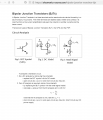
Ok quickly the idea of having a transistor with no 're' is that the only emitter resistor would be RE (RE external to the transistor). I dont think this is a too important though in the context of this discussion as this idea will come out from the analysis to eventually follow.

I believe we should start from the very beginning and so first i have to ask a question to make sure we all agree on the basics. I found this drawing and procedure on the web and i believe that is the way i found many years ago, and i believe this is the way most people start a design using this model. I did find some variations on the web though as some sites call this the "T" model transistor model.

Note the first step is finding the DC bias point, the second step is calculating 're'.
Referring to the drawing, do you agree that the these steps shown are correct?
 

Attachments

WBahn

Joined Mar 31, 2012
32,829
Hello again,

(Refer to the drawing for what is referred to as 're')
Ok quickly the idea of having a transistor with no 're' is that the only emitter resistor would be RE (RE external to the transistor). I dont think this is a too important though in the context of this discussion as this idea will come out from the analysis to eventually follow.

I believe we should start from the very beginning and so first i have to ask a question to make sure we all agree on the basics. I found this drawing and procedure on the web and i believe that is the way i found many years ago, and i believe this is the way most people start a design using this model. I did find some variations on the web though as some sites call this the "T" model transistor model.

Note the first step is finding the DC bias point, the second step is calculating 're'.
Referring to the drawing, do you agree that the these steps shown are correct?
They are reasonable to an extent. They suffer from the very big problem that they assume that you know what beta is, or at least that it is constrained to be within a pretty narrow margin. But with most small-signal transistors, the uncertainty in beta covers a range of a factor of five to ten, making the biasing selections difficult.

That paper uses one of four common large-signal models. Two are T-shaped topologies and two are pi-shaped topologies. In each topology, one is a current-driven model and the other is a voltage-driven model. They are all equivalent, but computationally they are not (meaning you do different computations but end up with the same end results). Which one is "best" depends on what you know and what you don't and how the transistor interacts with the circuitry around. One big problem with using either of the current-driven models is that you don't know beta very well, so it is usually better to use the voltage driven models when possible.

For small-signal models you have the same four options as far as models go. There is no requirement to use the same model for large signal as for small signal. In fact, that paper uses a current controlled pi model for large signal and a T-model for small signal. The hybrid-pi model is by far the more commonly used model, especially for some circuit topologies, because it can often neatly separate the input side of the circuit from the output side of the circuit with a very simple interaction between them. This is usually not the case with the T-model.

But in the cases of all of the models, the origin of all of the small-signal parameters is the application of superposition:

Define the following relations
i_C(t) = f(v_BE(t)) <<== Total response to total input
I_C(t) = f(V_BE(t)) <<== Large-signal response to large-signal input (almost always DC)
i_c(t) = f(v_be(t)) <<== Small-signal response to small-signal input

Then we HOPE to have the following:
v_BE(t) = V_BE(t) + v_be(t)
i_C(t) = f(V_BE(t) + v_be(t))
i_C(t) = f(V_BE(t)) + f(v_be(t)) <== This step uses superposition and therefore requires the circuit to behave linearly.
i_C(t) = I_C(t) + i_c(t)

The problem is that this DOES NOT WORK because f(v_be) is highly nonlinear. If you attempt to use the same model for both, you will get wrong results because the overall circuit behavior is highly non-linear and superposition is only valid for linear models.

The solution is use a DIFFERENT model of the transistor for the small-signal case than is used for the large-signal case.

I_C(t) = f(V_BE(t)) <<== Large-signal response to large-signal input (almost always DC) using a LARGE-SIGNAL model
i_c(t) = g(v_be(t)) <<== Small-signal response to small-signal input using a SMALL-SIGNAL model

Now we have
i_C(t) = f(V_BE(t)) + g(v_be(t)) <== This step uses superposition and therefore requires the circuit to behave linearly in the vicinity of f(V_BE(t)).
i_C(t) = I_C(t) + i_c(t)

Well, f(V_BE(t)) is whatever model adequately describes the relationship between i_C(t) and v_BE(t) for the entire region of interest (usually just the active region, as we generally want to avoid cutoff and saturation (but not always)). In other words, it simply the same model as would be used for f(v_BE(t)).

The Ebers-Moll model, either the basic model or one of the variants that incorporate other effects, such as the Early effect and high-frequency parasitics, are the usual choice.

But how due we get g(v_be)?

That comes down to calculus.

Given any continuous function, y(x), we can approximate y(x) in the vicinity of X_o using The first two terms of a Taylor series expansion:

\(
y \left( x \right) \; \approx \; y \left( X_0 \right) + y'(X_0) \left( x \; - \; X_0 \right)
\)

In case, y(x) is f(v_BE) which relates a current (the collector current) to a voltage (the base-emitter voltage).

X_o is the bias point, V_BE, and (x - X_o) is (v_BE - V_BE), which is simply v_be per our definition above.

Hence

\(
y \left( v_{BE} \right) \; \approx \; f \left( V_{BE} \right) + f'(V_{BE}) v_{be}
\)

Note that f'(v) is the rate of change of a current with respect to a voltage, hence it will have units of current per voltage. These happen to be the same units as conductance, and hence the reciprocal has units of resistance. However, in both cases it is NOT a conductance nor a resistance, which relates the voltage across a device to the current through that device, but rather a transconductance or a transresistance because it relates the current at one port (the collector) to the voltage across a different port (the base-emitter). Hence, just like a voltage-controlled current source in a DC circuit analysis problem, it is NOT a physical resistor.

So we define the small-signal transconductance, g_m, as

\(
g_m \; \equiv \; \left. \frac{ di_C \left( v_{BE} \right) ) }{ dv_{BE} } \right|_{V_{BE}}
\)

This means our g() function is

\(
g \left( v_{be} \right) \; = \; g_m \cdot v_{be}
\)

So what is gm for the basic Ebers-Moll model for a BJT transistor?

\(
i_C \; = \; I_S \left( e^{\frac{v_{BE}}{V_T}} \; - \; 1 \right) \; \approx \; I_S e^{\frac{v_{BE}}{V_T}} \\

g_m \; = \; \left. \frac{ di_C \left( v_{BE} \right) ) }{ dv_{BE} } \right|_{V_{BE}} \\

g_m \; = \; \left. \frac{d}{dv_{BE}} I_S e^{\frac{v_{BE}}{V_T}} \right|_{V_{BE}} \\

g_m \; = \; \left. \frac{ I_S e^{\frac{v_{BE}}{V_T}}}{V_T} \right|_{V_{BE}} \\

g_m \; = \; \frac{ I_S e^{\frac{V_{BE}}{V_T}}}{V_T} \\

g_m \; = \; \frac{ I_C }{V_T}
\)

Do you NOW see that THIS is how gm came to be associated with Ic/VT? That is was NOT defined as I_C/VT and then somehow, miraculously, we discovered that it was useful for small-signal analysis? It evolved directly from the very concept of crafting a linear small-signal model of the transistor's response in the vicinity of a large-signal bias point.

Furthermore, it ONLY has meaning within the small-signal portion of the response. It has NO meaning in the DC response. The DC current does NOT flow through re (which comes directly from backing out the T-model circuit equivalent using the small signal model relation above).

The DC response is ENTIRELY determined by the Ebers-Moll model (or whatever model is used) with NO NEED for ANY use of ANY of the parameters or results from g(v_be).


Also, do you see that re is NOT 1/gm?

It's close. Close enough that we often use it as an approximation. But can you see what it needs to be in order to make the T-model consistent with the mathematics of the small-signal model?

Now, if you want to expand the response so that it remains sufficiently valid for larger values of v_be, then the place to start is to add a quadratic term to the Taylor series expansion. But doing so would almost always (notice I am not saying always) be counterproductive, because the entire reason for using gm is because we either want a response that is very close to being linear or because we want to leverage the powerful tools we have at our disposal for designing and analyzing linear systems (and often both). If we don't want either of those, then there would seldom be a reason not to simply use the full model.
 
Last edited:

LvW

Joined Jun 13, 2013
2,027
Note the first step is finding the DC bias point, the second step is calculating 're'.
Referring to the drawing, do you agree that the these steps shown are correct?
Hi MrAl ,
may I ask you : What is your intention?
Do you want to discuss the validity of a small-signal model for the BJT which does exist since a long time and can be found in many textbooks?
Are you aware that - from ther drawing - we have:
vbe=(1+β)ib*re=ib*rbe and therefore
re=rbe/(1+β)=1/gm,e .
(1/gm,e=VT/Ie).
So, of course, the transconductance is indirectly a part of the model (which - as I have explained repeatedly - I do not like at all***).
But this is my personal view only. More than that, I never make use of such models. Circit diagrams are sufficient.

*** Looking at the small signal T-model one could have the impression that the small-signal input resistance rbe(=hie) at the base (against the emitter node) would be re. But this is not the case - in fact it is rbe=(1+β)re.
More than that, some unexperienced people could think (and in fact, I have observed this many times) that the quantity re would belong to the emitter - a totally false view how the transistor works.
 
Last edited:

MrAl

Joined Jun 17, 2014
13,704
Hi MrAl ,
may I ask you : What is your intention?
Do you want to discuss the validity of a small-signal model for the BJT which does exist since a long time and can be found in many textbooks?
Are you aware that - from ther drawing - we have:
vbe=(1+β)ib*re=ib*rbe and therefore
re=rbe/(1+β)=1/gm,e .
(1/gm,e=VT/Ie).
So, of course, the transconductance is indirectly a part of the model (which - as I have explained repeatedly - I do not like at all***).
But this is my personal view only. More than that, I never make use of such models. Circit diagrams are sufficient.

*** Looking at the small signal T-model one could have the impression that the small-signal input resistance rbe(=hie) at the base (against the emitter node) would be re. But this is not the case - in fact it is rbe=(1+β)re.
More than that, some unexperienced people could think (and in fact, I have observed this many times) that the quantity re would belong to the emitter - a totally false view how the transistor works.

Hello again,

I just ask that you stop going off on tangents. I asked a simple question, yes or no.
If you can not answer that there is no point in going any farther, that's why i asked. If you reject even that which has already been written in textbooks and apparently accepted main stream then i dont know what else to tell you.
If you cant answer yes or no without a huge discussion, then i have to take that as a 'no'.
As far as a know this model and technique have been around for years so if you dont accept that then you will have to just ignore this thread. I cant do anything about that sorry.
 
Top