impedance matching and mic electret

Status
Not open for further replies.

Thread Starter

lara3m

Joined Jan 15, 2015
9
Hi,

I am working in a project, where i have a Microphone Electret with a impedance at the output of 2,2kohm. and a impedance matching (FET) where i am using Mosftet VQ1000J.

My target is to see at the output of the Transistor a sinusoidal signal from the microphone.
When i tried the circuit just the impedance matching with a signal generator at the input using
frequency 1khz, offset 1 volt and a peak to peak voltage amplitud 2 Volts. i got the signal i am looking for BUT when i connected directly to the microphone i dont get any signal at all.

I already tried the microphone alone and it works well.

I dont have to much knowledge about transistors and with audio circuits.
I know there are many things i am missing to make the connection between the microphone and the impedance matching work but i dont know which one should i look.

I dont know if the impedance from the microphone could be a reason why it doenst work.

any idea, i will be really grateful

thanks in advance

Larissa


Alec_t

Joined Sep 17, 2013
15,101
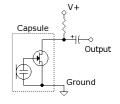
An electret microphone has a built-in FET for impedance-matching. I doubt you'll get as much as 100mV out (at least, not with voice input).
 

Thread Starter

lara3m

Joined Jan 15, 2015
9
Hi Thank you for sharing.

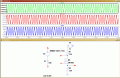
I was originally using a Jfet in the Simulation at it looks very well the signal but then now i am using a mosfet and the signal at the outpul is different. (cutted)
 

Attachments

Thread Starter

lara3m

Joined Jan 15, 2015
9
hi,
As we have said the electret mike module has already got an internal FET.?

Are you trying to model the electret or a following amplifier
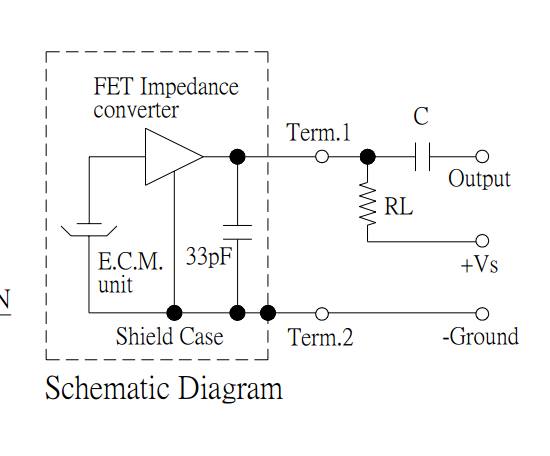
As far i saw in the datasheet from the microphone i am using, i understand that doesnt have it but i dont know if when it mean "FET Impedance converter" it refer to a internal transistor.
sorry is the first i am dealing with this kind of components. :/

I am trying to connect this schematic to a transistor (impedance matching)


ericgibbs

Joined Jan 29, 2010
21,390
hi lara,
If you could post the datasheet for the device that would help.
If the image you have posted is from the d/s, then it does have an inbuilt FET converter.

E
 

Thread Starter

lara3m

Joined Jan 15, 2015
9
Dont worry. :)
so the Zout is because the fet impedance convertor.

The output of the circuit of the mic i need to connected to the input of a impedance matching in german "impedanzwandler".
The Vo+ from the mic goes to the drain and the Vo- from the mic goes to the gate.

when i connected i am not able to see any signal in the output of the fet Vds.

i dont know which criteria should i take to match both circuits
 

ericgibbs

Joined Jan 29, 2010
21,390
This is the LTS sim I get when I use a 2N2002 in your asc file,which is similar to VQ1000.
The overall gain is low due to the relative values of the Source and Drain resistor values, you could try a capacitor bypass on the Source resistor.
 

Attachments

MikeML

Joined Oct 2, 2009
5,444
You do not need to worry about "impedance matching". By the time you add the 2.2k bias resistor, and the 2V bias source externally, the output impedance of the electret is fairly low, so it will drive the input impedance of almost any following voltage amplifier. You will have to capacitively-couple the signal to the following amplifier, however.
 

AnalogKid

Joined Aug 1, 2013
12,043
In the original schematic, there is no ground connection to the microphone element. Also, J1 drain should be connected directly to the +5 supply.

ak
 

#12

Joined Nov 30, 2010
18,224
I was originally using a Jfet. now i am using a mosfet and the signal at the outpul is different. (cutted)
So don't use a mosfet. A mosfet is not in its proper operating range with only 5 volts (total) to work with. But that does not seem as important as the fact that you do not need to "impedance match" a microphone that already has an amplifier in it.
 

Thread Starter

lara3m

Joined Jan 15, 2015
9
So don't use a mosfet. A mosfet is not in its proper operating range with only 5 volts (total) to work with. But that does not seem as important as the fact that you do not need to "impedance match" a microphone that already has an amplifier in it.
I am learning about this topic.
I am doing a projekt of a professor and he give the draw of a schematic ask me to use the microphone plus the "impedance matching" to measure frequencies between 20hz to 1 khz.

that is all.. :/ i really dont understand why he ask me to use the impedance matching even when is a already amplified, i guess is because the signal is really small to analyze.
 

MikeML

Joined Oct 2, 2009
5,444
Two completely different things: Impedance matching and frequency response.

The intrinsic frequency response of some microphones (like variable-reluctance dynamic) is effected by what load resistance is connected to them (effects damping). That does not apply to amplified electret mics
 
Status
Not open for further replies.
Top