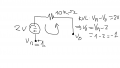
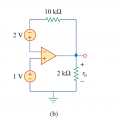
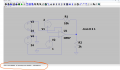
The 2 kΩ resistor at the output is not relevant.
The 10 kΩ from the output to the inverting input provides negative feedback. The value of the resistor is irrelevant.
The op amp will reach one of three states, the output will reach one of the supply voltages, positive or negative supply rail (op amp is saturated), or the voltage at the inverting input must be the same as the voltage of the non-inverting input.
What must the output voltage be for the two inputs to be at the same voltage?
Are you familiar that in an ideal opamp, the voltage difference between the inverting and non inverting inputs MUST BE zero when the opamp is operating linearly?
As such, what output voltage would satisfy this requirement?
Exactly! Vo = -1
Are you familiar that in an ideal opamp, the voltage difference between the inverting and non inverting inputs MUST BE zero when the opamp is operating linearly?
As such, what output voltage would satisfy this requirement?
Exactly! Vo = -1
I dont understand, op amp senses the difference between 2 input voltages and multiply with gain then have voltage output? right? how can it be -1 this case? Can you explain shortly and direct to the point with equations
An ideal op amp has a voltage gain equal to infinity.
Hence any voltage difference between the inverting input and the non-inverting input would result in infinite output voltage, only limited by the power supply voltage.
The analysis should be obvious. Apply Kirchhoff Voltage Law to the negative feedback loop. We cannot do all the thinking for you.
I dont understand, op amp senses the difference between 2 input voltages and multiply with gain then have voltage output? right? how can it be -1 this case? Can you explain shortly and direct to the point with equations
Are you familiar that in an ideal opamp, the voltage difference between the inverting and non inverting inputs MUST BE zero when the opamp is operating linearly?
As such, what output voltage would satisfy this requirement?
Exactly! Vo = -1
Can you read #8 from Mr @WBahn again, I follow his equation, Vo= K(Vp-Vn), Vp is voltage at non inverting terminal = 1, Vn is voltage at inverting terminal = 2. oh, you mean Vn here not 2V, I thought 2 VDC connect to inverting terminal then it is 2V.
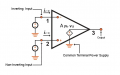
How about this pic, this pic shows V2 and V1 means they are different, then take V2-V1 and multiply with A gain then have Output voltage., compared to the problem , V2 = 1, V1 = 2, then V2-V1 = -1, is somewhere wrong??
and in the problem is the same, right? Why Cannot apply the definition of Op amp like the picture I just added? is something different between the problem and the Definition circuit in the picture I just added?

 Facebook
 Google
 GitHub
 Linkedin

 496.9 KB Views: 7