Low voltage, ultra-low frequency ideal rectifier

Thread Starter

JPR16

Joined Dec 8, 2025
12
A bicycle front wheel hub dynamo generates about 6V / 500mA AC, at a frequency between 2-8Hz.
To charge appliances (GPS, phone) through USB, 5V DC is needed.
I have a buck-boost converter with a high efficiency and am looking for an “ideal” rectifier.
4 regular diodes produce a voltage loss of about 1.5V, which is 25% of the input. This is not acceptable. Replacing them with Shottky diodes cuts the losses in half, which is much better, but still a big loss.

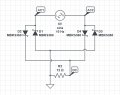
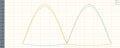
With CircuitLab I simulated a “standard” 4 diodes rectifier which gave me the expected result. With Shottkys also.
View attachment 360566
View attachment 360568


Replacing the diodes with MosFets seems the way to go, but so far I’m struggling to find the right way to do it.

Using the Analog Devices’ LT4320 is unfortunately not possible, since it only works from 9V up.

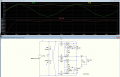
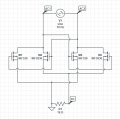
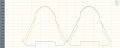
Then I tried a design using 2 P-type and 2 N-type MosFets with the gates attached to the opposite AC-inputs. I got a reasonable simulation result. But I am aware of the problem of the slow rising (and falling) of the gate voltage, which can be seen in the picture..

(I found the article of Jürgen Heidbreder and Benno Kröck on the German site https://fahrradzukunft.de/14/mosfet-gleichrichter)

View attachment 360567
View attachment 360569


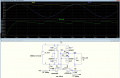
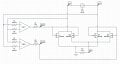
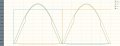
To overcome the slow rising (or falling) Ug, I added 2 comparators. A similar, but slightly better result!
View attachment 360570View attachment 360571

I can understand the late rising of the output in the the “german” circuit, but do not understand the rising delay in the circuit with the comparators!
Knowing that the transmitted energy is the surface under the graph, I’d like to find a way to get rid of the uneven rise/fall and find the same smooth curve of the diodes, but up to the full high.

Thanks for any help!
 

crutschow

Joined Mar 14, 2008
38,400
That seems like a very low frequency that would cause very noticeable flicker in the headlights.
Are you sure it's that low, and not 20-80Hz?
(Could not read your attachments, as they all gave an error).

Below are two MOSFET ideal rectifier bridge circuits operating at 20Hz:
The first uses BJTs to control the P-MOSFETs' gate voltages, and the second uses comparators.
The voltage drop between the peak of the generator voltage and the MOSFET output is just due to the on-resistance of the MOSFETs times the load current.
Note the large 10mF capacitor needed for ripple reduction.
The MOSFETs must be logic-level types with a max Vgs(th) of <2V.

1765814801601.png

1765815364762.png
 

BobTPH

Joined Jun 5, 2013
11,482
I calculate that a 27’ bicycle wheel rotates at at 1.9Hz ai 10 MPH.

Assuming more than 1 pole for the alternator, 2-8 Hz sounds like a reasonable range. 20-80 does not.
 

Thread Starter

JPR16

Joined Dec 8, 2025
12
Thank you for your fast replies!
For the frequency: you're right, I didn't count the fact that there are 6 pole pairs in the dynamo, so the frequency is 6 times the rotation frequency, which makes 2-8 times 6 = 12-48Hz! But I don't think that this actually makes any difference for my problem, the most efficient rectifier!
You could not open the attached files? Ok, I try again...

rectifier with schottky diodes
schematics rectifier with Schottky diodes.jpg

simulation rectifier with Schottky diodes.jpg

rectifier with MosFets
schematics rectifier with MosFets.jpg

simulation rectifier with MosFets.jpg

rectifier with MosFets and comparators
schematics rectifier with MosFets and comparators.jpg

simulation rectifier with MosFets and comparators.jpg
 
Last edited by a moderator:

MisterBill2

Joined Jan 23, 2018
27,311
I have never seen a direct wheel drive bicycle generator. Are they something new?? Or is this an invention?? I certainly WOULD NOT want one on my bike.
All of the dynamos that I have seen are friction drive off the the tire. AND they put out enough voltage to burn out a 6 volt bike headlight bulb, if you go very fast.
 

crutschow

Joined Mar 14, 2008
38,400
do not understand the rising delay in the circuit
The is not a "delay" as such, it's just the Vth voltage of the MOSFETS (about 3V for the ones you are using).
Below that voltage you are seeing the conduction of the MOSFET body diodes.

You show no filter on the output of your rectifiers.
Do you plan on feeding the unfiltered rectified output to your buck-boost regulator?
 
Last edited:

Thread Starter

JPR16

Joined Dec 8, 2025
12
I have never seen a direct wheel drive bicycle generator. Are they something new?? Or is this an invention?? I certainly WOULD NOT want one on my bike.
All of the dynamos that I have seen are friction drive off the the tire. AND they put out enough voltage to burn out a 6 volt bike headlight bulb, if you go very fast.
Hi Bill,
No, this is nothing new. Check out SON, the undisputed leader of this market https://nabendynamo.de/en/tech/son-28-vs-sondelux/.
It addresses different communities of bike riders;
1. the commuters who need something reliable to ride to work every morning and don't want to take the risk of forgetting recharging the batteries of a battery driven light.
2. the long distance riders who need a system that holds more than one night (what batteries or power banks don't), are reliable and don't use too much energy.
I'm definitively of the second type. My SON dynamo uses (slows me down) a bare 5W to produce 3W of electricity, which is enough to drive a high tech AC lamp which delivers over 100 Lux, meaning almost as bright as a motor bike lamp! When off, the dynamo consumes only 1W, which is negligible.
As for the much cheaper friction dynamos, they only work on big, sturdy tires (which my racing bike doesn't have), are much less reliable and have, compared to the hub dynamos, a very bad efficiency.
 

Ian0

Joined Aug 7, 2020
13,112
A couple of things to think about: Does the extra circuitry required to avoid voltage drop actually consume more power that is lost due to the extra voltage drop?
if Schottky diodes don’t do the job, have you considered germanium?
A bit of a long-shot: have a look at bridge-less PFC circuits.
The trouble with a simple rectifier is that it takes high pulse currents, and the losses are proportional to the peak current.
Is it a single phase or three phase alternator?
 

Thread Starter

JPR16

Joined Dec 8, 2025
12
The is not a "delay" as such, it's just the Vth voltage of the MOSFETS (about 3V for the ones you are using).
Below that voltage you are seeing the conduction of the MOSFET body diodes.

You show no filter on the output of your rectifiers.
Do you plan on feeding the unfiltered rectified output to your buck-boost regulator?
Thanks!
As said, I understand that "delay" of the rising, which is due to the Vg not being at Vth yet in the "MosFet only" configuration.
But why is something similar happening using the comparators? They provide a very clear gate signal, right from the zero-crossing.
Yes, I plan on putting a good capacitor at the output, but here I'm just concerned about the rectifier itself.
 

Thread Starter

JPR16

Joined Dec 8, 2025
12
A couple of things to think about: Does the extra circuitry required to avoid voltage drop actually consume more power that is lost due to the extra voltage drop?
if Schottky diodes don’t do the job, have you considered germanium?
A bit of a long-shot: have a look at bridge-less PFC circuits.
The trouble with a simple rectifier is that it takes high pulse currents, and the losses are proportional to the peak current.
Is it a single phase or three phase alternator?
Hi Jan,
There are two levels, the theoretical and the practical.
on the theoretical level, it really annoys me very much that a simple rectifier would eat up 25% of the energy it is supposed to rectify! Knowing that MosFets have a Rds close to zero makes me clearly wanting to use them instead.
On the practical level I don't want anything too complex, since it has to fit into a tight space, must be very reliable and, as you said, should not use extra energy to make the rectification efficient! So, in this view, 4 Schottkys seems the way to go.
 

Ian0

Joined Aug 7, 2020
13,112
A Schottky will lose about 2x 0.2V from a 6V supply. By my calculations that’s 6.6%.
How about a voltage doubler supply? That would give you 12V with only two diode drops at the expense of greater ripple.
12V to 5V could be done with a simple buck regulator, instead of a buck-boost.
 

Thread Starter

JPR16

Joined Dec 8, 2025
12
That seems like a very low frequency that would cause very noticeable flicker in the headlights.
Are you sure it's that low, and not 20-80Hz?
(Could not read your attachments, as they all gave an error).

Below are two MOSFET ideal rectifier bridge circuits operating at 20Hz:
The first uses BJTs to control the P-MOSFETs' gate voltages, and the second uses comparators.
The voltage drop between the peak of the generator voltage and the MOSFET output is just due to the on-resistance of the MOSFETs times the load current.
Note the large 10mF capacitor needed for ripple reduction.
The MOSFETs must be logic-level types with a max Vgs(th) of <2V.

View attachment 360575

View attachment 360576
Hi,
Your 2 N-type Fets are fed with the opposite AC input. Therefor the Ug rises as slowly as the AC, right? So, until the Gate to source Voltage hits the Uth, the Fet is not completely open and there should be big losses during this time, no?
 

Thread Starter

JPR16

Joined Dec 8, 2025
12
A Schottky will lose about 2x 0.2V from a 6V supply. By my calculations that’s 6.6%.
How about a voltage doubler supply? That would give you 12V with only two diode drops at the expense of greater ripple.
12V to 5V could be done with a simple buck regulator, instead of a buck-boost.
Can you give me the name of a Schottky that looses only 0.2V?
the voltage doubler idea looks intriguing... I'll have to explore it!
 

Ian0

Joined Aug 7, 2020
13,112
Can you give me the name of a Schottky that looses only 0.2V?
the voltage doubler idea looks intriguing... I'll have to explore it!
From MOuser Toshiba CUHS20S30 0.25V@ 500mA
Voltage doubler is useful if your alternator has one terminal permanently attached to the chassis/frame.
 

MisterBill2

Joined Jan 23, 2018
27,311
OK, I'll bite.
Why?
Why would I not want a directly driven at wheel speed dynamo on the front wheel of my bike?? several reasons, the first being that added mass and weight will certainly impair all aspects of control, including no-hands riding. In addition, any such installation will be in the way when servicing the front wheel, including it's removal for secure locking the bike. Also, the connecting wires will certainly be flexed with every bit of steering. Since I occasionally "ride hard", I do not need that!
What sort of mechanism does such a front-wheel generator consist of??
My experience with the friction driven generator had it on the rear wheel, BTW.
 

BobTPH

Joined Jun 5, 2013
11,482
My Ebike has a 500W motor in the rear hub. The drag when running without power is pretty much negligible, it rides with effort similar to the Trek road bike I previously rode even though it is 12 lbs heavier.
 
Top