IC Sockets - when should be used ?

Thread Starter

2Hexornot2Hex

Joined Apr 16, 2020
54
Hi gurus,

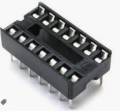
ic socket.png
You all know those guys, called 'IC Sockets' (aka 'IC holder').
I do understand that it gives you an opportunity to extract easily an IC from soldered PCB.
But, what's the rule of thumb for using those 'guys'....every IC should get its' IC socket ? or maybe only those that tend to fail ?

Please advise what are the rules of thumbs for using IC sockets ?
When/how do you actually use the sockets ? ... if at all.

In my example:
I'm working on a small project with over dozen of ICs (555's, TTL gates, en/decoders, counters...) - which ICs should 'get a seat' in an IC socket ?

Thanks.
 

dl324

Joined Mar 30, 2015
18,221
I usually use a socket for every IC. The first time you need to replace a chip, you'll be thankful.

The socket you showed is referred to as dual wipe (it contacts both sides of the pins). Other types are single wipe, machined pins, and zero insertion force (ZIF).
 

nsaspook

Joined Aug 27, 2009
16,252
I still use a socketed part or two on a board design that could be all SMD. For board designs that are likely to have large ground connection loops in a high EMI/RFI environment the serial communications/opto-isolator transceiver/opto chip are the most likely parts to get fried.


Industrial electronics systems have design lifetimes exceeding a decade so repairability is key.
 
Last edited:

dendad

Joined Feb 20, 2016
4,635
I use machine pin sockets like those above.
If a board does not need most ICs socketed, do use sockets on things like line drivers. A lot of boards I make have RS485 drivers. The boards have SMT and through hole build options. These are the one place a socket is really a good idea.
Some installations get zapped with close lightning strikes and it is a lot easier to replace a popped driver if it is in a socket.
But make the effort to use good sockets!
 

Wolframore

Joined Jan 21, 2019
2,619
I’ve just finished a design and have put in sockets to test a few different opamps. I like that the ICs never get exposed to soldering heat.
 

BillB3857

Joined Feb 28, 2009
2,573
In one of my prior lives, I repaired through hole multi layer boards. Even with proper equipment, it was a bear to pull defective ICs without damaging the board. Any IC replaced got a socket.
 

OBW0549

Joined Mar 2, 2015
3,566
Please advise what are the rules of thumbs for using IC sockets ?
I don't think there is any generally-recognized rule of thumb regarding use of IC sockets; we use them where experience, economics and whimsy tell us to.

Of the products I've designed for mass production, none have used sockets except for EPROMs containing executable code; all others are soldered to the board. Products built with surface mount devices don't use sockets.

For my hobby projects, I socket all ICs if possible because I like to re-use ICs as I go from one project to another.

Use, or don't use, sockets as you wish.
 

ElectricSpidey

Joined Dec 2, 2017
3,312
One thing to be considered when deciding to place chips in sockets, is some chips such as load drivers have their wattage/dissipation ratings based on being mounted directly to a PCB of a given size,
 

jpanhalt

Joined Jan 18, 2008
11,087
I have stopped using them, unless I know swaps will be needed. The cost of most chips I use is less then the cost of the sockets. Most microcontrollers are easily programmed in circuit. Albeit,replacing one that is soldered in place usually results in destruction of the original, at least in my practice.

Perhaps most important, fewer and fewer chips are available in DIP packages, and "sockets" (e.g., "burn-in" sockets) are quite expensive foe SMD.
 

dendad

Joined Feb 20, 2016
4,635
In one of my prior lives, I repaired through hole multi layer boards. Even with proper equipment, it was a bear to pull defective ICs without damaging the board. Any IC replaced got a socket.
I had to replace a load of ICs for a job. The boards were made and the manufacturer was supplied with a grey market part. These were 8 pin dual Op-Amps, supposedly. They were all crook.
The easiest way to replace them was to cut all the pins off with a good sharp side cutter, them remove each pin from the board on at a time.
Next, clean the solder out and install the new IC.
After doing a few hundred boards, I got pretty good at it, but a couple of times I started cutting the wrong IC off! Oops.
 

BillB3857

Joined Feb 28, 2009
2,573
Cutting off the pins and removing one at a time is exactly what we started to do after a few boards had to be repaired beyond just replacing the IC.
 

dl324

Joined Mar 30, 2015
18,221
My first technician job was troubleshooting newly assembled refrigerator sized computers to the component level. There were about a dozen boards that were probably 16"x16". Nothing was in sockets; even the 4Kx1 DRAM chips that had a high failure rate.

Some techs used the pin clipping method, but I preferred to extract them intact.

We had a good vacuum pump, so desoldering wasn't much of an issue. During our training class, the instructor would remove the solder from a pin on a chip in a working computer and challenge us to troubleshoot the problem.
 
Last edited:
Top