power sockets/ DC devices

Thread Starter

thor21

Joined Sep 29, 2024
424
Hello,
as you can see on the photo - the main power socket for the AVR/streaming looks crazy in the room so i was thinking to Unify it somehow...

1) from the pantry/chamber where i have routers/NAS etc... source 2 separate circuits one for 5V other for 12V into the living room

the distance is around 10m from the panty to living room, so i believe i can calculate cable diameter easily and also add 50% capacity in case new devices will be added later on.

- attach to these circuits all 5/12V devices

2) 230V devices
install into the wall for each device separate wall socket


Is it something which makes a sense from the design point of view?

Thanks
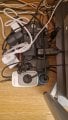
20250831_205432.jpg
 
Last edited:

panic mode

Joined Oct 10, 2011
4,864
what is your question? i look at the photo and read your statement and have no idea what is that you want to accomplish? have a larger power-bar with more outlets?

if you are interfacing circuits that are not powered from the same source, you need to know if they are isolated or not. if they are not isolated, direct connection can be destructive. that is why interfacing to other circuits typically involves isolation circuits/barriers such as optocouplers, signal transformers, capacitive coupling, radio, IR or whatever...

so what is that you are trying to do?
 

Thread Starter

thor21

Joined Sep 29, 2024
424
hello @panic mode
the thing is thaht power-bar is in the middle of the wall close to the audio/HT rack. IT doesnt looks good, even i install wall power sockets it will be visible ie like many power sockets in the wall and also i wont like it.

So i am thinking how to "hide it" or how to centralize power source AC or DC for all these devices in the rack.

if you are interfacing circuits that are not powered from the same source, you need to know if they are isolated or not.
I am not sure if i do understand that - what does it mean interfacing circuits?

The are random devices - each comes with its own adaptor ... 5/12/V etc.

The other solution on my mind - move whole power-bar to separate room, and make for each device separate line (DC) ... the problem might be distance as its around 10m, so maybe if i choose properly 2line cable for each device - it might work?


Thanks
 

panic mode

Joined Oct 10, 2011
4,864
ok so this is really only esthetic thing, has nothing to do with running signals between devices that have separate supplies (post #2).

at work i run bunch of little loads also each with own supply so i used powerbar that allows me to easily plug anything. but in my case i needed access so i can frequently swap out some of the devices. you want to keep connections permanent and hide them.

you can use small cabinet, could be recessed into the wall (easy or hard depending on building construction).

running long wires means one need to be cautious about voltage drop. the lower the voltage and higher the current, this becomes more of an issue.
 

Sensacell

Joined Jun 19, 2012
3,767
I would caution that this idea can be more trouble than you might imagine.
Some loads are noisy, some loads pull large inrush currents when starting.

Combining them can work, but there are gotcha's lurking that make the exercise a frustrating waste of time.
 

boostbuck

Joined Oct 5, 2017
1,032
.....source 2 separate circuits one for 5V other for 12V into the living room
Running a common 12V and common 5V to a number of devices - personally I expect it would work, although maybe put diode blocking after the split to guard against backfeed so make your source slightly high to compensate for diode drop.

However each of the wall-warts is an isolated supply so you would be wise to check the negative is a common ground on all receiving units that are connected by signal path.

Something of an experiment for you, with likely, but not certain, success.
 

Thread Starter

thor21

Joined Sep 29, 2024
424
Got lost as usual.

Its purely esthetic thing. It cant be recessed as the wall is thin 15cm only and it's neighbours wall, unfortunately even other are thick.

Okay isnt it the easiest to move all adaptors far away into separate room... And run for each device separare DC line. I think it can be calculated how thick the wire should be - to prevent any voltage drop.
Or even this is the wrong solution?
 

MisterBill2

Joined Jan 23, 2018
27,159
I see a serious problem with the concept of multiple devices sharing a single DC supply. The problems are multiple, and the first issue is polarity: There does not appear to be any rule as to which part of the circular power connector is positive:Often the center is positive, except for Sony devices and some TV cameras that make the center negative and the sleeve positive. Also at least one keyboard instrument. MOST of the devices have no protection against reversed polarity. So the wrong wall-wart destroys a $275 camera instantly. And the keyboard wall wart burns out my radio when the wife does not understand that they are not all the same.
The second problem is that some devices use the negative as the common and others use the positive as the NON-ISOLATED common. So the devices spark when connected. Or smoke and fail.
What could work to hide the nest of wires and modules is something similar to the wire duct (wireway) used in electrical control panels. That is available in white, more often in gray, and it usually has a snap-on cover. Available from AUTOMATION DIRECT, and other suppliers. This is not an ad for the company, but it is an honest organization: What you pay for is what you get. No surprises
 

Thread Starter

thor21

Joined Sep 29, 2024
424
If you run separate wires of sufficient cross-section it will work for sure. Probably the simplest for you.
Sounds reasonable to me also.
7 devices around 100m of cable in total.

Do you use that calc?
https://www.calculator.net/voltage-drop-calculator.html?utm_source=chatgpt.com

Also should i do calculation with max 1% voltage drop?

Anyone can suggest some connectors (in wall) so i can then from the wall connector plug each device with short cable...


Thanks!
 

boostbuck

Joined Oct 5, 2017
1,032
Personally , having started in NZ, I have always sized using Gencalc from General Cable.

I suggest ordinary barrel connectors for extra-low voltage DC. There are locking versions avaliable if needed.
 

MisterBill2

Joined Jan 23, 2018
27,159
I suggest caution! Consider that there are quite a few different sizes of the barrel connectors , as well as he two different polarities for connection,it is likely to lead to confusion and unfortunate results, because most low voltage powered devices lack reverse polarity protection.
 
Top