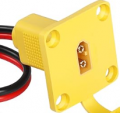
Why not use RC connectors, and run 12g cable to each, the recessed wall mount socket is fairly small. Run from a single voltage source of sufficient capacity.
Why not use RC connectors, and run 12g cable to each, the recessed wall mount socket is fairly small. Run from a single voltage source of sufficient capacity.
My point is that the connections to each of the appliances will probably be unique.
Of course, this is based on my guess that the plan would be to use a single supply with multiple tap points on a common power cable. One alternative concept would be a section of commercially available outlet strip along that wall. The plug strip is available with single outlets every few inches , and it used to be available in four and eight foot lengths. If the installation is in a rented location, it would make much more sense, since it could be removed easily, leaving only small easily patched mounting screw holes. You would probably choose to greatly shorten the cords of some of those little power modules, though.
To figure the probable voltage drop you will need to look at the listed current for each device being powered. That is a lot easier than actually measuring the required current, and close enough to reality to be adequate for determining the wire size.
For any of the devices that also can operate from batteries, consider that the battery voltage that provides correct operation drops a fair amount while the device is still working acceptably. So for many things the tolerance is a bit wider.
To figure the probable voltage drop you will need to look at the listed current for each device being powered. That is a lot easier than actually measuring the required current, and close enough to reality to be adequate for determining the wire size.
Most devices will continue to perform satisfactorily with a 5% voltage drop.
In post #28, I pointed out:
For any of the devices that also can operate from batteries, consider that the battery voltage that provides correct operation drops a fair amount while the device is still working acceptably. So for many things the tolerance is a bit wider. (post #28).
For low power wiring, often mechanical durability determines the wire size much more than the voltage drop. For the wires connecting each device to your DC distribution buss, I suggest no thinner than #22 wires.
That #12 wire suggested in an earlier post is rated for a continuous current of 20 amps. That is quite a lot!!!
Most devices will continue to perform satisfactorily with a 5% voltage drop.
In post #28, I pointed out:
For any of the devices that also can operate from batteries, consider that the battery voltage that provides correct operation drops a fair amount while the device is still working acceptably. So for many things the tolerance is a bit wider. (post #28).
For low power wiring, often mechanical durability determines the wire size much more than the voltage drop. For the wires connecting each device to your DC distribution buss, I suggest no thinner than #22 wires.
That #12 wire suggested in an earlier post is rated for a continuous current of 20 amps. That is quite a lot!!!
@MisterBill2
this is related to devices with adaptor/PSU, not for battery powered devices.
what does it mean no thinner than #22 wires? awg 22?
regarding the awg 12 wire... thats what i got from the calculator?
if oyu are saying its a lot - than calculator is wrong or i dont know how to use it properly...
OK, I see that calculator is a bit different. My comment is based on the National Electrical code, which is concerned with heating and temperature rise in the wiring. AND yes, #12 means 12 AWG 12 gage wire.
I looked at the photo of that nest of cords and supplies and the total current for all of those loads did not seem to be very much. Of course that was a guess. I see in your post 5 volts and 4 amps. What device is drawing that much current?? Are ALL of those supplies providing 5 volts?? Usually that is not the case.
In the picture I see six power modules, with only one of them looking very substantial, like for a laptop computer.
Re-visiting post #14, and the statement "that there is no room", if the existing rack is at all similar to most audio system racks, there can be a few inches of added height tolerated. So an enclosure beneath the existing rack, with some ventilation, and a totally different mains distribution scheme, might work out very well. The first benefit would be not needing to revise any DC power connections, the second benefit would be reducing the size of the assembled group of modules. AND not having to consider any voltage drops. The hard part will be shortening the mains supply cords of the modules that do not directly plug in to an outlet.
Yes, if the signal (audio, video) common isn't connected directly to the power negative in each device, you could have a ground loop. Some things might choose to make signal common half-way between +12 and 0 volts, or keep and power and signal grounds separate for other reasons.
Even if signal and power commons are tied internally, if one device draws power in pulses of current and the power cable isn't thick enough, that could induce noise in other devices. But that's mainly a risk with low-level analog signals.
Yes, if the signal (audio, video) common isn't connected directly to the power negative in each device, you could have a ground loop. Some things might choose to make signal common half-way between +12 and 0 volts, or keep and power and signal grounds separate for other reasons.
Even if signal and power commons are tied internally, if one device draws power in pulses of current and the power cable isn't thick enough, that could induce noise in other devices. But that's mainly a risk with low-level analog signals.
BBD, in post#35, is totally correct! To expand on the one portion: Not all equipment uses the power supply negative point as the common for external signal and control connections. That can possibly lead to nasty shorted circuits, damage, and destruction. Sometimes luck prevails and it all works out. But not in every instance. So there is certainly a benefit provided by using separate isolated power supplies. MOST of the time.
If the "system rack" is a furniture-type rack, possibly with castors and a glass front door, and an open back, and about 22 inches wide, then building a base that can hold all of those supplies will be the better choice. BUT it may certainly be that a physically smaller device would be an improvement . It may also be that the TS is not in a position to produce even a very simple structure.
@MisterBill2 i would prefer not to go with any rack, etc... and if possible just to run cables as was mentioned above... if there is no issue with that.
How are the various devices arranged presently??? On a shelf, on a table, or in a stack?? Or some other scheme. Or just next to each other on the floor??

 Facebook
 Google
 GitHub
 Linkedin