I need a design challange.

Ya’akov

Joined Jan 27, 2019
10,235
But over half of them now are just silence.
This happens when a call center is using predictive dialing. In that case a computer is using statistical analysis of call times to decide when to get a new "customer" on the line to coincide with a "customer service representative" being available. The calls are routed to the next available CSR by the system.

This can work very well but often results in a short (1 or 2 second) gap between when the customer answers and when the CSR is connected to the call. This is why you will often get something like "can you hear me now" or equivalent from the CSR—they act as if they were there all along but you couldn't hear them, they weren't.

In a dysfunctional case, using PD could result in a call that when answered can't be routed because no CSR is available. I have found that these systems will time out and hang up after 11 seconds. It may be they are all using the same open source dialer package with something like Asterisk.
 

MrAl

Joined Jun 17, 2014
13,702
Possibly that three-tone sequence used by the phone companies when one reaches an unassigned number would be a good starting response. It might result in no more calls if the calling computer recognized what it meant.
I have discovered that responding to the greeting some of them by reciting a string of numbers does give results in that they disconnect. But over half of them now are just silence.

In response to those wanting to sell medicare, I always was telling them that as I was only 42 years old, I did not qualify. That stopped them every time..
The ultimate fix will be for the ISP that receives the VOIP call to attach the sender's internet address to the caller ID string. Then it would be simple to reject calls based on address of origination. It would also require permanent banning of internet access providers that allowed spoofing of addresses.
Isn't that all after the fact though or is this a different design challenge?
With the fake call detection we would want to detect a fake call before plugging them with the three-tone dead end signal.
 

MisterBill2

Joined Jan 23, 2018
27,508
This happens when a call center is using predictive dialing. In that case a computer is using statistical analysis of call times to decide when to get a new "customer" on the line to coincide with a "customer service representative" being available. The calls are routed to the next available CSR by the system.

This can work very well but often results in a short (1 or 2 second) gap between when the customer answers and when the CSR is connected to the call. This is why you will often get something like "can you hear me now" or equivalent from the CSR—they act as if they were there all along but you couldn't hear them, they weren't.

In a dysfunctional case, using PD could result in a call that when answered can't be routed because no CSR is available. I have found that these systems will time out and hang up after 11 seconds. It may be they are all using the same open source dialer package with something like Asterisk.
There may be much more to that "can you hear me now?" question. One fraud scheme involves getting a victim to say "Yes" , and then patching that in behind some sales question. That is why I always try to answer that question with "No, I can not hear you at all.." That is an answer that is not useful, in addition it shows that I don't take the caller seriously.
What might be interesting is a scheme using IA and a computer to engage the actual human in a conversation and waste enough of their time to do some economic damage to the caller's operation.
 

Ya’akov

Joined Jan 27, 2019
10,235
There may be much more to that "can you hear me now?" question. One fraud scheme involves getting a victim to say "Yes" , and then patching that in behind some sales question. That is why I always try to answer that question with "No, I can not hear you at all.." That is an answer that is not useful, in addition it shows that I don't take the caller seriously.
What might be interesting is a scheme using IA and a computer to engage the actual human in a conversation and waste enough of their time to do some economic damage to the caller's operation.
Though I have heard about the "saying yes" thing, it seems to be an urban myth. Other than assertions and "warnings" I've seen no evidence for it.

I know for sure the predictive dialer explanation is true. Even non-scammers do it. It's part of how the CSRs are trained.
 

billnow

Joined Aug 4, 2010
23
OK, it's time for a challenge that is actually possible.
Design a continuity tester than can tell the difference between a ~zero ohm resistor and an inductor with zero series resistance. There used to be an IC that could do this but it has been out of production for decades.
 

ElectricSpidey

Joined Dec 2, 2017
3,334
Though I have heard about the "saying yes" thing, it seems to be an urban myth. Other than assertions and "warnings" I've seen no evidence for it.

I know for sure the predictive dialer explanation is true. Even non-scammers do it. It's part of how the CSRs are trained.
I got a robo call 2 days ago on my cell...

Me: Hello
Robo: Hello, this is some protection agency or somesuch.
Robo: Can you hear me?
Me: Click
 
Last edited:

Ya’akov

Joined Jan 27, 2019
10,235
I got a robo call 2 days ago on my cell...

Me: Hello
Robo: Hello, this is some protection agency or somesuch.
Robo: Can you hear me?
Me: Click
I am not sure that is proof of anything, but it doesn't really matter—there is nothing legally binding about a recording of the word "yes", it could only be used as intimidation. All of these scammers have no more power than the victim gives them.
 

ElectricSpidey

Joined Dec 2, 2017
3,334
Well, I'm not trying to prove anything other than people are getting unsolicited calls and being asked "can you hear me".

I heard about the scam a few months ago, so after I got the call I did some searching and it does seem legit.

Scam or not...I sure as hell wasn't going to say "yes".
 
Last edited:

Ya’akov

Joined Jan 27, 2019
10,235
Well, I'm not trying to prove anything other than people are getting unsolicited calls and being asked "can you hear me".

I heard about the scam a few months ago, so after I got the call I did some searching and it does seem legit.

Scam or not...I sure as hell wasn't going to say "yes".
There is an idea that getting people to say “yes” from the outset of a sales pitch is a psychological advantage. This seems much more likely than recording it and using it as proof of something. I usually say “I can hear you” if I answer at all, mainly because I want to throw them off if they are using a script that includes this “lever”.
 

MisterBill2

Joined Jan 23, 2018
27,508
Nobody iis ready for it when I say "NO, I can not hear you", and so it certainly is a response they are not ready for.And if it is a computer calling, it really confuses the machine.
 

Tanner01

Joined Jan 25, 2024
9
I need a design challenge.
Someone tell me some specs. and I'll design a circuit with no integrated circuits and battery powered.
I have one that is complicated for me and perhaps it will be something you find challenging enough to interest you.
I have a simple 12v dc motor that will need to travel in a forward direction until a limit switch is tripped. Then when required it needs to reverse back to the original position indicated by a second limit switch.

The movement will be started by a separate receiver and transmitter already commercially available. The output from the receiver to initiate the start of the motor to either position will be 6 volts for a duration of 1.3 seconds +/- .

Motor is a small gear motor 12V DC, No load speed-16rpm, no load current-350mA, Rated speed-12rpm, rated torque-70kg.cm, rated current-1.6A
No other requirements
 

tonyStewart

Joined May 8, 2012
235
Can you design a servo-controlled brushed DC motor, using voltage commutation spikes to work in either direction with 0 to 10V RPM control from 0 to full speed at rated load? Choose any motor >1A. or use a direction switch to change direction or use a centered pot with a detente from 0 to V for 0 RPM. Monitor motor load current with a tiny speaker that ticks louder with load and faster with speed. Then put the motor in another room and remote control it asking your kids to play with slowing down the motor and see if your speed regulated servo works as specified. Start with specs 1st for review.
 
Last edited:

tonyStewart

Joined May 8, 2012
235
I have one that is complicated for me and perhaps it will be something you find challenging enough to interest you.
I have a simple 12v dc motor that will need to travel in a forward direction until a limit switch is tripped. Then when required it needs to reverse back to the original position indicated by a second limit switch.

The movement will be started by a separate receiver and transmitter already commercially available. The output from the receiver to initiate the start of the motor to either position will be 6 volts for a duration of 1.3 seconds +/- .

Motor is a small gear motor 12V DC, No load speed-16rpm, no load current-350mA, Rated speed-12rpm, rated torque-70kg.cm, rated current-1.6A
No other requirements
I like a good challenge too.


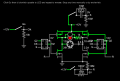
Simulated here http://tinyurl.com/2xg73ynu


Design time 39 min. Note connections are made with the same Node like R,S,Q2,Clk,!Q1
1706209462896.png

Using HV logic CD4074 and < 50 mohm FETs.

Rather than a 3 button remote. I chose a 1 button momentary switch to GO. The logic remembers which direction to Go from last limit switch momentary Set or momentary Reset.
 
Last edited:

tonyStewart

Joined May 8, 2012
235
My design, your feedback from everyone is invited.

Go means start the sequence. Fwd. Stop,Rev. or until you press the end switch on the opposite side, not the same side as the LED. if not , it goes in the opposite direction or until either end switch is pressed. But only reverses if the correct end switch is pressed. The end switch is normally not momentary but I differentiated it to a momentary Set or Reset.

The 10 Meg across each cap. is internal leakage and redundant for ceramic.
 
Last edited:

MisterBill2

Joined Jan 23, 2018
27,508
A much messier challenge is a half HP permanent split capacitor motor in a grill vent duct that has stopped working. A replacement cap did not start it running again. Rated speed is 165- RPM, with 60 HZ mains that tells me it must be high slip.
The OEM setup has some sort of series speed control and I wonder it that could be the issue. The whole thing is very nasty greasy, except the motor was protected. Does anybody have a clue about failure modes of inline motor speed controllers?? This is a small unit in a single position electrical box.
 

tonyStewart

Joined May 8, 2012
235
A much messier challenge is a half HP permanent split capacitor motor in a grill vent duct that has stopped working. A replacement cap did not start it running again. Rated speed is 165- RPM, with 60 HZ mains that tells me it must be high slip.
The OEM setup has some sort of series speed control and I wonder it that could be the issue. The whole thing is very nasty greasy, except the motor was protected. Does anybody have a clue about failure modes of inline motor speed controllers?? This is a small unit in a single position electrical box.
Messy from the grease but it's a repair challenge. Measure the phase-phase differential voltage after the (I assume) 10uF cap and push with finger starting stiction or torque and then winding resistances if that fails. It was 10 uF??
 
Top