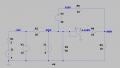
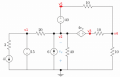
For one of the nodes that has a voltage close to 42 i get:
42.592592592592592592592592592592592592...repeating "592"
which is exactly:
1150/27 volts.
The node with the highest voltage i see is just as bit over 73 volts, but none higher than that.
The lowest is a bit over 14 not including the -15 volt source.
For one of the nodes that has a voltage close to 42 i get:
42.592592592592592592592592592592592592...repeating "592"
which is exactly:
1150/27 volts.
The node with the highest voltage i see is just as bit over 73 volts, but none higher than that.
The lowest is a bit over 14 not including the -15 volt source.
Are you talking about the circuit but sign of Vx is reversed (the plus on the top and minus at the bottom)?
With that I got one node voltage equal to 460/11V = 41.81818182V.
Are you talking about the circuit but sign of Vx is reversed (the plus on the top and minus at the bottom)?
With that I got one node voltage equal to 460/11V = 41.81818182V.
Ok i also misread the 40 Ohm resistor as a 10 Ohm resistor my monitor has crummy contrast.
I got these results close to 42 or -42:
-41.57894736842106
41.05263157894737
Those two are two of the 5 nodes. When i use all 5 nodes and calculate the voltage additions and the currents though all the branches they prove to be correct.
The branch currents are tested by using the theory that the sum of currents entering a node equals the sum leaving. or that all the currents entering equals zero, or all leaving equals zero.
Also all calculations using 16 digits of precision but all the results come out as the ratio of two integers (i could post those numbers also which when converted to float appear as above).
I think you made a mistake somewhere as it does not match with the simulation. If you swap the polarity of Vx as you initially did the result is 460/11V = 41.81818182V which agrees with the simulation.
I think you made a mistake somewhere as it does not match with the simulation. If you swap the polarity of Vx as you initially did the result is 460/11V = 41.81818182V which agrees with the simulation.
Well i could check it over again, but what did you use to simulate?
Do you have a file set up?
Also, did you look at the raw schematic and using the voltages your sim gave you compute the currents and verify that currents into a node sum to zero?
I's not hard to calculate the currents once you have all the node voltages. If you like you can PM me the node voltages and what node they go to and i'll check that over too.
Well i could check it over again, but what did you use to simulate?
Do you have a file set up?
Also, did you look at the raw schematic and using the voltages your sim gave you compute the currents and verify that currents into a node sum to zero?
I's not hard to calculate the currents once you have all the node voltages. If you like you can PM me the node voltages and what node they go to and i'll check that over too.
I simulated it with LTspice. I actually did solve it first with nodal analysis and then verified it with simulation. They're matched.
I'm going to attach the simulation file below.
I simulated it with LTspice. I actually did solve it first with nodal analysis and then verified it with simulation. They're matched.
I'm going to attach the simulation file below.
Thank you.
I thought you said that Vx was negative on top? It looks like you are taking Vx to be positive on top because that node is labeled Va and the sense terminal of the dependent voltage source that is positive gets Va directly. So i dont see any inversion of Vx (or Va).
Did i read it right my monitor isnt very good and my eyes are old ha ha.
Thank you.
I thought you said that Vx was negative on top? It looks like you are taking Vx to be positive on top because that node is labeled Va and the sense terminal of the dependent voltage source that is positive gets Va directly. So i dont see any inversion of Vx (or Va).
Did i read it right my monitor isnt very good and my eyes are old ha ha.
It all comes down to how you treat the sign of Vx or, if you prefer, the sign of the multiplier. Is the signage of Vx an assumption of its polarity or an indicator of the polarity to assign it even if it was positive wrt ground? After all, we've all assigned the label v1 to the first node even though we know its -ve wrt to ground.
You mean give you my infinite number of sets of solutions?
I wanted to do a flow graph of this circuit but way too tired right now did too much today.
I think we are dealing with a positive feedback mechanism here that makes the circuit node voltages dependent not only on component values and source voltages but how the actual calculations are done as well as the numerical precision being used.
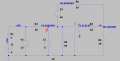
Referring to your diagram:
Note that as vx increases, v2 decreases and v3 decreases, which decreases v4 which decreases v5 which decreases v2 and that means v2 has decreased even more which decreases v3, etc., looks like a positive feedback loop.
Positive feedback loops sometimes result in a stable condition and sometimes not.
So see what you can find out regarding a possible bad positive feedback loop i have to rest for the remainder of the day been up and down stairs and moving stuff around.
What might help to see more into this is to connect a large value capacitor across the 10 Ohm resistor that goes to ground, then do a transient analysis of that last node. See if it behaves abnormally.
Also, a different simulator may come up with an entirely new set of node voltages.
It all comes down to how you treat the sign of Vx or, if you prefer, the sign of the multiplier. Is the signage of Vx an assumption of its polarity or an indicator of the polarity to assign it even if it was positive wrt ground? After all, we've all assigned the label v1 to the first node even though we know its -ve wrt to ground.
It would be conventional to take the blue plus and minus signs associated with the blue Vx symbol right under v2 as serving the same function as the plus and minus signs inside the controlled voltage source symbol.
Just like there is an assumed multiplier of +1 associated with all five variables v1, v2, v3, v4 and v5.
Using the designators shown in post #34, v1 = -15 and Vx = -v2
I said earlier in post #17 " This problem is the sort that can lead to sign confusion. " and I think RBR1317 got my drift when he said
in post #18 " It seemed this problem was deliberately designed to lead one into making a polarity error "
Just imagine if in front of the blue Vx symbol there were a minus sign!!
Or if instead of v2 in my schematic, it said -v2!
I'm using the conventional assumptions in my analysis.
You mean give you my infinite number of sets of solutions?
I wanted to do a flow graph of this circuit but way too tired right now did too much today.
I think we are dealing with a positive feedback mechanism here that makes the circuit node voltages dependent not only on component values and source voltages but how the actual calculations are done as well as the numerical precision being used.
Referring to your diagram:
Note that as vx increases, v2 decreases and v3 decreases, which decreases v4 which decreases v5 which decreases v2 and that means v2 has decreased even more which decreases v3, etc., looks like a positive feedback loop.
Positive feedback loops sometimes result in a stable condition and sometimes not.
So see what you can find out regarding a possible bad positive feedback loop i have to rest for the remainder of the day been up and down stairs and moving stuff around.
What might help to see more into this is to connect a large value capacitor across the 10 Ohm resistor that goes to ground, then do a transient analysis of that last node. See if it behaves abnormally.
Also, a different simulator may come up with an entirely new set of node voltages.
I did my calculations with infinite numerical precision. This can be done by keeping all numerical quantities as rational numbers (fractions), not floating point numbers. In that case there is only one solution which satisfies the relevant laws (KCL, KVL, Ohm's law).
I believe it's correct as my calculation and simulation matches. Just wonder why people got many different results which is almost 42 when Vx is swapped.

 Facebook
 Google
 GitHub
 Linkedin