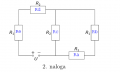
Help me! I need to solve this circuit

Thread Starter

Gorazd

Joined Mar 30, 2025
1
I need to solve this circuit. R1 resistors have 1 kiloohms resistance and R2 have 4 kiloohms. What is the equivalent resistance of the resistors in the circuit in the figure? What is the current flowing in the individual branches, if the driving voltage of the galvanic cell is 12V?
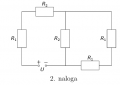
1743365841439.png
 
Last edited by a moderator:

MrChips

Joined Oct 2, 2009
34,628
Which resistor is R1?
Which resistor is R2?

That is confusing. Redraw the circuit and give each resistor a unique identifier, R1, R2, R3, R4, ... etc.
Then assign a value to each resistor.

Then we will be able to describe the proper solution using each unique resistor by name.

(Also, can you think of a better thread title than "Help me!" ?)
 

panic mode

Joined Oct 10, 2011
4,864
it could be that this is how circuit in question was actually drawn.

seem to be taken as is from a textbook. besides, students are rarely up to drawing schematics on their own.
 

MrChips

Joined Oct 2, 2009
34,628
it could be that this is how circuit in question was actually drawn.

seem to be taken as is from a textbook. besides, students are rarely up to drawing schematics on their own.
I am aware of that but it would still be better to describe which two resistors to combine instead of saying "add R1 and R1 in series", wouldn't it?
 

WBahn

Joined Mar 31, 2012
32,703
I need to solve this circuit. R1 resistors have 1 kiloohms resistance and R2 have 4 kiloohms. What is the equivalent resistance of the resistors in the circuit in the figure? What is the current flowing in the individual branches, if the driving voltage of the galvanic cell is 12V?
View attachment 345694
You need to show your best attempt to get as far as you can. That will let us see how much you grasp and, more importantly, where you are getting stuck. Then we can help you gain the understanding needed to get back that sticking point so that you can progress further.

We do NOT just work your homework for you and give you the answers. That helps no one, least of all you.

One thing you might do is look at the circuit and simplify it a bit so that you can solve the simplified circuit easily. Do this in such a way that you know which side of that value the actual answer must lie on. Then do this again, making other simplifications that but the actual answer on the other side of the new result. This will give you bounds that you know the correct answer must lie between.

In this case, remove the R2 in the middle. What is the resulting equivalent resistance? Is the real resistance greater or less than this?

We can actually do better than this very easily. By inspection, without writing anything down, we can almost immediately say that the total resistance has to be strictly between 6 Ω and 7 Ω. Can you see the minor tweaks I made to the circuit to achieve those two results? Can you see why the actual resistance has to be larger than the first and smaller than the second?
 

MrAl

Joined Jun 17, 2014
13,667
I am aware of that but it would still be better to describe which two resistors to combine instead of saying "add R1 and R1 in series", wouldn't it?
Hi,

That's an interesting observation. Mathematically it does not matter, but in order to describe the process of simplifying the circuit it would have been better to number them separately as you suggested. Without that we have to resort to "right and left and up and down and here and there".

What you could do if you feel motivated is provide a number for each one and draw it on the schematic, then provide a parts list.
Alternately, just draw the resistor id's as lower case like r1, r2, r3, etc., or even p1, p2, p3 (part 1, part 2, etc.).
Maybe even letters Ra, Rb, Rc, etc.
Other ideas welcome.

This attachment might help...
 

Attachments

Last edited:

panic mode

Joined Oct 10, 2011
4,864
Yes but TS still did not show any attempt yet. I think he is gone after realizing there is no free solution.

But if i am wrong, here are some suggestions:

Mark all nodes and branch currents.

Assign current direction arbitrarily.... If result is negative, initially assumed direction was wrong but magnitude is still correct, so it is easy to update circuit with this info.
 
Last edited:

WBahn

Joined Mar 31, 2012
32,703
This can be solved mentally. It is that simple.
Do you know how to sum resistors in series and resistors in parallel?
For you and me, yes. Particularly with the numbers involved. But the focus should be on developing skills such that they can be applied much more generically. This is one of the reasons that it is so important that the TS show their best attempt to get as far as they can. Helping them get over a problem having to do with the math of combining parallel and series resistors is quite different from helping them recognize when two resistors are, and are not, in series or parallel, which is quite different yet from helping them see how to not get lost in the forest for the trees when working with a more complex circuit (or, more aptly, be able to recognize and work with the trees that make up the forest).
 
Top