How to solve this circuit

MisterBill2

Joined Jan 23, 2018
27,186
Certainly it is some sort of trick question, BUT there is also a trick answer, presuming that the circuit is drawn correctly!
The answer is that the Vcc is + 15 volts, because that is how the battery symbol is drawn, with the positive side feeding the collector load resistor.. All the other information is distractions.
 

MrChips

Joined Oct 2, 2009
34,628
Certainly it is some sort of trick question, BUT there is also a trick answer, presuming that the circuit is drawn correctly!
The answer is that the Vcc is + 15 volts, because that is how the battery symbol is drawn, with the positive side feeding the collector load resistor.. All the other information is distractions.
MisterBill, this is a PNP transistor.
 

Thread Starter

hoyyoth

Joined Mar 21, 2020
528
May I know the direction of current flow in this circuit .Is it from collector to emitter or emitter to collector
 

sghioto

Joined Dec 31, 2017
8,633
Normally, collector to emitter for a PNP transistor.
In this case no current flow because the transistor is connected incorrectly.
 

MrChips

Joined Oct 2, 2009
34,628
Current will flow in the direction of the arrow as shown as the emitter of the transistor.
Ignore the orientation of the battery symbol, in other words, remove the battery symbol entirely. Decide if the voltage applied on the collector is to be positive or negative.
 

MisterBill2

Joined Jan 23, 2018
27,186
" Ignore the orientation of the battery symbol, "????? I don't Think SO!! When there are no words, all we have is the symbols. Certainly the polarity is incorrect. And just as certainly that incorrect bias is connected to the collector. That make Vcc=15 volts. The question was not about the circuit operating, nor about the current direction. It certainly was a trick question.
 

panic mode

Joined Oct 10, 2011
4,866
Yes so.... this is a theoretical question and choices include both positive and negative values. and there is only one plausible or most likely solution. and MrChips already gave a huge tip.
 
Last edited:

WBahn

Joined Mar 31, 2012
32,706
Daer Team,

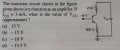
Can you kindly provide the solution for this problem.

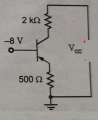
View attachment 343831
I don't know why everyone is having so much trouble with this circuit. It is pretty straight forward.

@hoyyoth: Normally, a post like this would get moved to Homework Help and we would be expected to NOT just give you the answer. But you have made clear elsewhere that you aren't a student, so I'm going to make an exception.

While is can certainly help to draw the circuit in a more conventional orientation, that isn't necessary. To make that point, I'm going to work with it as drawn, though that is certainly more awkward (for me, at least). But that just means we need to be more careful and explicit.

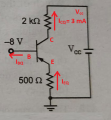
First, annotate the schematic with what we are given and with labels we can refer to.
1741316871904.png

The first thing to determine is whether the transistor is in cutoff or not. The fact that the collector current is nonzero indicates that it is not. But we need to confirm that this is consistent with the other information. If it is conducting (whether it is in the active region or saturation), that means that the base-emitter junction is forward biased. For that to happen, the base voltage must be negative (given where our common reference is located). Which is it. That then means that the Vbe is about -0.7 V (since it is a PNP transistor), which means that the emitter voltage is -7.3 V,

Next, what is the current in the 500 Ω resistor?

We know the voltage on both sides of it, and we know the resistance, so Ohm's Law tells us that the emitter current is:

I_EQ = (0 V - -7.3 V) / 500 Ω = 14.6 mA

Now, and here is the key to solving the circuit, what mode is the transistor in?

We know that the collector current is 3 mA and the emitter current is 14.6 mA, making the base current 11.6 mA. That makes the beta of the transistor:

ß = Ic / Ib = 3 mA / 11.6 mA = 0.259

This transistor is deep into saturation, which makes the Vce equal to Vcesat. This is often assumed to be about -0.2 V for an unspecified PNP transistor.

That makes the collector voltage

Vce = Vc - Ve

Vc = Ve + Vce = -7.3 V + -0.2 V = -7.5 V

We are given the current in the 2 kΩ resistor, so now we can solve for Vcc using Ohm's Law:

I_CQ = (Vc - Vcc) / 2 kΩ

Vcc = Vc - (I_CQ · 2 kΩ)

Vcc = -7.5 V - (3 mA · 2 kΩ) = -7.5 V - 6 V = -13.5 V
 

WBahn

Joined Mar 31, 2012
32,706
" Ignore the orientation of the battery symbol, "????? I don't Think SO!! When there are no words, all we have is the symbols. Certainly the polarity is incorrect. And just as certainly that incorrect bias is connected to the collector. That make Vcc=15 volts. The question was not about the circuit operating, nor about the current direction. It certainly was a trick question.
All the battery symbol does is establish the reference polarity for the voltage value.

A battery symbol is commonly (though arguably not correctly) used as the symbol of a generic DC voltage supply. That voltage supply has a value, let's call it Vdc, which can be positive or negative or zero. That value is the voltage difference of the terminal with the long line relative to the terminal with the short line. Nothing more, nothing less.

V_dc = V_long - V_short
 

0ri0n

Joined Jan 7, 2025
161
Can you kindly provide the solution for this problem.
Vcc = -13.5V

With -8V at the base and Veb = 0.7 V there is a current of around Ie = (8V - 0.7V) / 500 Ohm = 14.6mA flowing into the emitter. Icq = 3mA is flowing out of the collector and through the 2 kOhm resistor. That leaves 11.6mA flowing out of the base into the (ideal) -8V voltage source. The transistor is completely saturated with Uec being very small, we assume something like Uec = 0.2V. If you now add the voltage across the 500 Ohm resistor (7.3 V), Uec (0.2 V) and the voltage across the 2 kOhm resistor (6 V) you arrive at |Vcc| = 13.5V.
 
Last edited:

WBahn

Joined Mar 31, 2012
32,706
Vcc = -13.5V

With -8V at the base and Vbe~0.7V there is a current of around Ie = (8V - 0.7V) / 500 Ohm = 14.6mA flowing into the emitter. Icq = 3mA is flowing out of the collector and through the 2 kOhm resistor. That leaves 11.6mA flowing out of the base into the (ideal) -8V voltage source. The transistor is completely saturated with Uce being very small, we assume something like Uce = 0.2V. If you now add the voltage across the 500 Ohm resistor (7.3 V), Uce (0.2 V) and the voltage across the 2 kOhm resistor (6 V) you arrive at |Vcc| = 13.5V.
You are being pretty sloppy with your values and, as a result, having to throw in a lot of magical mystery minus signs.

The base voltage is not 8 V, it is -8 V.

Vbe is not ~0.7 V, it is ~-0.7 V.

Uce is not 0.2 V, it is -0.2 V.
 

sghioto

Joined Dec 31, 2017
8,633
I used the battery symbol as shown.
Which is universally drawn as the short end negative shown connected to a ground in this schematic.
If we agree that the PNP transistor and resistor symbols are correct then that should also apply to the battery.
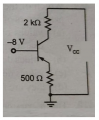
This how the schematic should have presented IMO.
1741321263080.png
 

WBahn

Joined Mar 31, 2012
32,706
Then you assumed that the negative side of Vcc was connected to the 2K resistor?
No I didn't.

Look at the schematic.

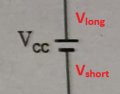
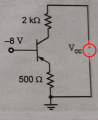
The voltage on the top node (the one connected to the 2 kΩ resistor) is Vcc, relative to the common, which is EXACTLY what the battery symbol, as drawn, tells us.

1741319681259.png

Vcc = (Vlong - Vshort)

That's ALL that that symbol is telling us.

In the circuit, Vshort = 0 V because it is directly connected to the node that has been defined as the common reference node ("ground") for the circuit.

The top node, Vtop, which is connected to the 2 kΩ resistor, is Vlong. Therefore:

Vtop = Vlong = Vshort + Vcc = 0 V + Vcc = Vcc

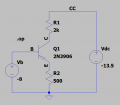
Here's an LTSpice simulation schematic laid out just like the provided schematic:

1741320815408.png

And here's the operating point results:

1741320856536.png

Here we can see that the collector current is 3.23 mA, which is within 10% of the value given in the problem.

The deviation comes from two factors. First, the -200 mV saturation voltage that is commonly used is generally too big for most modern small-signal transistors, which are able to saturate much more heavily -- especially when being driven as hard as this one is. So instead of -200 mV, the sim has it at closer to -10 mV.

Second, the assumption that Vbe = -0.7 V is off because of how much base current there is and it is more like -0.98 V.
 

WBahn

Joined Mar 31, 2012
32,706
Which is universally drawn as the short end negative shown connected to a ground in this schematic.
If we agree that the PNP transistor and resistor symbols are correct then that should also apply to the battery.
This how the schematic should have presented IMO.
View attachment 343923
In which case the polarity of Vcc is undefined, and hence ambiguous.

You seem to want to insist that the schematic, as you've modified it, requires that Vcc tells us the voltage at the top of the gap relative to the bottom of the gap. But there is nothing in your schematic that requires any such thing -- that is merely one of two perfectly legitimate choices that can be made, the other being that Vcc is the voltage at the bottom of the gap relative to the top of the gap.

You need to define which choice is imposed by providing some kind of symbolic polarity definition. That can be done a few different ways:

Using + and - labels (although just one, usually the +, is actually sufficient):
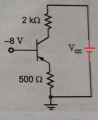
1741322079912.png

Using a generic ideal voltage source symbol:

1741322187343.png

Or using a symbol that also conveys that the voltage source is a DC source, one of which is the battery symbol:

1741322317575.png

The first two don't place a restriction on the nature of the voltage source, but that isn't critical in this problem because the context of the problem strongly implies it is DC and, even if we aren't willing to make that assumption, we would then have to make the assumption that we are talking about a point in time in which the instantaneous collector current is 3 mA and we are looking for the instantaneous value of Vcc.
 
Top