How to solve this circuit

WBahn

Joined Mar 31, 2012
32,871
Debateable.
Not very.

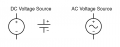
There is no shortage of places, including the E-Book right here on AAC, that show the circle and the cell symbol as being equivalent when specifying a DC voltage source:

1741325210735.png

Note that even an AC source needs to have the polarity indicated, otherwise there is a 180° ambiguity in the interpretation of the associated voltage. In many problems, this isn't important (such as, usually, when looking only at RMS values).

The thing that you need to break out of is this engrained notion that the positive terminal of a DC source means that the voltage at the positive terminal is physically higher (more positive) than the voltage at the negative terminal. This is NOT what the symbol means. It means that the voltage at the positive terminal is SYMBOLICALLY higher than the voltage at the negative terminal.

This is no different than writing a + and a - symbol on the ends of a resistor and associating that with a voltage labeled Vout. This does NOT mean that the voltage at the end of the resistor that has the + symbol is actually higher than the other side of the resistor, only that it is symbolically higher. It defines a mathematical relationship between the voltages at the two points, namely that Vout is equal to the voltage at the end with the + minus the voltage at the end with the -.
 
Last edited:

Thread Starter

hoyyoth

Joined Mar 21, 2020
528
I don't know why everyone is having so much trouble with this circuit. It is pretty straight forward.

@hoyyoth: Normally, a post like this would get moved to Homework Help and we would be expected to NOT just give you the answer. But you have made clear elsewhere that you aren't a student, so I'm going to make an exception.

While is can certainly help to draw the circuit in a more conventional orientation, that isn't necessary. To make that point, I'm going to work with it as drawn, though that is certainly more awkward (for me, at least). But that just means we need to be more careful and explicit.

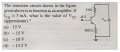
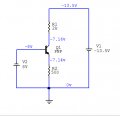
First, annotate the schematic with what we are given and with labels we can refer to.
View attachment 343915

The first thing to determine is whether the transistor is in cutoff or not. The fact that the collector current is nonzero indicates that it is not. But we need to confirm that this is consistent with the other information. If it is conducting (whether it is in the active region or saturation), that means that the base-emitter junction is forward biased. For that to happen, the base voltage must be negative (given where our common reference is located). Which is it. That then means that the Vbe is about -0.7 V (since it is a PNP transistor), which means that the emitter voltage is -7.3 V,

Next, what is the current in the 500 Ω resistor?

We know the voltage on both sides of it, and we know the resistance, so Ohm's Law tells us that the emitter current is:

I_EQ = (0 V - -7.3 V) / 500 Ω = 14.6 mA

Now, and here is the key to solving the circuit, what mode is the transistor in?

We know that the collector current is 3 mA and the emitter current is 14.6 mA, making the base current 11.6 mA. That makes the beta of the transistor:

ß = Ic / Ib = 3 mA / 11.6 mA = 0.259

This transistor is deep into saturation, which makes the Vce equal to Vcesat. This is often assumed to be about -0.2 V for an unspecified PNP transistor.

That makes the collector voltage

Vce = Vc - Ve

Vc = Ve + Vce = -7.3 V + -0.2 V = -7.5 V

We are given the current in the 2 kΩ resistor, so now we can solve for Vcc using Ohm's Law:

I_CQ = (Vc - Vcc) / 2 kΩ

Vcc = Vc - (I_CQ · 2 kΩ)

Vcc = -7.5 V - (3 mA · 2 kΩ) = -7.5 V - 6 V = -13.5 V
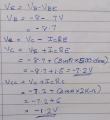
Thank you for the solution.I am not a student, I tried to solve this and got a wrong answer.I forgot to post my effort in the first post.
Please see my wrong attempt below.
1741335176079.png
 

Thread Starter

hoyyoth

Joined Mar 21, 2020
528
I don't know why everyone is having so much trouble with this circuit. It is pretty straight forward.

@hoyyoth: Normally, a post like this would get moved to Homework Help and we would be expected to NOT just give you the answer. But you have made clear elsewhere that you aren't a student, so I'm going to make an exception.

While is can certainly help to draw the circuit in a more conventional orientation, that isn't necessary. To make that point, I'm going to work with it as drawn, though that is certainly more awkward (for me, at least). But that just means we need to be more careful and explicit.

First, annotate the schematic with what we are given and with labels we can refer to.
View attachment 343915

The first thing to determine is whether the transistor is in cutoff or not. The fact that the collector current is nonzero indicates that it is not. But we need to confirm that this is consistent with the other information. If it is conducting (whether it is in the active region or saturation), that means that the base-emitter junction is forward biased. For that to happen, the base voltage must be negative (given where our common reference is located). Which is it. That then means that the Vbe is about -0.7 V (since it is a PNP transistor), which means that the emitter voltage is -7.3 V,

Next, what is the current in the 500 Ω resistor?

We know the voltage on both sides of it, and we know the resistance, so Ohm's Law tells us that the emitter current is:

I_EQ = (0 V - -7.3 V) / 500 Ω = 14.6 mA

Now, and here is the key to solving the circuit, what mode is the transistor in?

We know that the collector current is 3 mA and the emitter current is 14.6 mA, making the base current 11.6 mA. That makes the beta of the transistor:

ß = Ic / Ib = 3 mA / 11.6 mA = 0.259

This transistor is deep into saturation, which makes the Vce equal to Vcesat. This is often assumed to be about -0.2 V for an unspecified PNP transistor.

That makes the collector voltage

Vce = Vc - Ve

Vc = Ve + Vce = -7.3 V + -0.2 V = -7.5 V

We are given the current in the 2 kΩ resistor, so now we can solve for Vcc using Ohm's Law:

I_CQ = (Vc - Vcc) / 2 kΩ

Vcc = Vc - (I_CQ · 2 kΩ)

Vcc = -7.5 V - (3 mA · 2 kΩ) = -7.5 V - 6 V = -13.5 V
I have one more question,will the current direction is opposite of that shown in your solution figure.Why I asked is collector is connected to positive supply
 

MisterBill2

Joined Jan 23, 2018
27,551
All the battery symbol does is establish the reference polarity for the voltage value.

A battery symbol is commonly (though arguably not correctly) used as the symbol of a generic DC voltage supply. That voltage supply has a value, let's call it Vdc, which can be positive or negative or zero. That value is the voltage difference of the terminal with the long line relative to the terminal with the short line. Nothing more, nothing less.

V_dc = V_long - V_short
NO!!! A battery symbol has a specific meaning, which is " a DC power source WITH A DEFINED POLARITY". While the generic symbol does not state voltage or current, it CERTAINLY states the polarity. The longer bar in a battery symbol is always the POSITIVE end.
While not all individuals understand that meaning, that does not alter it. Just as some folks choose to assign new "and goofy" uses to words, failing to be aware of their meaning does not render it void. Not understanding a word does not void it's meaning. That is the reality of written language.
Except for instances of battery charging, current does not flow into the positive terminal of a battery.
THUS THIS IS CERTAINLY A TRICK QUESTION.
Wanting something to be true does not make it true. (Totally contrary to the Jim Moore tradition!) (Mister Moore was a sales person at a long-gone employer of mine. Severely prone to wishful thinking.)

The Mister Moore in my reference is long since deceased, so while others may have a similar name, I am referencing an entirely different individual. The syndrome of believing something is what you want it to be is especially damaging in the engineering technical sales field. Certainly others here can verify that reality.
 
Last edited:

BobTPH

Joined Jun 5, 2013
11,521
I think all the confusion would have been avoided by using the generic voltage source symbol (circle with + and -). Since I am self studying circuit analysis (from a book recommended by @WBahn), I am familiar with the solutions often being negative voltages. The sign in the voltage source is definitely arbitrary by convention. Not so sure about the battery symbol. I can see it either way.
 

sghioto

Joined Dec 31, 2017
8,634
Measured from ground I see -13.5 volts unless the meter leads are reversed.
Not much of an amplifier if the hfe is only .259.
 

WBahn

Joined Mar 31, 2012
32,871
Thank you for the solution.I am not a student, I tried to solve this and got a wrong answer.I forgot to post my effort in the first post.
Please see my wrong attempt below.
View attachment 343939
Your first problem is in your second line.

You used Vbe = 0.7 V.

But this is a PNP transistor. When a PNP is on, the emitter is at a higher voltage than the base, so Veb = 0.7 V, when means that Vbe = -0.7 V.

It goes downhill from there.

Your next equation says

Ve = Vc - IcRe

Where is this coming from?

This means that

Ve - Vc = Ic·Re = Vec

Think about this. This is saying that the voltage across the transistor is equal to the product of the current through one resistor (the 2 kΩ resistor, Rc) times the resistance of a different resistor (the 500 Ω resistor, Re). Does that make sense?

Take the time to draw an annotated schematic with the definitions of all of the voltages and currents, including polarities, that you are going to use and then apply EE principles to that circuit to develop your equations. Don't just try to throw memorized equations at it and force them to fit, ask whether your equations actually make sense for that circuit before you commit your work to their mercy.

You also need to track your units properly through your work. Sooner or later you are going to make a mistake that doing so would have caught.
 

WBahn

Joined Mar 31, 2012
32,871
I think all the confusion would have been avoided by using the generic voltage source symbol (circle with + and -). Since I am self studying circuit analysis (from a book recommended by @WBahn), I am familiar with the solutions often being negative voltages. The sign in the voltage source is definitely arbitrary by convention. Not so sure about the battery symbol. I can see it either way.
I don't like the use of a battery symbol in a schematic unless symbolic polarity matches the physical polarity. But that doesn't mean that it doesn't get used as a generic DC voltage source and not being able to work a problem just because someone uses it in a way someone isn't used to or doesn't like doesn't change the fact that it IS used that way. This is like insisting that the problem must be a trick problem because they used the earth ground symbol instead of a voltage reference symbol, or that you can't understand what someone means when they use a double negative. It would be nice if everyone were to use perfect symbology and grammar when drawing schematics or writing/saying things, but we live in a world where this isn't the case and humans are generally very good at discerning what was meant despite that.
 

Bordodynov

Joined May 20, 2015
3,431
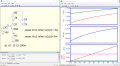
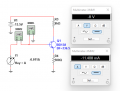
In this circuit, the transistor is not in amplification mode! Because the current direction is not specified, I considered both options.Catch.png
 
Top