How to run a car compressor from mains

Status
Not open for further replies.

Tonyr1084

Joined Sep 24, 2015
9,744
Well alrighty then. Just do this. There done. With what is available this is about as good as it gets.

Ron
In the video he pulled the piston out of the cylinder, albeit by accident. When it was out you see a soft rubber cone shaped seal. When the piston pushes toward the cylinder head that piston seal expands and creates an even tighter seal. HOWEVER, when the piston pulls away from the head air can easily leak past that piston seal. If you've ever taken a bicycle pump apart you see a similar thing. As memory serves back in the days when dinosaurs and us kids roamed, that bicycle pump had a single valve at the bottom that consisted of a ballbearing and a spring. When you pulled the plunger UP air bypassed the piston seal and filled the pump chamber with air. When you pushed it down - that leather and grease seal would expand and prevent air from going anywhere except through the ball valve and out the hose. Using the method shown in the video is going to be nearly as useless as harnessing the energy of a house fly. Yeah, he got some vacuum, but probably not more than a centimeter of water for vacuum.

The thing about those tiny pumps is the fact that it uses thousands upon thousands of strokes to move small amounts of air. Yes, it will inflate a tire, but it takes several minutes to take a standard tire up to a useable pressure. But again, it's a "Pressure". Using it as a vacuum is highly impractical.
 

Reloadron

Joined Jan 15, 2015
7,893
Well ya see Tony I got tired of the thread so since the thread starter wanted a how to I just gave them a how to. Would I do it? Nope, I made that clear early on. Do I think it's a good idea? Nope again. Rather than argue I just tossed a link out there. Tell them what they want to hear and loved the drawing in your post #21. :)

Ron
 

shortbus

Joined Sep 30, 2009
10,049
Then he clarified that he wants to do vacuum filtrations and possibly (eventually) pull a vacuum in a desiccator.
For simple jobs it doesn't even need to be motorized. Or cost a whole lot(although buying on of the ones I linked to isn't any more expensive than what he bought and IS a real vacuum pump) it's called a "brake bleeder". https://www.harborfreight.com/brake-bleeder-and-vacuum-pump-kit-63391.html They do make two different types, the one shown is the best, it has a brass cylinder, the other type is all plastic.
 

shortbus

Joined Sep 30, 2009
10,049
The last two automotive tire inflaters that I disassembled were different from the drawing in that the piston was solid, and the crank was offset from the cylinder axis, so that the cylinder was only sealing on the compression stroke, on the intake stroke the flat piston was angled to allow air in. The discharge valve was part of the casting and not reversable. so without a fair bit of changing and running the motor the other direction it could not pull a vacuum. The pump in Tony's drawing costs quite a bit more.
Can you give a link to one of that type? since you had them you should know who sold them. I have questions about what you said on how it/they worked.
1. What kind of seal/piston ring would even work if the piston "angled" in the bore of the cylinder?
2.How would changing the rotation of the crankshaft/motor result in changing it from a pressure to a vacuum? The piston would still only be reciprocating in the cylinder.
3. How does offsetting the crank tip the piston?
 

MisterBill2

Joined Jan 23, 2018
27,684
Ran across this: It's not in keeping with your question but - - - .
OK, I watched the video and recall now why I avoid yootoob.
That is not a conversion, that is an attachment. It is OK for applications like shown, a medium vacuum at a lower flow. And appicabe to that model ony, with way too much cutting and drilling shown.
But it does show that it can be done, for that style of compressor.
 

MisterBill2

Joined Jan 23, 2018
27,684
Can you give a link to one of that type? since you had them you should know who sold them. I have questions about what you said on how it/they worked.
1. What kind of seal/piston ring would even work if the piston "angled" in the bore of the cylinder?
2.How would changing the rotation of the crankshaft/motor result in changing it from a pressure to a vacuum? The piston would still only be reciprocating in the cylinder.
3. How does offsetting the crank tip the piston?
OK, shorty
In those compressors there is only a one piece piston/con rod, crank bearing. thus the angle of the conrod sets the ange of the piston top, which is not a long skirted piston like normal engines and pumps. And mostly I was asked to repair these because they did not perform correctly. In one instance the cord had been damaged and the polarity was reversed and so it did sort of try to pull a vacuum. The other two had simply worn down the piston sea so that it would not develop enough pressure. Wear happens when the castings are a poor grade of pot metal. And I never asked about where they had been purchased, and I never cared about the brand names.
It was just interesting to see that there was a way to provide the functional equal, almost, for an intake valve while cutting costs.
Do you mean to say that you have never seen one of that style of pump??
 

Tonyr1084

Joined Sep 24, 2015
9,744
MisterBill2 the point of the video is to show that an air compressor, which has an intake port and likely a filter of some sort CAN be modified to function as a vacuum pump. Given the much higher quality of the compressor, the chances of turning it into a decent vacuum pump is good. However, the odds of turning one of those cheap tire inflators into a vacuum pump is nearly impossible. Even if you turn the inlet into a tubed connection, the piston seal will likely prevent any substantial vacuum from being drawn.

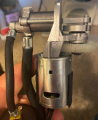
This is one of those tire inflators I happen to have laying around. As in the picture I drew a few posts back, doesn't matter which direction the motor runs, the pump will only act as a pump. Polarity of the DC motor does not matter. Simply running it in reverse will not produce a vacuum of any kind. The motor drives a cam that drives a piston forward and back. Every forward stroke produces pressure. Every backward stroke will simply recharge the cylinder with fresh air to be pumped in on the next forward stroke. It doesn't care which direction the motor is turning. This particular tire inflator WILL NOT PRODUCE A VACUUM no matter what you do to it. The piston seal will not allow a vacuum to be pulled.

1647450579080.png
 

MisterBill2

Joined Jan 23, 2018
27,684
MisterBill2 the point of the video is to show that an air compressor, which has an intake port and likely a filter of some sort CAN be modified to function as a vacuum pump. Given the much higher quality of the compressor, the chances of turning it into a decent vacuum pump is good. However, the odds of turning one of those cheap tire inflators into a vacuum pump is nearly impossible. Even if you turn the inlet into a tubed connection, the piston seal will likely prevent any substantial vacuum from being drawn.

This is one of those tire inflators I happen to have laying around. As in the picture I drew a few posts back, doesn't matter which direction the motor runs, the pump will only act as a pump. Polarity of the DC motor does not matter. Simply running it in reverse will not produce a vacuum of any kind. The motor drives a cam that drives a piston forward and back. Every forward stroke produces pressure. Every backward stroke will simply recharge the cylinder with fresh air to be pumped in on the next forward stroke. It doesn't care which direction the motor is turning. This particular tire inflator WILL NOT PRODUCE A VACUUM no matter what you do to it. The piston seal will not allow a vacuum to be pulled.

View attachment 262925
The mechanism of that compressor you show is fundamentally different than the one I am describing, in which the piston is a fairly thin disk and is a solid part of the connecting rod. THAT arrangement has the axis of the crank bearing off center from the axis of the cylinder, with the result that in normal operation the piston surface is at an angle and so air flows in past the edges. Then on the compression stroke the piston surface is not tilted so much and thus there is a seal, so compression happens. It is a very cheap scheme and it is less efficient, but it does actually work. and if the motor spins in the opposite direction it does not work.
And if you do not understand this description,
 

Tonyr1084

Joined Sep 24, 2015
9,744
And if you do not understand this description,
I didn't say I didn't understand it. Actually it makes sense. Yes, it's a poor design but I agree it would work. But as you said, never as a vacuum. MY comments on the type of pump I have in hand is that it may ever so slightly pull a vacuum WITH heavy modifications, but as a practical vacuum pump it will never suffice. The video I linked I just happened to come across it. And yes, you're right, there's a bit of modification involved, but is likely to produce a fair amount of vacuum.

The TS asked about the cheap tire inflator type pump just like the one I've had so many of in my lifetime. And to answer specifically the TS question, first you need a power supply that turns mains into 12V. Second, it's an impractical endeavor because you're not likely to get more than a few cmH2O of a vacuum pull. We can discuss all day the myriads of different types of pumps, vacuum and pressure, but we then get away from what the TS is hoping to do.

In short, to run a tire inflator from mains one just needs a battery charger capable of a few amps. The battery powered inflator I have only draws a about 3 amps at startup but runs continuously with no load at about half an amp. What the TS asks can be done, though none of us experienced persons believe it's a worth while endeavor. And I believe the TS has already gotten that point.

Peace bro.
 

MisterBill2

Joined Jan 23, 2018
27,684
Never. What is to keep the piston from tipping at the top of the stroke too? Or does the crank move to align as the piston goes up? I'm learning so much from you lately.
Because the axis of the cylinder is offset from the axis of the crank center, the piston is not tipped enough to leak during the upward portion of the stroke. as the crank continues to rotate the piston does tilt and admit air during the down stroke. The scheme is very different from an engine or a normal compressor.
 

shortbus

Joined Sep 30, 2009
10,049
Because the axis of the cylinder is offset from the axis of the crank center, the piston is not tipped enough to leak during the upward portion of the stroke. as the crank continues to rotate the piston does tilt and admit air during the down stroke.
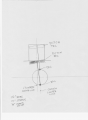
Well I don't believe you, imagine that! So nothing worth watching on TV last night and I keep paper, pencils, and other drawing stuff near my easy chair. So I drew out your scheme to see for myself. Look what it shows, the dimensions were taken from a junk 12V compressor, except for the offset, but any offset that would be eye catching would do the same thing.

1647703706526.png
 

MisterBill2

Joined Jan 23, 2018
27,684
Well I don't believe you, imagine that! So nothing worth watching on TV last night and I keep paper, pencils, and other drawing stuff near my easy chair. So I drew out your scheme to see for myself. Look what it shows, the dimensions were taken from a junk 12V compressor, except for the offset, but any offset that would be eye catching would do the same thing.

View attachment 263208
You have the drawing Done incorrectly. For a one inch bore the offset was about 5/16 as I recall, and the piston was not perfectly square edged, but rather rounded on the edges. Thus it was close on the way up but open on the way down. It really was quite impressive, and it must have cost quite a bit less because of not needing as many parts that had to be fairy accurate, and assembled carefully.
 

shortbus

Joined Sep 30, 2009
10,049
You have the drawing Done incorrectly. For a one inch bore the offset was about 5/16 as I recall,
But changing the sizes and offset does nothing to change the fact that the piston is always tilted throughout the whole stroke. Using your dimensions actually makes things worse not better. And the piston in yours or mine would have to be elliptical not round to fit the bore at an angle. Your still not making me a believer.
 

MisterBill2

Joined Jan 23, 2018
27,684
But changing the sizes and offset does nothing to change the fact that the piston is always tilted throughout the whole stroke. Using your dimensions actually makes things worse not better. And the piston in yours or mine would have to be elliptical not round to fit the bore at an angle. Your still not making me a believer.
Think whatever you wish to think, believe whatever you want. The dumb things worked but not as efficiently as the more expensive ones.
Clearly you will never understand.
 

Tonyr1084

Joined Sep 24, 2015
9,744
Using what little I can glean from your comments and drawings, it looks like this could work. Poorly, but it could work. The drawing doesn't show a valve or an outlet - so use your imagination. And imagine a clockwise rotation. AND looking at this drawing, running it counter-clockwise would produce a vacuum. Again, poorly, but - um - yeah.

Notice that the upper end of the cylinder is angled and the crank is offset by 5/16" according to the comment. Stroke is 1 1/2". If the cylinder were not angled at the top then the shaft would hit the cylinder wall and jam the device.

The compression stroke starts in the third drawing. The first drawing takes air into the cylinder. The second closes the cylinder, the third starts the compression stroke, the fourth apparently leaks a little air but not much, and the fifth completes the compression stroke.
1647784742952.png

Now: What does any of this have to do with the TS request for help running a 12V tire inflator pump from mains? Absolutely nothing. We're so far off topic by this point one could be easily confused. The TS has stated he wants a vacuum pump made out of a tire inflator. It's been clearly stated that it's impractical and unlikely to succeed should he pursue the endeavor. Now, everybody grab a Snickers bar and settle down.
 
Status
Not open for further replies.
Top