How to control 24VDC solenoid using 12VDC relay & separate power supplies?

Thread Starter

schaeferchristopher@yahoo

Joined Aug 14, 2024
11
The following was a solution provided via AI (Microsoft “Copilot”).
Does this make sense?
Components Needed:
12VDC relay (SPDT type)
12VDC power supply
24VDC power supply
24VDC solenoid
Wiring Guide:
Connect the 12VDC power source to Pin 30 of the relay.
Connect the control circuit (trigger) to Pins 85 and 86 of the relay. [24VDC or 12VDC?]
Connect the 24VDC solenoid to Pin 87 of the relay. Pin 87 will be normally open when the relay is active.
Finally, connect the negative (-) wire of both power supplies to a common ground. [The Negative of the 24VDC power supply? Or the negative return of the 12VDC power supply?]
Remember to check the relay’s datasheet or markings for specific pin assignments. This setup allows you to control the 24VDC device using the 12VDC relay while keeping the power supplies isolated.
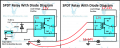
[A schematic would help.]

This would be part of a pipe organ control system. Most of the organ components (e.g. air valves under pipes) are 12VDC. However, the solenoids to pull or push some items on or off can operate on either 12VDC or 24VDC. However, their design is such that they’re more efficient at 24VDC.
 

Thread Starter

schaeferchristopher@yahoo

Joined Aug 14, 2024
11
OK simple question (without AI suggestion):
How to control 24VDC solenoid using 12VDC relay & separate power supplies?
This would be part of a pipe organ control system. Most of the organ components (e.g. air valves under pipes) are 12VDC. However, the solenoids to pull or push some items on or off can operate on either 12VDC or 24VDC. However, their design is such that they’re more efficient at 24VDC.
So how would one power the 24VDC solenoids with a 24VDC power supply, but control them with the 12VDC relay system which has its own 12VDC power supply which powers everything else in the organ?
 

ronsimpson

Joined Oct 7, 2019
4,646
I probably do not understand but,
On the left is your organ, with a 5 volt computer that drives a 5V relay that switches 12V to turn on 12V solenoids. "load"
But you have some solenoids that need 12 to 24V from a different supply.
On the right side is a 12V relay that we will wire in so it looks like a 12V solenoid. This relay, is on the outside, acts much like the 12V solenoid. The 12V relay switch on power from a different source to drive the new solenoid.
The new supply can be any voltage. The top "12-24V" comment goes to the positive terminal and the bottom "12-24V" goes to the negative lead of the new supply. The new "Ground" does not have to connect to the organ.
1723727180376.png
 

AnalogKid

Joined Aug 1, 2013
12,043
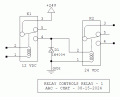
If this is the same question as on Stackex, here is the basic setup. This circuit assumes you have things like coil currents and contact ratings under control.

GND2 is the return for the 24 V supply. Note that it can or cannot be tied to the GND for the 12 V supply - the circuit works the same either way.

ak


!!Relay-Control-Relay-1-c.gif

I would have posted this before Ron, but I was hungry.
 

crutschow

Joined Mar 14, 2008
38,316
Why do you think you need isolation?
Just control the 24V solenoid with a MOSFET controlled by the 5-12V signal (with a diode across the solenoid coil, of course).
 

AnalogKid

Joined Aug 1, 2013
12,043
Why do you think you need isolation?
There is nothing in the non-AI part of #1, or #3, that says the two supplies are, or can be common-grounded.

IF they are, then the 12 V relay (which already exists) certainly could control a power MOSFET in the 24 V circuit.

ak
 

eetech00

Joined Jun 8, 2013
4,704
This would be part of a pipe organ control system. Most of the organ components (e.g. air valves under pipes) are 12VDC. However, the solenoids to pull or push some items on or off can operate on either 12VDC or 24VDC. However, their design is such that they’re more efficient at 24VDC.
The operating range of the solenoid seems a stretch. Most energize at about 70% of nominal voltage. The solenoid will operate quicker at nominal, or higher, operating voltage than a lower operating voltage, but will generate more heat at a higher voltage.
Can you supply a photo and part number of the pipe organ solenoid(s)?
 
Last edited:

Thread Starter

schaeferchristopher@yahoo

Joined Aug 14, 2024
11
I probably do not understand but,
On the left is your organ, with a 5 volt computer that drives a 5V relay that switches 12V to turn on 12V solenoids. "load"
But you have some solenoids that need 12 to 24V from a different supply.
On the right side is a 12V relay that we will wire in so it looks like a 12V solenoid. This relay, is on the outside, acts much like the 12V solenoid. The 12V relay switch on power from a different source to drive the new solenoid.
The new supply can be any voltage. The top "12-24V" comment goes to the positive terminal and the bottom "12-24V" goes to the negative lead of the new supply. The new "Ground" does not have to connect to the organ.
View attachment 329320
Thanks Ron. I think for my purposes the part on the right is what I need. The part on the left is standard for pipe organ control systems in the USA: dozens of relays on a standardized organ control system board, controlling electromagnet valves to pipes. However, the standard organ setup is for those relays also to control the 12V solenoids. Because I want to run the solenoids on 24V, I need to have the already-in-place 12V relay switch the relay that will turn on/off the 24V to the solenoid. Does this make sense? This definitely is NOT how organ builders do things. In the USA everything is 12V, in certain European countries organs are all 24V. So that's why I'm turning to engineers who can help with this. Organ builders typically have very little electrical engineering background. They just take standard components from organ supply companies and plug them together per accompanying instructions.
 

AnalogKid

Joined Aug 1, 2013
12,043
Where does it say the relays already exist?

That is my interpretation of "12VDC relay system":
how would one power the 24VDC solenoids with a 24VDC power supply, but control them with the 12VDC relay system which has its own 12VDC power supply which powers everything else in the organ?

That is confirmed here:
I need to have the already-in-place 12V relay switch the relay that will turn on/off the 24V to the solenoid.
ak
 

Thread Starter

schaeferchristopher@yahoo

Joined Aug 14, 2024
11
To the TS - Why can't the already existing 12 V relay drive a solenoid directly, without an intervening relay? Are the 12 V relay's contacts not capable of driving the load?

ak
I actually don't know. the 12V relays are on standardized boards designed to run numerous 12V components, which is standard in the USA. So I feel it will be safer to isolate the 12V supply controlling the 1st relay and the 24V supply powering the solenoid and to do this via an intervening relay. The specialized solenoids are quite expensive; a SPDT relay is very inexpensive.
 
Top