How to amplify a differential output from a wheatstone bridge?

Thread Starter

anoopak

Joined Nov 24, 2023
77
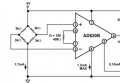
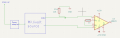
I want to amplify differential output (~30mV, CMV~9V) of a Wheatstone bridge (Gain=50.4). The power supply GND of bridge circuit and AD620 power GND is common. After building this circuit I am able to get output as expected.
But whenever I feed AD620 with a millivolt output from a standalone DC source (Multimeter), the output from AD620 is giving output less than expected (Almost 60% of expected value). What can be the issue?
I am not from electronic background but started studying about bridge circuits recently. Is this something related to GND not common? I noticed that a handheld multimeter shows accurate results eventhough it doesn't have any idea about the common mode voltage/GND associated with differential input.
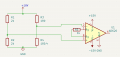
AD620.png
 

crutschow

Joined Mar 14, 2008
38,316
This means whether I have to tie negative terminal of signal source to ad620 GND for correct results?
Yes.
The ground connection can be through a resistor, but there must be a path to ground for the op amp input bias current (even though it is very small).
Both inputs cannot be left floating without a ground path.
 

Thread Starter

anoopak

Joined Nov 24, 2023
77
Yes.
The ground connection can be through a resistor, but there must be a path to ground for the op amp input bias current (even though it is very small).
Both inputs cannot be left floating without a ground path.
I wonder how a multimeter is able to measure bridge output even though there is no physical connection between bridge supply GND and multimeter GND. Please comment on this
 

WBahn

Joined Mar 31, 2012
32,703
I wonder how a multimeter is able to measure bridge output even though there is no physical connection between bridge supply GND and multimeter GND. Please comment on this
One side of the bridge is connected to the multimeters common reference point (erroneously called "ground" by most people). This is why most meters label this input "COM".
 

BobTPH

Joined Jun 5, 2013
11,463
It must have a DC path to ground for the the amp input bias currents, and not be floating.
Isn’t that connection internal in an instrumentation amp? The AD620 datasheet shows it with a bridge connected that way. And it has a ground (ref) pin, unlike an opamp.
 

crutschow

Joined Mar 14, 2008
38,316
I wonder how a multimeter is able to measure bridge output even though there is no physical connection between bridge supply GND and multimeter GND. Please comment on this
GND or COM are just names of a reference node for voltage measurement values. They have no other special meaning.

The two GNDSs (more correctly called common {COM}) are completely different, and have no relation, other than having the same label.
Each circuit or device can have it's own separate COM, and they are only the same voltage if they are connected together.

Thus the meter can measure the bridge voltage because it's COM is just an isolated input, the same as its other input, and can accurately measure the bridge voltage independent of the bridges COM connection.
 

crutschow

Joined Mar 14, 2008
38,316
Isn’t that connection internal in an instrumentation amp? The AD620 datasheet shows it with a bridge connected that way. And it has a ground (ref) pin, unlike an opamp.
No.
The inputs only connection is to the outside world, and must have a DC path to ground, otherwise they float to undefined voltages.
The AD620 ground (ref) pin is to establish the output reference voltage and is not related to the input biasing.

The bridge from the AD620 data sheet (below) is connected to ground, which provides that path.

1727199222917.png
 

crutschow

Joined Mar 14, 2008
38,316
In the TS’s circuit in post #1, note that the bridge and the IA are both connected to ground.
Yes, I noted that, and if you read his first post, he stated, that it worked correctly.
The problem was when he applied a (apparently) isolated voltage from his multimeter.

Ball's back in your court.
 

MisterBill2

Joined Jan 23, 2018
27,164
What sort of "Multimeter" does the TS have???? My model 260 multimeter only puts out a voltage when I measure ohms.
Or maybe the TS has one of those multiple function boxes that do everything, except that the digital voltmeter is powered by a hidden battery.

Funny story about that. I think that those are marketed as a "multi-meter." It included a power supply and an oscillator and some other functions, and everything except the digital meter was mains powered. So none of the other folks who used it on rare occasions ever switched off the voltmeter. So the battery was always dead. After several months I replaced the 9 volt battery with a small DC supply made from a wall-wart transformer supply. It switched off with the rest of the package. Nobody ever figured out what happened that the meter started working.
 
Last edited:

Thread Starter

anoopak

Joined Nov 24, 2023
77
Yes.
The ground connection can be through a resistor, but there must be a path to ground for the op amp input bias current (even though it is very small).
Both inputs cannot be left floating without a ground path.
Thank you for the help. Problem got solved when I connected COM of millivolt source to AD620 GND through a 10k resistor. How to decide upon the value of the resistor? Both 10k resistor and 1k resistor worked for this case. Is there any "Optimum".
Untitled-R1.png
 

MisterBill2

Joined Jan 23, 2018
27,164
REALLY! to preserve the noise reduction benefits of the balanced differential inputs, both inputs should have equal resistors. The actual resistance must be low enough so that the input bias current flowing does not put either input outside of the allowable common mode voltage range, and high enough that the sensor output voltage is not affected by the resistor current. My experience has been resistance values between 100K ohms and one megohm have been OK.
 

Thread Starter

anoopak

Joined Nov 24, 2023
77
REALLY! to preserve the noise reduction benefits of the balanced differential inputs, both inputs should have equal resistors. The actual resistance must be low enough so that the input bias current flowing does not put either input outside of the allowable common mode voltage range, and high enough that the sensor output voltage is not affected by the resistor current. My experience has been resistance values between 100K ohms and one megohm have been OK.
Thank you for the explanation.
 

Thread Starter

anoopak

Joined Nov 24, 2023
77
REALLY! to preserve the noise reduction benefits of the balanced differential inputs, both inputs should have equal resistors. The actual resistance must be low enough so that the input bias current flowing does not put either input outside of the allowable common mode voltage range, and high enough that the sensor output voltage is not affected by the resistor current. My experience has been resistance values between 100K ohms and one megohm have been OK.
I had noticed a small offset in the In-Amp output with only single input pin connected to GND. I will try connecting both input pins to GND through 100k resistors. I expect this will eliminate offset error completely.
 
Top