I have a Mg Air Fuel Cell that produces about 0.4 V. Desire amplifying the voltage to 2.0 v so that an LED will light up. Need a circuit design for this.
Thanks for your rapid response! I want the 0.4V fuel cell voltage to directly power the LED. In other words, the LED circuit would be the load for the fuel cell. The fuel cell current is approximately 28 mA.
The LED can be either steady on or blinking, which ever works best.
You cannot amplify a voltage without giving up something.
In this case, assuming 100% efficiency, increasing the voltage by a factor of 5 means that the available current is reduced by a factor of five.
I will provide you with three solutions.
1) Put five cells in series to give 2 V.
2) Use a Joule Thief circuit.
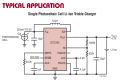
3) Use an energy harvesting IC such as LTC3105.
You can use a self-oscillating boost converter aka joule thief but since you have 0.4V available only (less than 0.7V Vbe of Bjt) you need to use a depletion-type mosfet or germanium transistor as a switch.
You cannot amplify a voltage without giving up something.
In this case, assuming 100% efficiency, increasing the voltage by a factor of 5 means that the available current is reduced by a factor of five.
I will provide you with three solutions.
1) Put five cells in series to give 2 V.
2) Use a Joule Thief circuit.
3) Use an energy harvesting IC such as LTC3105.
You can use a self-oscillating boost converter aka joule thief but since you have 0.4V available only (less than 0.7V Vbe of Bjt) you need to use a depletion-type mosfet or germanium transistor as a switch.
+1
As long as the source can supply the power needed (coverter losses + LED), a small dc-dc converter should work.
The OP didn't mention what fwd state the LED needs to be. Is it full rated LED power, or just barely turn on? I do assume it's probably in the middle, just enough to see the LED or use that light in some kind of sensor setup.
There are low current glass reed switches that work down to nanovolts. They can be a normally open or normally closed switch.
The reed body can be wound with a fine gauge enameled wire. Since 400mV needs enough current to close the switch,
An appropriate value resistor is used to set the current threshold of the switch.
I'm going to analyze this way.
Your power source provides 0.4V at 28ma which is 0.0112W available power.
A LED is say 10ma at 2V or 0.0200W.
Even with the impossible 100% efficiency DC-DC converter your LED requires more power than you can source.
I think you will find it much easier if you can put at least two cells in series. As already mentioned, 0.4V is below what silicon transitions can operate on.
Looong time ago I was after Mg/C in seawater generation; and found still have few working links on my borehole bookmarks folder from work on submarine beacons... May not be applicable to you but at least very educational :
These devices all will work. Of the list the ones with " Thermoelectric " are designed for this job.
I while back I designed one that charged up a large cap. I wanted a couple of seconds of power. These are used where there is not enough power to do a job. In my case I charged up for 1 minute, transmitter information for seconds, then went back to charging. In your case, if you reduce the LED current to 2mA (?) it could stay on all the time. Or at 10mA it could be made to blink on 1 second out of 5 seconds.
Search for " energy harvesting ".
There are a number of parts that will start up if they can get 200mV.
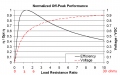
I do not know what type of thermoelectric thing you have. Here is data from one that I have.
It was designed to work best at about 0.4V, 3 ohms or 133mA. (about 4.5x your current??) Under a 30 ohm load it makes 0.9V.
This appears to be much like a solar cell, pulling too much power or too little makes the energy source not efficient.
On this graph, a 3 ohm load is best, or limit the current to 133mA or the voltage to 0.4.
I think a dumb boost circuit will not run at the Maximum Power Point. Some of the Harvesting circuits do have a MPP controller built in.
There are a number of circuits that need 0.9V to start but will run down to 0.4V. I think they will work.
I think the original post is not about a thermoelectric device; but a magnesium-air cell battery. From my adventures with Mg generation in seawater I suggested the same type of DC converter links I dealt with, similar to thermoelectric-input boost circuit harvester circuits. Will see...

 Facebook
 Google
 GitHub
 Linkedin



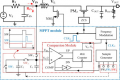
 I think used the unobtanium LD1010D device.