What changes should I made to the connections of the circuit to use an NPN instead of PNP transistor?

Thread Starter

Michael George

Joined Feb 8, 2015
62
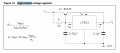
1758137085012.png
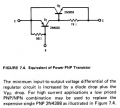
Hello, I have many PHE13007 power transistor (which is NPN) and I don't want to go and buy PNP transistors. So, I would really appreciate it if you tell me how to replace the PNP transistor with PHE13007 ? How should it be connected (the base, collector, and emitter)?
I have one more question for teaching purpose, is there any chance that the transistor delivers the full input voltage (Vi) to the load? because this may destroy the load.
What I'm trying to do is to "improve" the max current that the circuit can supply. The load is variable and will draw 0.5A to 2A.
Thank you all. Every answer, comment, or a hint will be liked and appreciated.
 

panic mode

Joined Oct 10, 2011
4,864
PNP and NPN transistors are opposite polarity. they can be used interchangeable if entire circuit is changed for different polarity. (use 79xx with NPN).

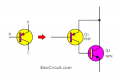
the other option (keeping 78xx) and still using NPN as pass through transistor is to use small PNP transistor to makeyour NPN power transistor function as PNP.

1758138570680.png

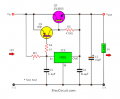
to get something like this (5V 3A)
1758138669823.png

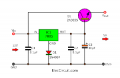
note, you could go el-cheapo and try this but regulation will be not as good because Vbe changes with current and temperature
1758138759697.png
 
Last edited:

crutschow

Joined Mar 14, 2008
38,316
The PNP can be just about any small device BJT, such as the 2N2905, 2N2907, 2N3906, etc., since it only needs to provide the base current to the NPN.
 
Last edited:

crutschow

Joined Mar 14, 2008
38,316
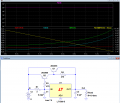
Below is an LTspice sim showing the operation of the NPN-PNP circuit using a regulator similar to the 7805, with R1 = 2Ω for a load of 0.5A to 2A:

Displayed is the total output load current (green trace), the regulator current (red trace), and the NPN output current (blue trace).

Edit: The value of R1 determines the current division between the regulator and the transistor, with a higher value causing more relative transistor current.

1758205780428.png
 
Last edited:

Thread Starter

Michael George

Joined Feb 8, 2015
62
PNP and NPN transistors are opposite polarity. they can be used interchangeable if entire circuit is changed for different polarity. (use 79xx with NPN).

the other option (keeping 78xx) and still using NPN as pass through transistor is to use small PNP transistor to makeyour NPN power transistor function as PNP.

View attachment 356031

to get something like this (5V 3A)
View attachment 356032

note, you could go el-cheapo and try this but regulation will be not as good because Vbe changes with current and temperature
View attachment 356034
Hi,
In your second image, would you tell me a rule of thumb how R2 and R3 are calculated? I just need the basic/simplified equations to determine their values.
Thank you in advance for your help
 

panic mode

Joined Oct 10, 2011
4,864
R2 is there to limit base current of Q1 on powerup. This is when C1 is empty and acts as a short circuit.
Value is not critical as it does not need to be exact. Obviously circuit designer chose 12mA for base current.
R2 = 12V/12mA = 1k

read datasheet of the transistor to confirm what base current is tolerable. Don't push the limits,..

R1 is calculated based on Vbe of Q1 which is about 0.6V, and current that IC1 should handle. When using external transistors to handle higher current, one can choose how much current id going through IC1. for example one can try to keep heat dissipation of IC1 low (<0.5W) if IC1 is not on a heatsink.
Suppose we do want to keep IC1 not stressed and let transistor handle the brunt of heat dissipation. Since Vin is 12V and Vout is 5V, IC1 will see voltage drop of 7V. so 0.5W/7V = 71.4mA

In this case R1 would need to be 0.6V/0.0714A = 8.4 Ohm. So 8.2 Ohm is nearest common value.
the same idea is used to calculate R3.
Vbe of Q2 is a bit higher, i would use some 0.75 - 0.80V

You want to turn Q2 on before Q1 is stressed too much.
 
Top