Can you amplify a signal with only resistors?

Thread Starter

tsmspace

Joined Mar 16, 2026
67
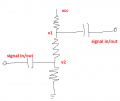
would it be possible to amplify a signal with this resistor circuit?


i put 'signal in/out' because i mean, if any works.

the theory question is basically, this circuit would present a voltage divider, so if a signal comes in at v2/v1, would this voltage result in a change in the voltage at v1/v2 , and in this configuration (or an alternate resistor organization) would it be possible to result in an amplification of the signal?
 

Attachments

WBahn

Joined Mar 31, 2012
32,777
Nope. At signal frequencies (i.e., above the cutoff frequencies imposed by the coupling capacitors), the gain is essentially the voltage divider action of the top two resistors. It will actually be less due to the interaction of the bottom resistor with the output impedance of the signal source, but if that impedance is low enough in relation, that can be neglected.

Don't try to spitball the analysis -- actually analyze the circuit.
 

Thread Starter

tsmspace

Joined Mar 16, 2026
67
Nope. At signal frequencies (i.e., above the cutoff frequencies imposed by the coupling capacitors), the gain is essentially the voltage divider action of the top two resistors. It will actually be less due to the interaction of the bottom resistor with the output impedance of the signal source, but if that impedance is low enough in relation, that can be neglected.

Don't try to spitball the analysis -- actually analyze the circuit.
i still don't know how to do that
 
You can amplify a signal without active components using a transformer.
Respectfully - I disagree.

If you have a 500mV signal at 2W you can transform that voltage (and lets assume 100% efficiency) if you transform that voltage from 500mV to 1V you still get 2W. The voltage is higher but the volume remains the same. The amperage gets cut in half. Again, in a perfect world.

10V @ 10A is 100W. Transform that to 20V it's 5A. And that still works out to 100W.
 

MrChips

Joined Oct 2, 2009
34,714
Respectfully - I disagree.

If you have a 500mV signal at 2W you can transform that voltage (and lets assume 100% efficiency) if you transform that voltage from 500mV to 1V you still get 2W. The voltage is higher but the volume remains the same. The amperage gets cut in half. Again, in a perfect world.

10V @ 10A is 100W. Transform that to 20V it's 5A. And that still works out to 100W.
If amplification means increasing the power, then that is not possible because it defies the law of conservation of energy.
 

Thread Starter

tsmspace

Joined Mar 16, 2026
67
You can amplify a signal without active components using a transformer.
To change the voltage of a signal using a transformer, would you need to overcome the resistance of the inductors, meaning there would be a threshold minimum voltage to pass the signal?

when initially thinking about this resistor line and wondering if there was a way to amplify using only resistors, i was looking at common-base amplifiers. These amplifiers are good at taking weak small signals and increasing the voltage of the signal (according to the description i read on the net) so that it can be passed to another form of amplifier for power amplification. So, would a transformer work in this kind of way as well, or would it be better suited for an already quite powerful signal?
 

panic mode

Joined Oct 10, 2011
4,947
define what is that you wish to gain... usually amplification is referring to voltage gain Av=Vo/Vi. this ignores any currents, so transformer can be used to increase AC voltage...
similarly it can also be used to increase output current but not both voltage and current at the same time. to increase both, means increasing power and energy needs to come from somewhere - batteries or PSU
 
in simple single transistor amplifier, transistor works as variable resistor which is part of voltage divider.

so maybe try replacing transistor with some other resistor that can change value. for example use photoresistor or carbon microphone etc. and drive it with something suitable.
 
You can amplify a signal without active components using a transformer.
NO!!! You CAN NOT "AMPLIFY" A SIGNAL WITH A TRANSFORMER!!! What you CAN DO is increase the voltage, AND match the output to an external load impedance ! THAT is entirely possible,!
HOWEVER, if we accept the standard definition of the term "amplify" to mean "increase the power level" of the signal, that action MUST include the addition of POWER from an external source. Certainly there are tricks to mislead those who do not fully understand what amplification actually is.

Of course, POWER TRANSFER to aload can be improved by correct impedance matching, but that does not meet the definition of Amplification.

There does exist the possibility that some writer has decided that the meaning is different, for reasons that we are not given.


The unfortunate reality is that WISHING SOMETHING WERE TRUE DOES NOT MAKE IT TRUE!!! This applies no matter how intense the result is wished for.
ACTUALLY, that reality has saved humanity from awhole lot of serious problems. BUT that is off topic for this discussion.
 

Thread Starter

tsmspace

Joined Mar 16, 2026
67
NO!!! You CAN NOT "AMPLIFY" A SIGNAL WITH A TRANSFORMER!!! What you CAN DO is increase the voltage, AND match the output to an external load impedance ! THAT is entirely possible,!
HOWEVER, if we accept the standard definition of the term "amplify" to mean "increase the power level" of the signal, that action MUST include the addition of POWER from an external source. Certainly there are tricks to mislead those who do not fully understand what amplification actually is.

Of course, POWER TRANSFER to aload can be improved by correct impedance matching, but that does not meet the definition of Amplification.

There does exist the possibility that some writer has decided that the meaning is different, for reasons that we are not given.


The unfortunate reality is that WISHING SOMETHING WERE TRUE DOES NOT MAKE IT TRUE!!! This applies no matter how intense the result is wished for.
ACTUALLY, that reality has saved humanity from awhole lot of serious problems. BUT that is off topic for this discussion.
in my original post, i showed a voltage divider. what percent of change in v2 would occur from a change in v1?
 
Top