Amplify a +-20mV signal to a positive range for an ADC

Thread Starter

4lch_

Joined Nov 16, 2023
22
Hi all !
I am currently looking into designing an amplifier for a custom thermocouple that will be used to measure temperature and heat flux across surfaces in buildings.

The thermocouple is designed to output voltages in a +-20mV range, and the response is pretty much DC, since it will measure slowly changing temperatures and fluxes (and it will only be read out every 15 minutes or so).

I am looking for a solution to design an amplifier with high accuracy and low-drift, to feed it to a dedicated 16 or 24-bits ADC if it makes sense with the achievable accuracy. So the task would be to take the +-20mV range and map it to something like 0-2.048V for example.

Thanks in advance for your tips and help ! Analog stuff is not where I'm the most comfortable yet, but learning about it is awesome :)
 

Thread Starter

4lch_

Joined Nov 16, 2023
22
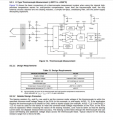
If you use the right application specific IC, you can eliminate the amplifier.
https://www.analog.com/media/en/technical-documentation/data-sheets/max31855.pdf
An example: https://www.adafruit.com/product/269
Thanks a lot for your quick reply !
I am actually currently using a MAX31856 that has a raw ±19.531mV mode, but I would love to have a little more flexibility regarding the range, since it is very close to my expected range, and in the future, the range might increase. It also has a ±78.125mV mode, but with decreased accuracy. I am also having issues getting these to work correctly but that's another topic, and that's probably on me :)

The point would also be to learn more about analog electronics of course, even if this is surely a case where using a dedicated IC makes a lot of sense, as you suggested :)
 

nsaspook

Joined Aug 27, 2009
16,255
Thanks a lot for your quick reply !
I am actually currently using a MAX31856 that has a raw ±19.531mV mode, but I would love to have a little more flexibility regarding the range, since it is very close to my expected range, and in the future, the range might increase. It also has a ±78.125mV mode, but with decreased accuracy. I am also having issues getting these to work correctly but that's another topic, and that's probably on me :)

The point would also be to learn more about analog electronics of course, even if this is surely a case where using a dedicated IC makes a lot of sense, as you suggested :)
There is an infinite number of old-school analog TC designs.
 

AnalogKid

Joined Aug 1, 2013
12,054
There are hundreds of high-precision, low-error, low-drift opamps and instrumentation amps to choose from.

You don't say what kind of performance / accuracy / precision you need. For insane DC performance, consider a chopper-stabilized amp.

ak
 

MrChips

Joined Oct 2, 2009
34,630
A thermocouple amplifier is just a special case of op-amp applications.
Learn about basic op-amp configurations first.

https://www.electronics-tutorials.ws/opamp/opamp_1.html

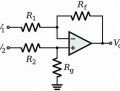
Start with the basic differential amplifier
where R1 = R2, Rf = Rg.
Av = -Rf / R1

Vo = -(V1 - V2) x Rf / R1

1700162397911.png

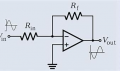
Then study these circuits:

Inverting amplifier
1700162637527.png


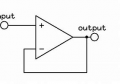
Unity gain non-inverting buffer
1700162795255.png

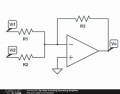
Summing amplifier
1700162854084.png


Here are some tips that you should commit to memory:
Characteristics of an ideal op-amp:
  1. Infinite input impedance
  2. Zero output impedance
  3. Infinite voltage gain
  4. Infinite bandwidth

In a properly biased op-amp circuit with negative feed-back, the voltage at the inverting input is equal to the voltage at the non-inverting input i.e. the voltage difference at the inputs is zero.
 

Thread Starter

4lch_

Joined Nov 16, 2023
22
There are hundreds of high-precision, low-error, low-drift opamps and instrumentation amps to choose from.

You don't say what kind of performance / accuracy / precision you need. For insane DC performance, consider a chopper-stabilized amp.

ak
Thanks a lot !
The sensor voltage is pretty much DC, so there isn't a lot of constraints frequency-wise, but I would love to be able to map the full range of the sensor to a high-accuracy ADC. Ideally, the precision should be enough to be able to justify using a 20-24 bits ADC.

I had not heard of chopper-stabilized amps and definitely checking them out !

Regarding mapping the negative-positive range to a single-ended positive range, it is enough to apply an offset after the amp, so that 0V lies in the middle of the target range and there is enough headroom on either side ?
 

Thread Starter

4lch_

Joined Nov 16, 2023
22
A thermocouple amplifier is just a special case of op-amp applications.
Learn about basic op-amp configurations first.

https://www.electronics-tutorials.ws/opamp/opamp_1.html

Start with the basic differential amplifier
where R1 = R2, Rf = Rg.
Av = -Rf / R1

Vo = -(V1 - V2) x Rf / R1

View attachment 307743

Then study these circuits:

Inverting amplifier
View attachment 307744


Unity gain non-inverting buffer
View attachment 307745

Summing amplifier
View attachment 307746


Here are some tips that you should commit to memory:
Characteristics of an ideal op-amp:
  1. Infinite input impedance
  2. Zero output impedance
  3. Infinite voltage gain
  4. Infinite bandwidth

In a properly biased op-amp circuit with negative feed-back, the voltage at the inverting input is equal to the voltage at the non-inverting input i.e. the voltage difference at the inputs is zero.
Thank you so much for the high quality answer and examples ! A refresher on OPAMPs is definitely the right place to start :)
I am waiting for a copy of Sergio Franco's "Design with operational amplifiers and analog integrated circuits" in the mail which should hopefully but me back on track for more advanced stuff :)
 

AnalogKid

Joined Aug 1, 2013
12,054
Ideally, the precision should be enough to be able to justify using a 20-24 bits ADC.
That is a lovely ideal. But . . .

That is between 1 million-to-1 and 16 million-to-1. No voltage reference has that kind of accuracy, stability, or noise performance. Those high-bit A/D's can give you very fine increments within a range, but the accuracy of the overall range is set by external components.

Analog Devices (ADI) and Linear Technology (now owned by ADI) have several high-bit A/D's, and the app notes and design guides to support them. I rank them above Maxim and TI, and LT is my fav.

ak
 
Hi all !
I am currently looking into designing an amplifier for a custom thermocouple that will be used to measure temperature and heat flux across surfaces in buildings.

The thermocouple is designed to output voltages in a +-20mV range, and the response is pretty much DC, since it will measure slowly changing temperatures and fluxes (and it will only be read out every 15 minutes or so).

I am looking for a solution to design an amplifier with high accuracy and low-drift, to feed it to a dedicated 16 or 24-bits ADC if it makes sense with the achievable accuracy. So the task would be to take the +-20mV range and map it to something like 0-2.048V for example.
There are specific amplifiers designed to read thermocouples, if you want more flexibility for your custom sensor i'd design the system in this way:
  • Bias the TC inputs as in the application quoted by @nsaspook (pullup and pulldown resistors, lowpass filter)
  • Use an instrumentation amplifier (i.e. INA128 or INA121)
  • Connect the ref input to a voltage that is half the common mode input range of your ADC (i.e. if the ADC accepts signals up to 3.3V you can generate a 1.65V reference with two resistors and an opamp as a buffer)
  • Read the signal with a differential amplifier (sigma-delta typically have differential inputs or can be configured as such)

In general it is challenging to design a system that can take full advantage of a 24bit adc, it requires high precision opamps, voltage references, resistors, careful shielding, etc....

A couple of years ago i used an INA121 + ADS1115 to read heat flux (Hukseflux FHF04) sensors with good results but for the integrated T-type thermocouple i chose the MCP9600 because it semplified considerably the design.
 

Thread Starter

4lch_

Joined Nov 16, 2023
22
That is a lovely ideal. But . . .

That is between 1 million-to-1 and 16 million-to-1. No voltage reference has that kind of accuracy, stability, or noise performance. Those high-bit A/D's can give you very fine increments within a range, but the accuracy of the overall range is set by external components.

Analog Devices (ADI) and Linear Technology (now owned by ADI) have several high-bit A/D's, and the app notes and design guides to support them. I rank them above Maxim and TI, and LT is my fav.

ak
Thanks a lot for your reply, indeed that would be quite demanding on the external components ! I guess it is fine if the external precision is good, this way the ADC is not a bottleneck at least :)
Thanks also for the manufacturers recommendations ! I have been looking mostly at Analog Device's catalog and they indeed have some seemingly really nice converters that aren't too expensive either.
Thanks again !
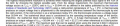
You can get very good accuracy, stability, or noise performance with a good Sigma-Delta 24-bit ADC like the TI ADS1220. I've tested it pretty much full range with a precision calibrator. Yes, you need quality external components but that true of any precision circuit.
https://forum.allaboutcircuits.com/threads/super-moon-shine.100322/post-899878
https://www.ti.com/lit/ds/symlink/ads1220.pdf

View attachment 307751
View attachment 307752
Thank you so much, that's a great thread !
Actually heard about Sigma-Delta amps for the first time just today, as I came across a configurator on Analog Devices' website ! That seems perfectly suited for the job, especially with the included cold junction temperature sensor included in this specific component. The thermocouple I'm working with does not really fit a standard type, but being able to output the voltage is plenty enough since I have calibration data for the thermocouple.
Thanks again !
 

Thread Starter

4lch_

Joined Nov 16, 2023
22
There are specific amplifiers designed to read thermocouples, if you want more flexibility for your custom sensor i'd design the system in this way:
  • Bias the TC inputs as in the application quoted by @nsaspook (pullup and pulldown resistors, lowpass filter)
  • Use an instrumentation amplifier (i.e. INA128 or INA121)
  • Connect the ref input to a voltage that is half the common mode input range of your ADC (i.e. if the ADC accepts signals up to 3.3V you can generate a 1.65V reference with two resistors and an opamp as a buffer)
  • Read the signal with a differential amplifier (sigma-delta typically have differential inputs or can be configured as such)

In general it is challenging to design a system that can take full advantage of a 24bit adc, it requires high precision opamps, voltage references, resistors, careful shielding, etc....

A couple of years ago i used an INA121 + ADS1115 to read heat flux (Hukseflux FHF04) sensors with good results but for the integrated T-type thermocouple i chose the MCP9600 because it semplified considerably the design.
Hi Paolo and thank you so much for the in-depth answer !
Your detailed breakdown of the steps and recommendations are super useful to help me wrap my head around this :)

Indeed, 24-bits is most likely overkill and that kind of precision is probably not really all that useful, but at least it wouldn't be a bottleneck I guess. 16-bits is probably alright, 18-20 perfect and 24 over the top

Thanks again for taking your time for this, this is exactly what I was looking for in terms of completeness regarding every analog "brick" that would be needed to achieve this.
 

MrChips

Joined Oct 2, 2009
34,630
Don't be intimidated with 24-bit ADC. This is a viable solution for a lot of sensor applications.
Just imagine being able to measure 1μV with a 1V headroom (dynamic range). You don't have to use all 24 bits. You use only what you need. If you want 16-bit resolution then you use the upper 16 bits (the most significant bits).
 

AnalogKid

Joined Aug 1, 2013
12,054
You don't have to use all 24 bits. You use only what you need. If you want 16-bit resolution then you use the upper 16 bits (the most significant bits).
About 20 years ago (o.u.c.h), I did that in a tech refresh project for an FAA radar controller. The original system had an 8-bit A/D, two 8-bit D/As. All were 10 MHz parts running at 10 MHz, and there was a three page setup and calibration procedure with several adjustments. The new system had a true 12-bit reference, a 12 bit A/D, and 12-bit D/As. All were 20 MHz parts running at 10 MHz, and the system used only the upper 8 bits. Calibration was 4 steps.

Install a 2-pin shunt to cause the CPLD to force an FF to both D/A's.
Adjust one pot so the first D/A channel output was 10.000 V.
Adjust the other pot so the second D/A channel output was 10.000 V.
Remove the shunt.

Systems are still running.

ak
 

MrChips

Joined Oct 2, 2009
34,630
Wow! That brings back memories. My first waveform digitizer I built was based on a TRW TDC-1007J 20MHz 8-bit flash ADC. This chip got so hot you could literally fry an egg on it.
 
Top