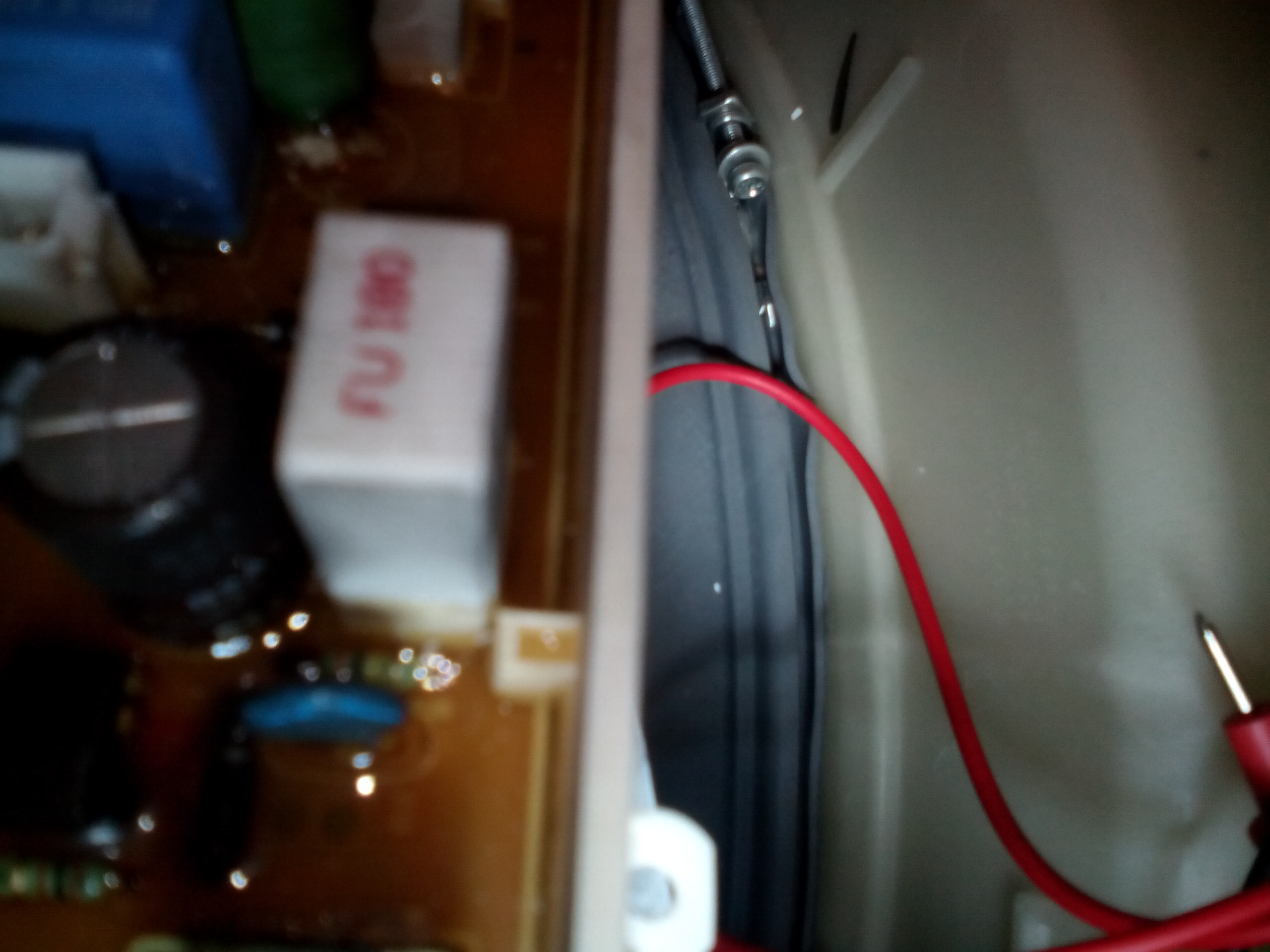
How do you test this relay?

LesJones

Joined Jan 8, 2017
4,511
Unplug you machine from the power socket. Unplug the connector from CN4. Unplug the connectors from the top of the heater relay. Set your meter to a low ohms range (200 ohms ?) Connect one of the meter probes (We will call this probe A) to CN4 If you can get to the connections to the inductor L1 connect the other meter probe (We will call this probe B) to each of the two wires in turn and note each resistance reading. Now connect probe B to D20 negative then D22 positive and note each reading. Disconnect probe A from CN4 and connect it to the connector on the top of the heater relay that had the wire to the noise filter connected to it. If you can get to the wires on PTC1 connect probe B to each in turn and note the readings. Connect probe B to D21 negative and D23 positive in turn and note the readings. Post the results of these tests. I think using an angle grinder to remove the circuit board is a bit drastic. Can you post some well focused pictures (You may need to use manual focus on your camera if it has that option.) of how the circuit board is mounted in the plastic housing and how the housing is mounted in the machine. I may be able to see a way to remove it without using an angle grinder.

Les.
 

Thread Starter

elli

Joined Jun 12, 2017
37
Multimeter set to 200 ohms...

CN4-L1 = Nothing

CN4-D20 negative = Nothing

CN4-D22 positive = Nothing

Heater relay (noise filter wire point)-PTC1 = 01.2ohms/26.4ohms

Heater relay (noise filter wire point)-D20 negative = 26.4ohms

Heater relay (noise filter wire point)-D23 positive = 26.4ohms

I'm gonna try to get a better camera for the pictures.
Here's one thats very similar...
 
Last edited:

LesJones

Joined Jan 8, 2017
4,511
There are no components between CN4 and one side of L1 so there must be a broken track or a bad solder joint at one end of the track. Are you sure that you have identified CN4 correctly ? It is just to the left of PTC1. It looks like the board in the picture is held in with plastic clips. I can only see one. (There will be more.) It is on the top edge of the plastic housing about a third of the way from the right hand side. It looks like pressing it towards the edge of the moulding will allow the board to be lifted out. It may be difficult to release all of the clips at the same time.

Les.
 

Thread Starter

elli

Joined Jun 12, 2017
37
There are no components between CN4 and one side of L1 so there must be a broken track or a bad solder joint at one end of the track. Are you sure that you have identified CN4 correctly ?It is just to the left of PTC1.
Ok, my mistake. Was testing the wire side. Here are the actual numbers...

CN4-L1 = Nothing/2.2ohms

CN4-D20 negative = 2.2ohms

CN4-D22 positive = 2.2ohms


It looks like the board in the picture is held in with plastic clips. I can only see one. (There will be more.) It is on the top edge of the plastic housing about a third of the way from the right hand side. It looks like pressing it towards the edge of the moulding will allow the board to be lifted out. It may be difficult to release all of the clips at the same time.

Les.
Its not a clip but rather a wedge (fixed) to keep the board permanently secured in place. That's the only one that looks like that, the others around the board are squarish as shown in below picture. Sorry, that's the best by phone camera can do.
The only way i could see to lift the board in that way is to break those points, but then i would have to figure out how to keep the board in place. I guess they designed it to be replaced and not repaired. A quick Google search confirms it.
 

LesJones

Joined Jan 8, 2017
4,511
What do you mean by "nothing" on a resistance reading. Do you mean the display is blank, the resistance reading is zero or there is an overrange indication on the display ?
From the results in posts #62 and #64 you should be getting about 220 volts AC at the input of the bridge rectifier. (D20, D21, D22 and D23)
With your meter set to a suitable AC voltage range measure the voltage between D21 negative and D22 positive. If you get a reading of about 220 volts AC then goto test 2. If not goto test 3

TEST 2
Set your meter to a suitable range to measure 320 volts DC. Connect your negative meter probe to D23 negative. Connect the positive meter probe to D20 positive Note the reading and goto Post results.


TEST 3
With you meter still set to the same AC voltage range connect one meter probe to the connector that plugs into CN4 (With it still plugged into CN4) Connect the other probe connected to the connector on the heater relay that comes from the noise filter. (With the connector still connected to the relay.) Note the reading. At the noise filter measure the voltage between it's output terminals and note the reading. Measure the voltage between its input terminals and note the reading. Goto Post results.


POST RESULTS
Post the results of the tests. Consider the that the circuit board had to be fitted to the plastic moulding in manufacture. Work out how it was done. This should give you a clue about how to try to remove it.


Les.
 

Thread Starter

elli

Joined Jun 12, 2017
37
What do you mean by "nothing" on a resistance reading. Do you mean the display is blank, the resistance reading is zero or there is an overrange indication on the display ?
Nothing as in no continuity. The numbers stay the same on the multimeter - 00.0.

From the results in posts #62 and #64 you should be getting about 220 volts AC at the input of the bridge rectifier. (D20, D21, D22 and D23)
With your meter set to a suitable AC voltage range measure the voltage between D21 negative and D22 positive. If you get a reading of about 220 volts AC then goto test 2. If not goto test 3
I am getting no reading. Could it be that it has something to do with the on/off switch?

TEST 2
Set your meter to a suitable range to measure 320 volts DC. Connect your negative meter probe to D23 negative. Connect the positive meter probe to D20 positive Note the reading and goto Post results.
Skipped

TEST 3
With you meter still set to the same AC voltage range connect one meter probe to the connector that plugs into CN4 (With it still plugged into CN4) Connect the other probe connected to the connector on the heater relay that comes from the noise filter. (With the connector still connected to the relay.) Note the reading. At the noise filter measure the voltage between it's output terminals and note the reading. Measure the voltage between its input terminals and note the reading. Goto Post results.
CN4 - Heater relay (back probing the wires while connected) = 220 v

Noise filter output terminals (back probing the wires while connected) = 220 v

Noise filter input terminals (back probing the wires while connected)
= 219 v

POST RESULTS
Post the results of the tests. Consider the that the circuit board had to be fitted to the plastic moulding in manufacture. Work out how it was done. This should give you a clue about how to try to remove it.

Les.
On it!
 

LesJones

Joined Jan 8, 2017
4,511
You don't seem to have any understanding of electricity. (Voltage, current and resistance.) If you have no continuity the resistance reading will be infinite. If you have perfect continuity then the resistance is zero. (I am using the terms infinity and zero in a practical sense. There would always be some very high resistance between two points due to moisture in the air. Your meter will display something to show that the resistance is above the range of the meter.) (What does you meter display on the ohms range when the test probes are not touching anything or each other ?) There will always be some resistance in a normal conductor. A supper conductor is the only thing that has zero resistance.) With your meter set to an ohms range and the probes not touching the meter will not be able to display the resistance as it's value will be over 200 million ohms (Which is the highest range I have seen on a normal meter.) Most meters will not have a resolution of less than 0.1 ohms If you touch the probes together you will get a reading close to zero ohms. This value is the resistance of the test leads. So if you are measuring low resistance values you will need to subtract the resistance of the test leads from the reading to get the actual resistance between the points that you are measuring.

The problem cannot be the on/off switch. If you look at the schematic the mains comes into the machine. It then passes through the noise filter. From the noise filter the neutral goes via a wire that plugs into CN4. From there it passes trough the inductor L1 and to one input of the bridge rectifier. The live comes from the noise filter via a wire to the white connector (Which is black on your machine.) which plugs into the heater relay. This connector connects through the relay to the board as well as one of the contacts in the relay. (See the link to the data on the relay posted by "bertus" in post #2) From your tests in post #66 you had 220 volts at the the connector to CN4 and the connector to the top of the heater relay. From yor tests in posts #62 and #64 you had continuity between CN4 and on iput to the bridge. From the heter relay terminal you had continuity to the other side of the bridge input. This suggests that the connector to CN4 is not making contact or the connector to the top of the heater relay is not making contact. WITH THE MACHINE UNPLUGGED FROM THE MAINS measure the resistance from each output of the noise filter to D21 negative and D22 positive. (Four readings)

Les.
 

Thread Starter

elli

Joined Jun 12, 2017
37
You don't seem to have any understanding of electricity. (Voltage, current and resistance.)
Wouldn't be here if i did.

If you have no continuity the resistance reading will be infinite. If you have perfect continuity then the resistance is zero. (I am using the terms infinity and zero in a practical sense. There would always be some very high resistance between two points due to moisture in the air. Your meter will display something to show that the resistance is above the range of the meter.) (What does you meter display on the ohms range when the test probes are not touching anything or each other ?) There will always be some resistance in a normal conductor. A supper conductor is the only thing that has zero resistance.) With your meter set to an ohms range and the probes not touching the meter will not be able to display the resistance as it's value will be over 200 million ohms (Which is the highest range I have seen on a normal meter.) Most meters will not have a resolution of less than 0.1 ohms If you touch the probes together you will get a reading close to zero ohms. This value is the resistance of the test leads. So if you are measuring low resistance values you will need to subtract the resistance of the test leads from the reading to get the actual resistance between the points that you are measuring.
How do i put this...Let's imagine the multimeter is off. Let's now turn it on, and set it to 200 ohms... the multimeter now displays 00.0 (resistance higher than 200 ohms without connecting the probes to anything). Now connect one probe to CN4 and the other to one of the wires on L1...the meter still shows 00.0 (so technically, a resistance higher than 200 ohms). Remove the same probe and connect it to the other wire of L1...the meter now reads 2.2.
Set the multimeter to continuity with sound...the meter now displays 1. Connect the 2 probes together and the meter starts beeping continuously while displaying between 0.00-0.01. Now connect one of the meter probes to CN4 and the other to one of the wires of L1...the meter shows 1...no beep. Connect it to the other wire of L1 and now the meter beeps....Hence, no continuity = Nothing.

The problem cannot be the on/off switch. If you look at the schematic the mains comes into the machine. It then passes through the noise filter. From the noise filter the neutral goes via a wire that plugs into CN4. From there it passes trough the inductor L1 and to one input of the bridge rectifier. The live comes from the noise filter via a wire to the white connector (Which is black on your machine.) which plugs into the heater relay. This connector connects through the relay to the board as well as one of the contacts in the relay. (See the link to the data on the relay posted by "bertus" in post #2) From your tests in post #66 you had 220 volts at the the connector to CN4 and the connector to the top of the heater relay. From yor tests in posts #62 and #64 you had continuity between CN4 and on iput to the bridge. From the heter relay terminal you had continuity to the other side of the bridge input. This suggests that the connector to CN4 is not making contact or the connector to the top of the heater relay is not making contact. WITH THE MACHINE UNPLUGGED FROM THE MAINS measure the resistance from each output of the noise filter to D21 negative and D22 positive. (Four readings)
Les.
Filter output which heather relay is connected to & D21 negative = 26.5 ohms
The other filter output & D22 positive = 03.2 ohms
 

LesJones

Joined Jan 8, 2017
4,511
Hi elli,
I have never seen a meter that show zero ohms on an open circuit. When the meter bleeps on the continuity range that is showing that there is continuity continuity. This is what you would expect between CN4 and one side of L1 The 2.2 ohms reading to the other side of L1 is the resistance of L1. (Which is about what I would expect)
The resistance reading of 26.5 ohms and 3.2 ohms are about what I would expect. This rules out my suspicion of a bad connection at CN1 or the connector on the top of the heater relay. I am now wondering if the diodes (D20 - D23) in the bridge rectifier have failed short circuit. I had initially discounted this as I would have expected it to have caused PTC1 or L1 to have burned out. WITH NO POWER TO THE MACINE can you measure the resistance between D21 negative and D22 positive and between the ends of each of the four diodes (D20 - D23) . Do each of these tests twice reversing the positive and negative probes. Have the meter set to continuity so you can tell the difference between zero ohms and greater than 200 ohms. If your meter has a diode test range repeat these tests using that range. Now with power to the machine and your meter set to The AC voltage range measure the voltage between CN4 and D22 positive and then between the connection on the heater relay and D21 negative

Les.
 

Thread Starter

elli

Joined Jun 12, 2017
37
Ok, i just tested again (actually earlier) and now i'm getting 01.7 between CN4 & L1 on the wire which was reading 0.00. It took a good 5 minutes of persistent probing it get a reading. There is some sort of protective (?) black chalk on the wire...i guess that and the putty made it difficult for the probe to make a clean contact.
Should i still do what you posted above?
 

LesJones

Joined Jan 8, 2017
4,511
Yes, we need to understand how we can have 220 volts at the input to the board but no voltage at the input of the bridge rectifier. I was expecting to find an open circuit (Lack of continuity.) but your tests between the noise filter and the input of the bridge rectifier measuring the resistance of both the live and neutral paths showed the readings to have been about the expected values. The present theory is that there is a short circuit across the input of the bridge rectifier and that the current is being limited to a safe value by PTC1. (PTC stands for positive temperature coefficient resistor. This means that as it heats up it's resistance increases. so it will limit the current. If it did not change it's resistance from it's value at room temperature (About 27 ohms) there would be a lot of power being dissipated in the form of heat. The power is V squared over R so it would be 220 x 220/27 = 40400/27 = 1792 watts. This is a lot of heat and would burn out a normal resistor in a fraction of a second) Testing diodes particularly in circuit can give confusing results with the normal resistance range on a meter which is why I have asked for the voltage tests as well. If this theory is not correct then I can't think of any other theory that fits the results of the tests so far.

Les.
 

Thread Starter

elli

Joined Jun 12, 2017
37
Multimeter set to continuity...

1. D21- and D22+ (red probe on D2-) = 1058 / Reverse = 1061

2. D20-+ (black probe on -) = 598 / Reverse = 784
3. D21-+ (black probe on -) = 605 / Reverse = 780
4. D22-+ (black probe on -) = 587 / Reverse = 777
5. D23-+ (black probe on -) = 605 / Reverse = 777

Multimeter set to AC 500...

6. CN4 and D22+ = 0.00 volts
7. Heater relay (noise filter connection) and D21- = 218 volts (climbs slowly).
 
Last edited:

LesJones

Joined Jan 8, 2017
4,511
I think the 4 diodes are OK. It looks like PTC1 is limiting the current to the switch mode regulator as almost the full mains voltage is being dropped across it. I suspect IC7 has failed but this could have been caused by another component failure in the switch mode power supply or this failure caused other components in the switch mode power supply to fail. It is common in switch mode power supplies for one component failure to cause other components to fail. I think you have gone as far as you can at tracing the fault. I think the manufacturers service method would be to replace the board assembly. As it looks on your version of the machine the connections between this board and the display board are soldered wires the assembly will be the two boards. I think that will be an expensive item. It is just a possibility that PTC1 is failing by going almost open circuit as soon as it starts to warm up. You would need the data sheet on the PTC, a means of monitoring the current through it and a means of mesuring it's temperature to work out if it is fauly or just behaving as it should do.

Les.
 

Thread Starter

elli

Joined Jun 12, 2017
37
Well, what a bummer!

Do you think, like Ron said, there is a permissive loop of conditions that have to be met before PTC1 is to allow current? If so, can those conditions be seen in the schematic? I've heard that the drain pump, when defective, causes a similar no start situation.

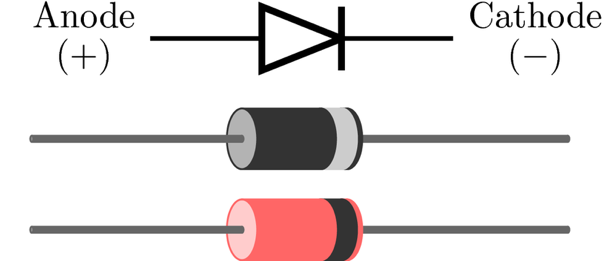
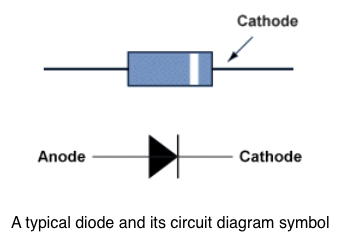
Yes you are correct. (The end of the diode marked with a band is the positive end.) Again be VERY CARFULL. Although you are only expecting 12 volts DC between those two points they will both have 220 volts AC on them with respect to earth. This is enough to kill you if you touch them.

Les.
I just noticed something. You said in an earlier post that the side of the diode with the band is the positive end. Was that a typo?
 
Last edited:

LesJones

Joined Jan 8, 2017
4,511
The PTC is a pasive two wire device. There are no control signals to it. The way it is used in this application you can think of it a bit like a fuse that will repair itself when the current drops to an acceptable level. If you were to measure the resistance straight after removing mains power you would find that it was much more than 27 ohms as it will have heated up and will take some time to cool down. To undersand fully how that particular PTC behaves you would need to find it's part number and then search the web for a data sheet. This would probably give you graphs of it's resistance against temperature and power dissipation. The positive end of a diode is the end with the band.

Les.
 

Thread Starter

elli

Joined Jun 12, 2017
37
The PTC is a pasive two wire device. There are no control signals to it. The way it is used in this application you can think of it a bit like a fuse that will repair itself when the current drops to an acceptable level. If you were to measure the resistance straight after removing mains power you would find that it was much more than 27 ohms as it will have heated up and will take some time to cool down. To undersand fully how that particular PTC behaves you would need to find it's part number and then search the web for a data sheet. This would probably give you graphs of it's resistance against temperature and power dissipation. The positive end of a diode is the end with the band.

Les.
I was researching common problems with my machine and how to repair them and i came across this...


LesJones

Joined Jan 8, 2017
4,511
I always think of the cathode as the positive end (Which is technically wrong.) as it will be the cathode that gives the positive output when used as a rectifier. For the diode to conduct the anode must be positive with respect to the cathode. When used as a rectifier the anode will be about 0.7 volts more positive than the cathode. (The positive output.)

Les.
 

Thread Starter

elli

Joined Jun 12, 2017
37
I was thinking of retesting...oh well.

So it's a dead end then huh? Since ill now have to bin it anyway, should i go ahead and open the board housing...or is that redundant now?
 

LesJones

Joined Jan 8, 2017
4,511
I don't think you can achieve anything by removing the board from it's plastic housing. I could not find anyone on the web selling the control board for your machine. I don't think you would be capable of repairing the board. Are there no companies near you that repair washing machines ? You also need to consider how old the machine is to decide how much it is worth spending to repair it Most machines that we have had have failed with corrosion causing the outer drum to leak after 10 or 12 years. (Although I did manage to buy a second hand drum for one to get a few more years out of it.)

Les.
 
Top