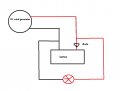
If the diode is on the battery's positive terminal it will allow the battery to charge but neither the bulb nor the windmill will be able to draw any current from the battery.
The bulb will not light if there is no wind. But when the generator is delivering power because of wind there will be an excess diode voltage drop. If the "generator" is actually an automotive type alternator it already includes diodes to prevent the battery from discharging through it, making the additional diode redundant. Is this a theoretical question or does
Is this a theoretical question or does he wind generator system already exist??
the goal is to have permanently attached load, which will act as a break for the turbine and prevent it to runaway... i dont want to have the load behind some control module, which can fail. just permanently attached load/brake...
next question, in this scenario - if there will be 100W produced from the generator, how much will go to battery and how much to a load? 50/50?
Depends on the load and the characteristics of the battery charger circuit, and we know nothing about either.
BTW, your plan is going to waste a *lot* of energy. Here's a fun fact: E.v.e.r.y.t.h.i.n.g fails, eventually. However, a reliable, dual-redundant brake control circuit is not very complex.
goal is to achieve as much charging as possible, but in the same time having the load/brake attached without anything between generator and load....
partial power loss is acceptable, as it will be producing heat, so it will be useful too... if the charging will be done in the same time, the produced and usefull heat(the loss) will be low price for turbine safety...
A relay that trips when the voltage gets too high or the battery is receiving too much current could put a low value resistance across the trubine's output, thus applying dynamic braking.
I hope somebody with experience in this area "speaks up" soon. I am just going by what I have read.
yes, this is a common solution. however, it doesnt meet the key safety requirement - nothing between generator and load/brake. when the relay will fail, turbine runaway...
partialy can be done the workaround with better lifespan ssr instead of mechanical relay, but ssr cant do disconnection in this scenario...
if there will be no part between generator and load/brake, then there can be 3 situations:
1 - more power goes to battery than to load(bulb)
2 - same to battery and load
3 - more power to load than battery
what is the dependent on? when will which situation occur?
To avoid over-speed of the wind turbine and generator a mechanical arrangement may be a better choice. changing the prop pitch or turning the prop to a much less efficient angle are two schemes that I have seen, both seem reliable. The challenge of an electrical scheme is when the wind goes beyond what can be handled by it. Those 70 MPH gusts contain a whole lot of power..
thank you, can be discussed as a different topic, i appreciate if you have any idea in mechanical solution, but for the moment lets get back to the load/brake/charge topic.
yes, this is a common solution. however, it doesnt meet the key safety requirement - nothing between generator and load/brake. when the relay will fail, turbine runaway...
ok, lets specify example situation. as for load lets consider resistor, standard heating kanthal wire
1 - turbine makes 100 w, load is 100w, battery 1000wh charged on 50%
2 - turbine makes 100 w, load is 500w, battery 1000wh charged on 50%
3 - turbine makes 100 w, load is 10w, battery 1000wh charged on 50%
what part of power will go to battery and what to load?
Assuming you have a charge controller, when the battery voltage is below the charger voltage then the battery will draw proportionally from the source according to what it needs. Battery chemistry is a crucial part of the equation. Lead Acid or Sealed Lead Acid (SLA) 12 volt battery typically needs to be charged and maintained at 13.8 float volts. Any higher and the battery can be forced to dry out and be ruined. However, during initial charging the battery voltage can go as high as nearly 15 volts. As long as that is for a short period of time it shouldn't hurt anything. Also, the battery should not be allowed to drop below 80% of its charge. Don't ask me what voltage that would be - I've gotten chewed out for handing out incorrect information.
IF the battery chemistry is Nickel Cadmium (Ni-Cad) then it's "Nominal" voltage should be 1.2V per cell. 10 cells would give you a 12 volt battery. Again, the characteristics of charging a Ni-Cad is something I'm not highly familiar with, so I'll suggest others be more specific - or you can google it. There's another type of battery chemistry that of Li-Ion or Lithium Ion based batteries. Those I know even less about. However, I DO know their charge characteristics are something that should be controlled by a specific charging circuit that maintains a given amount of current for a specific amount of time. Again I refrain from offering any specifics on it because I don't want to be wrong.
On the assumption we're talking about an SLA battery, those voltages I'm confident in. Suppose its resting charge is at 12.00 volts. When the generator spins the battery (depending on its size amperage wise) it will draw X amount of current leaving the remainder for the load. As its voltage increases its need for current will diminish accordingly, leaving still more energy for the load. All this is assuming a steady wind source at a steady speed producing a constant wattage. In life few things are constants. Nearly everything is subject to constant changes. Wind, sunlight, temperature - all things are constantly varying. So to understand this more fully one must assume a constant source of power, unwavering in energy output. That's where mathematics has left me behind. I can calculate the resistance needed for an LED circuit at a given voltage and desired current; pretty basic stuff. But the more advanced stuff is best left to those who understand more fully.
You cannot safely charge a battery - any battery - with just a diode between the power source and the battery. You need a charger controller, or "battery charger" circuit to protect both the battery and your house. A decent charge controller has three charging rates: one when the battery charge is very low, one for the main charging phase, and one for when the battery is fully charged. A normal battery charger doesn't care about what else might be connected to its power source. It draws the current needed for its charging program. If you want the charging energy to change based on the other loads connected to the generator, that is a more complex charger design.
Note: A 500 W load on a 100 W generator is going to appear as an almost dead short across the generator output.
What does " charged on 50% " mean? Do you mean that the battery is charged to 50% of its rated capacity?
Again, it is the battery charger circuit that determines how much energy the battery receives, and the rate at which it is charged.
lets not get to batteries, i have 10 years experience with charging batteries. the question is not battery, but how the circuit will perform and what part of produced power will go to battery and what to load...
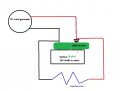
updated scheme:
so lets get BMS on 24V battery, which will disconnect battery as soon as any cell will reach max charge 3.6V. then all the power goes to the load. but how it will be before this happen?
lets say turbine makes 30V x 3A = 90W. where goes the power? to 24V battery or to 100w load or to both(what rate)?
battery is in this moment still connected, so not fully charged...
The battery will draw as much as it needs up-to what the generator can provide. The load will draw whatever wattage it draws based on voltage and resistance. If your generator is producing 90W then there's only 90 watts to be divided amongst the loads, lamps and batteries. If the battery charger is drawing 30W then 60W is available for the load. IF the load draws only 20W then you're using 50W and the remaining 40W of power is "Available". Not necessarily being used.
both will draw power...
load is 100w kanthal wire
battery is 1000wh lifepo4
which one will have the priority? or what will be the distribution key? something with resistance?
A little clarity on batteries and chargers: They draw what they draw depending on the charge status of the battery. A fully charged battery will draw no current, no wattage goes to the battery. A dead battery will draw as much as is available.
Now, assume the battery and charger is just one load. Suppose it draws 20 amps of current. And I'm making up numbers here so bear with me. Suppose the load also draws 20 amps of current. Suppose only 30 amps of current is available. Both will draw 15 amps because they share the load equally.
Now, keep in mind as the battery charges the load will change. No one can give a single answer as to how much the charger will draw because it all depends on the state of charge of the battery. Again, a discharged battery will draw more current than a nearly full battery.
Now, assume the battery and charger is just one load. Suppose it draws 20 amps of current. And I'm making up numbers here so bear with me. Suppose the load also draws 20 amps of current. Suppose only 30 amps of current is available. Both will draw 15 amps because they share the load equally.
but there must be something which will exactly determine how much will take the battery and how much load.
i assume, that in this scenario the 1000wh battery will be considered bigger load if it will be at 20% SOC, than 99%SOC. in the same time (20%SOC) it will be bigger load, than the 100w kanthal wire. isnt it? so i assume it will take more power and the ratio will be lets say 90% to battery / 10% to load. but as soon as the SOC will rise, it will be in some state 50/50, later 40/60 and a moment before the SOC=99%, the ratio will be 1% to battery / 99% to load. right? forget the exact numbers, just in general...

 Facebook
 Google
 GitHub
 Linkedin