Facebook
 Google
 GitHub
 Linkedin
OK, here's a diagram of three different configured transformers. Keep in mind that transformers can have many different configurations. You can have a single secondary, a center tapped secondary, two or more secondaries, each with similar or different voltages.
You also need to rectify that current. You can use two diodes as shown in the second illustration, four diodes as shown in the first and last illustration OR you can use a bridge rectifier (which is the same as the four diode illustration). AND you'll need to filter that output with a capacitor. The best value will be dependent on how much current your circuit draws.
Engineering is HEAVY in math and algebra (which is why I'm not an engineer). It will also serve you to learn Ohms Law (for starters). It's the most basic law out there. Easy to learn and use in a lot of applications. In time you can learn the rest of it. But keep in mind, it IS heavy in math.
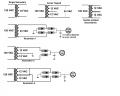
And THANKS to Lestraveled for catching my errors. The drawing has been corrected.
You also need to rectify that current. You can use two diodes as shown in the second illustration, four diodes as shown in the first and last illustration OR you can use a bridge rectifier (which is the same as the four diode illustration). AND you'll need to filter that output with a capacitor. The best value will be dependent on how much current your circuit draws.
Engineering is HEAVY in math and algebra (which is why I'm not an engineer). It will also serve you to learn Ohms Law (for starters). It's the most basic law out there. Easy to learn and use in a lot of applications. In time you can learn the rest of it. But keep in mind, it IS heavy in math.
And THANKS to Lestraveled for catching my errors. The drawing has been corrected.
Last edited: