How are Power Mosfets driven by Gate Drivers if the Vgs needs to be so high?

Thread Starter

mbferguson

Joined Apr 23, 2017
94
I'm working on a circuit with a power mosfet and a gate to drive it. I've quickly realized there is not any good way to activate the Vgs of my power mosfet with my gate driver that only outputs around 10V. I've looked online at some other gate drivers, and all of them only output low voltages around 20-30V MAX.

Every single datasheet for gate drivers intended to be used with power mosfets describes their output in terms of current. Sink or source, up to 4A/6A, etc.

These are 2 of the gate drivers that I have, one of them is also an isolated gate driver specifically used for power mosfets.

http://www.ti.com/lit/ds/symlink/ucc20520.pdf

https://www.mouser.com/datasheet/2/698/isl55110-11-1302115.pdf

I understand that the mosfet gates activate upon charging to a certain Qg, but if the gate voltage needs to be 10V > than Vs, and Vs is 200V+, how is it possible to turn the gate on when the drivers don't output anywhere near that?
 

wayneh

Joined Sep 9, 2010
18,089
The driver’s low side voltage would have to be referenced to that higher source voltage. The MOSFET source pin is normally tied to ground, as would be the gate driver.
 

dl324

Joined Mar 30, 2015
18,221
You're trying to drive your load high side with an N channel MOSFET, and you have the MOSFET wired backwards. As wired, the body diode will always conduct.

We usually use a P channel MOSFET to drive high side and an N channel MOSFET to drive low side.

If you swap the source and drain terminals and drive the load low side, the 10V from the gate driver may be sufficient. I haven't read either of the PDF's referenced and no part number was provided.
 

crutschow

Joined Mar 14, 2008
38,325
The max Vgs to fully turn off a typical MOSFET is never more than 10V.
Remember, Vg to ground is not always the same as Vgs.

In your circuit you need to ground the transistor source and place the 200V in series with RL and the transistor drain.
That way the Vgs of 10V will fully turn on the MOSFET and apply 200V across RL.

If you need to have RL grounded, then you would need to either use a P-MOSFET with a high driver, or an N-MOSFET with a bootstrap driver.
 

wayneh

Joined Sep 9, 2010
18,089
Right, place the MOSFET so that it is controlling the return-to-ground on the low side of your load. The load is attached to +200V on its high side. This is called a low side switch. You can use a high-side switch instead by using a P-channel MOSFET but that would require a different driver.
 

Thread Starter

mbferguson

Joined Apr 23, 2017
94
Right, place the MOSFET so that it is controlling the return-to-ground on the low side of your load. The load is attached to +200V on its high side. This is called a low side switch. You can use a high-side switch instead by using a P-channel MOSFET but that would require a different driver.
What driver is needed for a high side p-mosfet?

The max Vgs to fully turn off a typical MOSFET is never more than 10V.
Remember, Vg to ground is not always the same as Vgs.

In your circuit you need to ground the transistor source and place the 200V in series with RL and the transistor drain.
That way the Vgs of 10V will fully turn on the MOSFET and apply 200V across RL.

If you need to have RL grounded, then you would need to either use a P-MOSFET with a high driver, or an N-MOSFET with a bootstrap driver.
Low-side isn't an option unfortunately. I'll be looking into some P-mosfets for high side.
 

wayneh

Joined Sep 9, 2010
18,089
This might be a stupid question, but the datasheet for the transistor I have doesn't explicitly state if it is N or P type, and the name also hase both N and P in it... SiHP6N40D.
Check the little diagram. It says right there that it's N-type. The little arrow in the diagram also indicates N vs. P. It points away from the gate in a P-type.
 

wayneh

Joined Sep 9, 2010
18,089
High frequency is desired. I'm hoping to be able to open/close creating a 100ns pulse sent to RL.
I'm wondering if a better solution for this application would be some sort of "burst" circuit rather than just a switch. You would design it to store an amount of energy that won't damage the LED, and then when ready it would dump that energy to flash the LEDs. I've never built such a thing but I'm sure there are LED-as-flashbulb circuits out there.
 

Thread Starter

mbferguson

Joined Apr 23, 2017
94
I'm wondering if a better solution for this application would be some sort of "burst" circuit rather than just a switch. You would design it to store an amount of energy that won't damage the LED, and then when ready it would dump that energy to flash the LEDs. I've never built such a thing but I'm sure there are LED-as-flashbulb circuits out there.
I'm using a capacitor that discharges the high voltage within 100ns. Kind of similar to your idea.

What's the pulse frequency?
My intended pulse frequency is 2kHz, or 500us cycle.
 

crutschow

Joined Mar 14, 2008
38,325
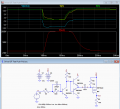
Here's an example driver circuit with its LTspice simulation, to generate a 200V, 100ns pulse.
Since the pulse has a low duty-cycle, it can be AC coupled to the high-voltage P-MOSFET.
(Note that the I only had a 200V P-MOSFET model, so you would need find a P-MOSFET with at least a 250-300V rating for the actual circuit.

upload_2018-11-24_20-18-32.png
 

Thread Starter

mbferguson

Joined Apr 23, 2017
94
Here's an example driver circuit with its LTspice simulation, to generate a 200V, 100ns pulse.
Since the pulse has a low duty-cycle, it can be AC coupled to the high-voltage P-MOSFET.
(Note that the I only had a 200V P-MOSFET model, so you would need find a P-MOSFET with at least a 250-300V rating for the actual circuit.

View attachment 164384
I'm impressed you got that working so quickly. I've been getting some crappy graphs that take me about 20X longer than that. I'm hoping I'll be able to use only a single P mosfet as opposed to combining it with other BJTs, although I do have a bunch of old crusty BJTs laying in my circuit box.
 
Last edited:
Top