VMOS -- Power MOSFETs

Thread Starter

Futurist

Joined Apr 8, 2025
721
Years ago I read all about the then new VMOS power transistors and I bought a few to use in a PWM DC motor control - designed but never built, this was back in like 1980 when I was a much more active hobbyist.

I have a question though, is VMOS still a thing? or has it been superseded these day? I recall that just touching the gate with my finger was enough to switch it on and drive a 12V DC motor, VMOS was also praised for not being subject to thermal run away.

I recall having a P and and N channel device, one was a 2SK133 (strange how we remember such numbers after decades) and I can't recall the other, these were to be used to provide reversibility.
 
Last edited:

sghioto

Joined Dec 31, 2017
8,633
The 2SK133 is a standard N channel mosfet according to the data sheet.
I see a difference in the internal connections where the vmos has a zener on the gate but not the body diode as seen on the modern mosfets.
 

Ian0

Joined Aug 7, 2020
13,097
Siliconix VMOS were the first vertical channel MOSFETs which developed into virtually every other MOSFET under the sun.
2SK133 wasn’t VMOS, it was one of the Hitachi horizontal channel MOSFETs (HMOS) which are still around these days under the Exicon brand, with a brief appearance as Renesas and as Semelab BUZ900.
As VMOS developed into modern MOSFETs with more Gfs, the zero temperature coefficient point of Vgs appeared at higher currents, so they now operate in a region of negative temperature coefficient so are now susceptible to thermal runaway like bipolar transistors’ secondary breakdown. HMOS transistors do not suffer secondary breakdown, and early vertical channel MOSFETs such as 2SK405 and 2SK1530 also don’t.
 
Last edited:

Thread Starter

Futurist

Joined Apr 8, 2025
721
Siliconix VMOS were the first vertical channel MOSFETs which developed into virtually every other MOSFET under the sun.
2SK133 wasn’t VMOS, it was one of the Hitachi horizontal channel MOSFETs (HMOS) which are still around these days under the Exicon brand, with a brief appearance as Renesas and as Semelab BUZ900.
As VMOS developed into modern MOSFETs with more Gfs, the zero temperature coefficient point of Vgs appeared at higher currents, so they now operate in a region of negative temperature coefficient so are now susceptible to thermal runaway like bipolar transistors’ secondary breakdown. HMOS transistors do not suffer secondary breakdown, and early vertical channel MOSFETs such as 2SK405 and 2SK1530 also don’t.
Thanks I think you are correct, a 2SK133 wasn't actually VMOS, my memory has faded, it seems it was "just" a power MOSFET.

Mod note: removed link to copyrighted material
 
Last edited by a moderator:

Ian0

Joined Aug 7, 2020
13,097
Thanks I think you are correct, a 2SK133 wasn't actually VMOS, my memory has faded, it seems it was "just" a power MOSFET.
I think that Hitachi came first, so the new kid on the block was VMOS. So 2SK133 was an “ordinary” MOSFET and VMOS was the new-fangled thing, but Horizontal channel MOSFETs couldn’t compete. A bit like the Newcomen engine being referred to a “common” engine when James Watt was trying to patent his.
 
Last edited by a moderator:

Thread Starter

Futurist

Joined Apr 8, 2025
721
I think that Hitachi came first, so the new kid on the block was VMOS. So 2SK133 was an “ordinary” MOSFET and VMOS was the new-fangled thing, but Horizontal channel MOSFETs couldn’t compete. A bit like the Newcomen engine being referred to a “common” engine when James Watt was trying to patent his.
So what is the state of the art today insofar as power transistors go?
 

Ian0

Joined Aug 7, 2020
13,097
So what is the state of the art today insofar as power transistors go?
State of the art for what? low voltage switching, higher voltage switching, high speed switching or linear?
could be silicon, gallium nitride, silicon carbide, igbt or, for linear, the old ones are the best! Of course there are no longer any P-channel IGBTs, and P-channel GaN and SiC never have existed: I’m not even sure that they are technically feasible (Perhaps someone else knows the answer to that)
 

Thread Starter

Futurist

Joined Apr 8, 2025
721
State of the art for what? low voltage switching, higher voltage switching, high speed switching or linear?
could be silicon, gallium nitride, silicon carbide, igbt or, for linear, the old ones are the best! Of course there are no longer any P-channel IGBTs, and P-channel GaN and SiC never have existed: I’m not even sure that they are technically feasible (Perhaps someone else knows the answer to that)
That's a fair response!

My context was PWM, an efficient (low on resistance) switch to turn on/off DC motors driven by 3.3v logic.
 

Ian0

Joined Aug 7, 2020
13,097
That's a fair response!

My context was PWM, an efficient (low on resistance) switch to turn on/off DC motors driven by 3.3v logic.
Whatever silicon MOSFET is available should do. Just go to Mouser/Digikey/Farnell and input the maximum voltage, and an acceptable Rds ON then sort on price.
But whatever you choose, you will probably need more than 3.3V gate drive, and low-side drivers are cheap.
 

Thread Starter

Futurist

Joined Apr 8, 2025
721
Whatever silicon MOSFET is available should do. Just go to Mouser/Digikey/Farnell and input the maximum voltage, and an acceptable Rds ON then sort on price.
But whatever you choose, you will probably need more than 3.3V gate drive, and low-side drivers are cheap.
I might want to opto isolate this actually, that way motor noise is decoupled from the controlling system.
 

Thread Starter

Futurist

Joined Apr 8, 2025
721
TI do some isolated MOSFET drivers. UCC21331 is an example of one I’ve been using. There are plenty to choose from.
Thanks that device looks idea, but I have a question, given that these power MOSFETs have very very low gate current (well that's what I read about the VMOS types anyway) why does this isolator need to be able to sink up to 4 amps gate current?

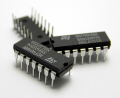
I guess the days of DIL IC packages are long gone too...

1745951508652.png
 

Ian0

Joined Aug 7, 2020
13,097
Thanks that device looks idea, but I have a question, given that these power MOSFETs have very very low gate current (well that's what I read about the VMOS types anyway) why does this isolator need to be able to sink up to 4 amps gate current?

I guess the days of DIL IC packages are long gone too...

View attachment 348085
To charge up the gate capacitance in a reasonable time-frame.
During the time that it is in the process of charging the gate capacitance, the MOSFET is dissipating on average a quarter of the load power.
Obviously, if it does this only rarely, it won’t make a scrap of difference, but if it is trying to do it 100,000 times a second you will have a very warm transistor
 
Top