Honda Generator Automatic Voltage Regulator

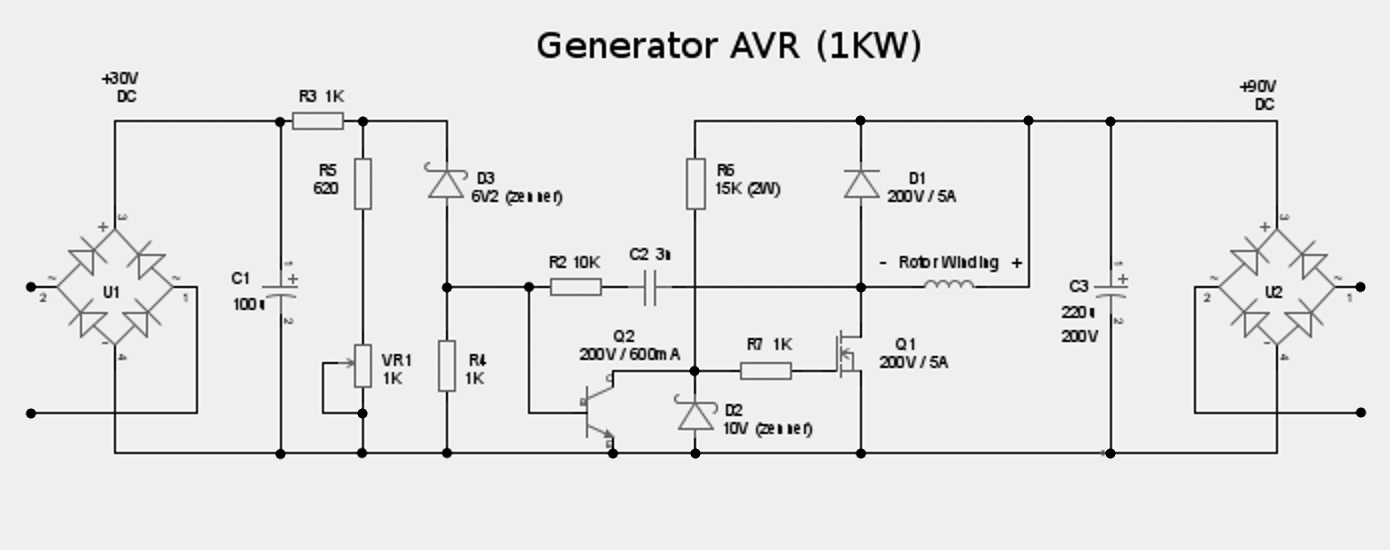
I guess you could find the appropriate parts (Mosfet, freewheeling diode and high-voltage dc link capacitor) on a PSU/UPS board. A 200V/10A Mosfet could be enough, by example (though you could find a higher rated one in those scrap boards).

Btw, you could replace the frewheeling diode (D1) with a Mosfet (as it has a built-in body diode rated at its Vds/Id).
 
I the near future, I will give up this discrete components solution and use a dedicated (PWM) IC instead (like UC3843, for example).

That way, you could switch the Mosfet way more efficient, use a much higher switching frequency and have a better output voltage regulation.

For now, I'll try this emergency solution as I need to use the generator this weekend. ;)
 

xing tao

Joined Jul 3, 2017
11
Good morning
When bjt IS ON, mosfet IS OFF and negative brush IS no more grounded. And only the 9v IS provided via this kind of resonant bridge ( cap + res) .. this IS right?
 
When bjt IS ON, mosfet IS OFF and negative brush IS no more grounded.
When the Mosfet is OFF, the inductor current is "recirculating" through the flywheel diode. That's it, the inductor is still energized, even if it is not connected to any power supply. The inductor is operating in continuous conduction mode (CCM).
only the 9v IS provided via this kind of resonant bridge ( cap + res) .. this IS right?
What 9V are you referring to?
 

xing tao

Joined Jul 3, 2017
11
Stupid question but i want to understand. What do you mean by inductor ? Rotor winding or feed winding?
In this case what IS the role of C2 R2 between bjt base and negative brush ? I calculate about 5.7 MHz
Thank you for your help
 
Yes, I was talking about rotor winding. It is actually the Mosfet "load".

You have to think about R2-C2 as being connected between BJT base and Mosfet drain.

When the BJT base is HIGH, its collector is LOW, the Mosfet gate is LOW hence the Mosfet drain is HIGH.

That's it, by connecting a RC network between the BJT base and Mosfet drain you get a positive feedback (oscillations).
 

xing tao

Joined Jul 3, 2017
11
After check datasheet of 2n3055, frequency is very low
Transition Frequency (ft): 0.2 MHz (100Mhz for 2n5551)
Forward Current Transfer Ratio (hFE), MIN: 20 (80 for 2n5551)

i keep seraching an equivalent for 2n5551
 
IRF740 should work (though the Id rating is only 10Amps).

You might put a reverse biased diode across the BJT base-emitter terminals (to avoid any collector-base voltage greater than 10V (D2 zenner)) then any regular small signal BJT could do the job (you don't need a 180V rated one).
 
I've redrawn the schematics to better understand the circuit topology.


As you can see, it's basically a buck converter (where the output inductor acts as a load, too). The PWM signal is generated by permanently connecting the Mosfet gate to the Vcc bus (through that current limiting resistor) and by the BJT, which is shunting to ground the Mosfet gate whenever the feedback voltage is greater than the preset threshold (VR1).
 
Last edited:

Tady43

Joined Aug 17, 2017
5
Hello,
First post here. I've aquired a small Honda portable generator (vintage 1977). The model is EG 1500 (1.5kw output). This generator is equipped with an automatic voltage regulator (avr) that is physically damaged. This particular avr uses the input of 120vac from the stator and apparently rectifies it for use as an output to the brushes to control rotor field current and therefore voltage output. Frequency appears to be regulated by engine rpm and does not appear to be controlled by the avr. The avr assembly is filled with what I believe to be fiberglass resin (or similar) material to seal all the components. This stuff is very difficult to remove and I don't think I can do it without destroying all the internal components. Honda no longer services this regulator and the universal ones are quite expensive. I'd like to recreate a suitable circuit to regulate the generator as a project for my own learning. At a minimum, I would need to rectify 120vac and use the the corresponding dc to drive the rotor field current to maintain 120vac under varying loads. Rotor resistance is 54 ohms. There is also an external cap of 200uF 250WV attached to the original avr. There are 4 wires from the stator for input to the avr (althought I'm not sure all would be required) and the coresponding 2 dc output wires from the avr to the rotor brushes. Any suggestions would be appreciated.
Hello,
First post here. I've aquired a small Honda portable generator (vintage 1977). The model is EG 1500 (1.5kw output). This generator is equipped with an automatic voltage regulator (avr) that is physically damaged. This particular avr uses the input of 120vac from the stator and apparently rectifies it for use as an output to the brushes to control rotor field current and therefore voltage output. Frequency appears to be regulated by engine rpm and does not appear to be controlled by the avr. The avr assembly is filled with what I believe to be fiberglass resin (or similar) material to seal all the components. This stuff is very difficult to remove and I don't think I can do it without destroying all the internal components. Honda no longer services this regulator and the universal ones are quite expensive. I'd like to recreate a suitable circuit to regulate the generator as a project for my own learning. At a minimum, I would need to rectify 120vac and use the the corresponding dc to drive the rotor field current to maintain 120vac under varying loads. Rotor resistance is 54 ohms. There is also an external cap of 200uF 250WV attached to the original avr. There are 4 wires from the stator for input to the avr (althought I'm not sure all would be required) and the coresponding 2 dc output wires from the avr to the rotor brushes. Any suggestions would be appreciated.
 

Tady43

Joined Aug 17, 2017
5
You can buy AVR FOR less than $10 on eBay
I bough one for a Stanley 3500watt worked fine the output from the stator(exciter) to the blue wires was 82Vac while running
I have a question I want to bench check the AVR
 

Tady43

Joined Aug 17, 2017
5
Hi, I have a Kraftech KT6500W 3 phase 6.5hp genetator ...which isn't actually 6500 watt at all, it's only 2800 va ...being a Chinese copy of a Honda design.
Anyway unaware of this and being a new user of such devises I put too much load on one phase and burnt out that winding on the stator.
Having priced a replacement stator (~£85) and realising 3 phase was totally unacceptable for unbalanced single phase loads, I decided to rewind it as a single phase generator.
Being a mechanical engineer I reversed engineered it and did my research. I then rewound the main power windings based on one of the original phases, this time using copper instead of Aluminium. I knew how many turns for the these windings (~240 turns total) but due to the damage it had sustained I didn't know where the AVR sense voltage tapping was taken. I rewound the exciter winding in the stator too, I was also unsure of how many turns was needed for it (I used 40 turns total based on what was left of the original winding).
Right or wrong it will now actually generate ~240vac (UK standard) no load if I inject about 42vdc using an external supply directly into the rotor brushes. Not having a sense tapping, after a few trials I found a mains to 15v transformer connected off the main windings provided a sense voltage which the AVR was happy with and connecting it to the brushes I could adjust the AVR to provide 240vac no load. Excitation windings I think were giving about 40vac.
My problems really started when I increased the load to 1400w, the output dropped to about 215vac. Voltage on the brushes was surprisingly low too at less than 30vdc??? if I recall it correctly.
Thinking the excitation windings turns were maybe insufficient I've nearly doubled them now to about 70 turns total. They now give 80vac no load but when I connected it to the original AVR it suddenly stopped giving any output for the brushes.
I've since ordered a new generic / universal AVR off eBay (£9.50 inc. p+p) that will accept 60 to 100vac off the excitation windings and 16 to 25vac sense. I've yet to see what this will do when it arrives but anybody reading this ....does all this sound right or will my next AVR go 'pop' too?
Steve
 

Tady43

Joined Aug 17, 2017
5
The excitation winding should be 70vac output i used 120vac from the generator output the output was 120vac with 70 or 120vac the BRIDGE RECTIFIER wil put out 120vac
i rewound the Colman 6500watt 10HP 120/240 this was the first time I ever did tried it using 14 awg copper wire seems to be working fine
TIM
 

wilko

Joined Sep 3, 2014
5
The excitation winding should be 70vac output i used 120vac from the generator output the output was 120vac with 70 or 120vac the BRIDGE RECTIFIER wil put out 120vac
i rewound the Colman 6500watt 10HP 120/240 this was the first time I ever did tried it using 14 awg copper wire seems to be working fine
TIM
Thanks, I may take some windings off my excitation coils, I'm getting roughly 1 vac per turn no load so go for 70 turns total The excitation finding voltage may tend to drop little as the load goes on but should recover instantly as the AVR responds and gives more power to the rotor. I don't think I had enough spare power from the excitation for the AVR to respond before ...but maybe I've overdone it a little by doubling it.
Have used 2 strands of 0.71mm copper on the main winding hoping to get at least 2kw out of it. Used the same but single strand copper on the excitation winding. The old aluminium windings had literally melted! ....it's only 0.6 that of coppers conductivity.
 

wilko

Joined Sep 3, 2014
5
Now have 70vac excitation and with a new eBay AVR fitted I could adjust the output volts to 240vac.
I really don't think the AVR is regulating properly though, at 1kw the output voltage is dropping to a bit below 230vac and 2kw 212vac. The motor also appears to be struggling at 2kw even though It is a 6.5hp unit. It may suffice my needs for now, its about in spec for UK + Europ mains tolerance for upto ~1.5kw. I will, however, check the sampling voltage and rotor slip ring voltage against load next.
 

wilko

Joined Sep 3, 2014
5
Oh dear ....maybe not enough turns on the power coils....

Load Output Sample Rotor
0 kw 242 vac 18.2 vac 40 v
1 kw 227.5 vac 17 vac 63 v
2 kw 212 vac 16 vac 96.7

I think the AVR is struggling to keep up
 
wilko, Are you using that Ebay AVR on one of the Coleman Powermate gens? I have been having a PITA of a time with my Coleman 6875. When i got it, it was not producing power. The BJT and the Darlington transistor were toast. So I opted to replace them. After they were in, still nothing. I read somewhere about re-magnetizing the exciter with 12V, So i did. I jumped across the brushes and voila power, only it was 144 volts.....not 120. Checking the engine idle and putting the A/C spoce meter on it, it was running at 60Hz, so it has to be the AVR that is the problem. I do some checking, and the Darlington I put in was sorted, as was one of the BJt's again. likely from jumping the 12v?......So I bough virtually all the components to rebuild the entire board based on the schematic on pg1 as well as the some recommendations for a different Varistor at S2. Back to no power. The only components I hadn't replaced were the resistors at R1-3 and R5. Mostly because i forgot to order them. While they do appear to be okay on the outside, with a minimal mark on one of them, they all test OK and are within range for their values.
Now I am getting like 2VAC at the outlets. So, I moved to have the AVR external, so I can do some prodding with the meter. I Jumped the 12v across the exciter brushes and got 30vac momentarily at the power outlets. tried it again, and D7 Let the magik smoke out. No worries, I bought spares, but now I am back to getting 144VAC. So i KNOW that the coils and exciter are working. I just can't get the darn AVR thing right.
 

Tady43

Joined Aug 17, 2017
5
Hello,
First post here. I've aquired a small Honda portable generator (vintage 1977). The model is EG 1500 (1.5kw output). This generator is equipped with an automatic voltage regulator (avr) that is physically damaged. This particular avr uses the input of 120vac from the stator and apparently rectifies it for use as an output to the brushes to control rotor field current and therefore voltage output. Frequency appears to be regulated by engine rpm and does not appear to be controlled by the avr. The avr assembly is filled with what I believe to be fiberglass resin (or similar) material to seal all the components. This stuff is very difficult to remove and I don't think I can do it without destroying all the internal components. Honda no longer services this regulator and the universal ones are quite expensive. I'd like to recreate a suitable circuit to regulate the generator as a project for my own learning. At a minimum, I would need to rectify 120vac and use the the corresponding dc to drive the rotor field current to maintain 120vac under varying loads. Rotor resistance is 54 ohms. There is also an external cap of 200uF 250WV attached to the original avr. There are 4 wires from the stator for input to the avr (althought I'm not sure all would be required) and the coresponding 2 dc output wires from the avr to the rotor brushes. Any suggestions would be appreciated.
Hello,
First post here. I've aquired a small Honda portable generator (vintage 1977). The model is EG 1500 (1.5kw output). This generator is equipped with an automatic voltage regulator (avr) that is physically damaged. This particular avr uses the input of 120vac from the stator and apparently rectifies it for use as an output to the brushes to control rotor field current and therefore voltage output. Frequency appears to be regulated by engine rpm and does not appear to be controlled by the avr. The avr assembly is filled with what I believe to be fiberglass resin (or similar) material to seal all the components. This stuff is very difficult to remove and I don't think I can do it without destroying all the internal components. Honda no longer services this regulator and the universal ones are quite expensive. I'd like to recreate a suitable circuit to regulate the generator as a project for my own learning. At a minimum, I would need to rectify 120vac and use the the corresponding dc to drive the rotor field current to maintain 120vac under varying loads. Rotor resistance is 54 ohms. There is also an external cap of 200uF 250WV attached to the original avr. There are 4 wires from the stator for input to the avr (althought I'm not sure all would be required) and the coresponding 2 dc output wires from the avr to the rotor brushes. Any suggestions would be appreciated.
 
Top