Homework help

Thread Starter

Garurumon

Joined Mar 17, 2013
99
Could someone explain to me how to solve this task?

So, there are two caps, and a switch. Before the switch is closed, the charge contained in the C2 is -180uC in given direction. The switch is then closed. How do I calculate charges for both capacitors after everything has settled (state II)?

I have a feeling that it's awfully simple, but still I can't imagine how does the initial charge in C2 affects the final outcome. :/

Pics:
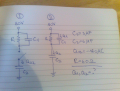
04022015515.png
 

Denesius

Joined Feb 5, 2014
124
OK, I'm not an electronics expert by any means, and I came across this out of curiosity, but I was wondering.....

When switch is closed, current is flowing thru R1 & begins to charge C2. This current will also produce a voltage that charges C1. As C2 charges, the current flow is reduced and the the subsequent voltage across R1 also reduces, so C1 begins to discharge. At the end when everything is settled, voltage across C2 is 80V, no current is flowing so voltage across R1 is zero, which means C1 is discharged.
Yes?
 

crutschow

Joined Mar 14, 2008
38,506
.....................
I have a feeling that it's awfully simple, but still I can't imagine how does the initial charge in C2 affects the final outcome. :/
.....................
It doesn't.
It only affects the time it takes to reach the final value.
 

t_n_k

Joined Mar 6, 2009
5,455
OK, I'm not an electronics expert by any means, and I came across this out of curiosity, but I was wondering.....

When switch is closed, current is flowing thru R1 & begins to charge C2. This current will also produce a voltage that charges C1. As C2 charges, the current flow is reduced and the the subsequent voltage across R1 also reduces, so C1 begins to discharge. At the end when everything is settled, voltage across C2 is 80V, no current is flowing so voltage across R1 is zero, which means C1 is discharged.
Yes?
Hi there,
It's worth recalling that the Homework forum requies the OP / TS to show their own work & reasoning applied to the problem at hand. It's poor form to offer a complete solution without that effort on the OP's part being demonstrated.
Your suggested explanation has some minor flaws. But that can be resolved once the OP has understood the problem and shown their work.
 

WBahn

Joined Mar 31, 2012
32,836
It's always easier to spout criticism rather than offer an explanation, isn't it!
Don't wear your feelings on your shirt-sleeves. He said the flaws in your explanation were minor, and they are. You are neglecting to take one factor into account that affects the initial behavior of the circuit but not the final results.

But t_n_k wants the OP to do what is expected of the OP -- namely to show their work -- and is simply reminding you that that is the expectation of this forum and to please not offer complete solutions except in response to a reasonable show of effort and understanding on the part of the OP. So neither t_n_k nor I are going to offer a complete solution until that expectation is met.
 

t_n_k

Joined Mar 6, 2009
5,455
It's always easier to spout criticism rather than offer an explanation, isn't it!
You missed the point. It wasn't particularly about your explanation which was fine with a minor omission - rather the fact that you basically handed the OP a solution free of obligation and no effort required on their part. I know of at least one other forum where the moderators are / were very strict on the homework principle - to the point where 'over-helpful' posts were deleted.
Of course, you can always add me to your ignore list .....
 

Thread Starter

Garurumon

Joined Mar 17, 2013
99
I'd like to apologize, I didn't know about that homework rule, won't happen again.

Actually, the major problem for me was comprehending the whole situation because of the initial charge, and if it's like the member crutschow said:

It doesn't.
It only affects the time it takes to reach the final value.
Then I guess, when everything settles, the voltage on C1 would be 0V => Q1 = 0V, and voltage on C2 would be 80V, and Q2=C2*80V, right?
 
Top