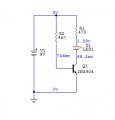
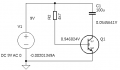
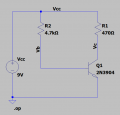
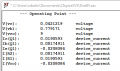
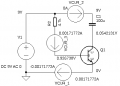
I finally got around to simulating a 2N3904 NPN, like in post #95. This simulation uses actual models (not Eagle defaults) for the Red LED and the 2N3904. Most of it makes sense, 1.77V across LED. But what's up with the negative current?!?
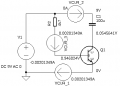
All simulators that I know of, particularly SPICE-based ones, use the convention (which is consistent with most device manufacturers) that the current at a device pin is defined as the current flowing INTO the pin. For two-terminal devices, the current flowing through the device is defined as the current flowing into INTO pin #1. For voltage sources, pin 1 is pretty universally defined as the positive terminal. So your simulation is saying that you have -17.2 mA flowing into the positive terminal of V1, hence it's really 17.2 mA flowing out of that terminal.
If you were to measure the current at the transistor pins, you should find that the base and collector currents are positive and the emitter current is negative. For diodes, the anode is pin 1, so forward currents are conveniently positive.
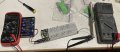
I looked up your meter to see what it says about the specs. First I followed your link on Amazon and discovered immediately that the description is misleading and contradictory. They say in one spot that the meter cannot be used to measure AC current or capacitance, but further down they clearly indicate that these are functions it has. In another spot they claim that it can measure frequency and temperature, which is clearly not the case. I then looked up the manual and it doesn't say what any of the input or burden resistances are. But it does say that the fuse is easily replaceable similar to the battery.
Probably just the LED NPN models used. We both get exactly the same emitter current (-17.185 mA). LED Vf is slightly different, mine is 1.77v, your is 1.82v.
Probably just the LED NPN models used. We both get exactly the same emitter current (-17.185 mA). LED Vf is slightly different, mine is 1.77v, your is 1.82v.
No. It does not depend on the model of the LED.
It is the forward voltage of the base-emitter junction of Q1 which behaves like a P-N silicon rectifier.
I removed R1 and LED from the circuit and left the collector not connected.
The simulation gives 0.721mV on the base of Q1.
No. It does not depend on the model of the LED.
It is the forward voltage of the base-emitter junction of Q1 which behaves like a P-N silicon rectifier.
I removed R1 and LED from the circuit and left the collector not connected.
The simulation gives 0.721mV on the base of Q1.
1M, 10M, 1u, 100u, all give the same result. So maybe the 2N3904 model is not right? This is what I found on the internet:
.MODEL 2N3904 NPN(IS=5.42E-14 ISE=1.20E-15 ISC=1.08E-11 XTI=3.00
+ BF=3.00E2 BR=1.19E1 IKF=5.58E-2 IKR=1.00 XTB=1.5
+ VAF=2.88E2 VAR=4.18E1 VJE=3.33E-1 VJC=3.83E-1
+ RE=1.29E-2 RC=1.63 RB=1.51E2 RBM=1.00E-2 IRB=1.70E-3
+ CJE=8.54E-12 CJC=4.75E-12 XCJC=1.00 FC=5.00E-1
+ NF=1.09 NR=1.02 NE=1.25 NC=1.66 MJE=3.68E-1 MJC=4.02E-1
+ TF=1.58E-10 TR=238.3E-9 PTF=0 ITF=2.86E-4 VTF=1.90E-1 XTF=4.69
+ EG=1.11 KF=1E-9 AF=1
+ VCEO=40 ICRATING=100M)
.MODEL 2N3904 NPN
There is something not quite right.
Voltage across R2 is V2 = I2 x R2 = 0.002 x 4700 = 9.4V
V2 + Vbe = 9.4 + 0.946 = 10.3V
Your supply voltage is V1 = 9V
There is something not quite right.
Voltage across R2 is V2 = I2 x R2 = 0.002 x 4700 = 9.4V
V2 + Vbe = 9.4 + 0.946 = 10.3V
Your supply voltage is V1 = 9V
Which is actually better than your CircuitMaker simulation.
Ie = 17.185 mA
Ic = 15.122 mA
Thus Ib = Ic - Ic = 2.063 mA
With a base voltage of 746 mV and a 4.7 kΩ base resistor, that yields a supply voltage of
Vcc = 746 mA + 2.063 mA · 4.7 kΩ = 10.442 V
I'm not too impressed with either of those simulators.
This is what LTSpice yields:
Vcc = 779.2 mV + 1.7491 mA · 4.7 kΩ = 9.0000 V
Ib = 20.808 mA - 19.059 mA = 1.749 mA
EDIT: The CircuitMaker and Eagle sim have the base resistor specified as 4k7, which to the simulator is just 4k, or 4 kΩ. The numbers make sense when that is accounted for.
It is counterintuitive. The thing to remember is that the simulator has to define a direction for all currents and it has to do it in a way that is consistent for all devices. To the simulator, a source is just another component with pins.
One thing to keep in mind is that this applies to non-polarized components, such as resistors, inductors, and capacitors, as well. I've seen people misinterpret results because the simulator told them the current in a resistor was some value and they just blindly used that in their analysis despite it being pretty obvious that the simulator's polarity was opposite what they were assuming. While I haven't done it for LTSpice (yet), when I was doing IC design I made my own library symbols for resistors and capacitors (and inductors, even though we almost never used them) that had tiny tick marks on the pin 1 side so that I could orient them to match the current polarities I wanted.
It doesn't seem to take 4k7 the same as 4.7k, actually I think - Eagle thinks - 4k7 is simply 4000, it ignores the 7. So this math works out better, although it's still a different Vbe than yours.
It doesn't seem to take 4k7 the same as 4.7k, actually I think - Eagle thinks - 4k7 is simply 4000, it ignores the 7. So this math works out better, although it's still a different Vbe than yours.
You are correct. I didn't catch that, and I really should have.
This almost certainly explains the discrepancies with MrChip's simulation, too.
Another thing to watch out for is that (if it's like most simulators), if you put a space in there it will ignore it. So 4.7 k will just be seen as 4.7 Ω.
The simulator treats everything after a recognized prefix that immediately follows a number as a comment. This is what allows me to set the resistance to 4.7kΩ, including the Ω symbol. I'd like to put a space between the value and the units, because that is the proper way to write it, but then the simulator will ignore the prefix.
Another thing to be aware of is that the simulator is not case sensitive, so 100m and 100M are the same, and are interpreted as 0.1, If you want mega, you have to use Meg.

 Facebook
 Google
 GitHub
 Linkedin