Home school circuit analysis class suggestions needed

Thread Starter

rpschultz

Joined Nov 23, 2022
826
We spent a couple weeks on transistors, the kids have a very basic understanding.

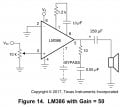
Last few weeks (April 17, 24, May 1) I want to work with the LM386 to build various versions of a small speakers amp. The datasheet has 3 different versions of a small speaker amp, the most basic one is this with a default gain of 20.
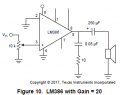
1680636382127.png

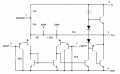
I'm trying to understand WHY the default gain is 20. It goes back to the schematic. I can see with gain pins 1 and 8 open, it looks like a voltage divider. 15k/(150+1350) = 10. But I can't figure out the other factor of 2.
1680636423894.png
 

Thread Starter

rpschultz

Joined Nov 23, 2022
826
The TI data sheet has this:

9489B7E3-5918-4C7C-82C9-328E616AEBA1.jpeg
When I calculate the gain with a 1.2k resistor across pins 1 and 8, I get a gain of 40. Not 50. What am I missing?
 

Irving

Joined Jan 30, 2016
5,138
Bit late to this party but projects I've used in the past when teaching basic electronics to my MSc students (typically arts/humanities background so little experience/knowledge) include:

* Day/Night light controller - turn lights on when it gets dark
* Sound triggered light - mic + amp + 555 timer (similar to clap cct but more sensitive)
* Temperature related Fan speed control - simple analogue temperature sensor and PWM DC speed controller

When I calculate the gain with a 1.2k resistor across pins 1 and 8, I get a gain of 40. Not 50. What am I missing?
I concur, G = 2 x 15k/(150 + 1200 || 1350) = 30000/(150 + 1/(1/1200 +1/1350)) = 30000/(150 + 635) = 38.2
 

Thread Starter

rpschultz

Joined Nov 23, 2022
826
Bit late to this party but projects I've used in the past when teaching basic electronics to my MSc students (typically arts/humanities background so little experience/knowledge) include:

* Day/Night light controller - turn lights on when it gets dark
* Sound triggered light - mic + amp + 555 timer (similar to clap cct but more sensitive)
* Temperature related Fan speed control - simple analogue temperature sensor and PWM DC speed controller
Yes I considered the 555 stuff, it's cool. I just felt that building a small speaker amp is more meaningful than a bunch of blinking lights, and probably simpler to understand with the LM386. You can use the 555 as an amp, but it's not as straight forward to understand. Just my opinion.

I found an 0.8W speaker on Jameco for $1 each, and the LM386-3's are about $1 each too. I have all the rest of the parts and they all have breadboards so for $2/student, they can build a speaker amp that plugs into their iphone/computer. I also got some electret mics we can use instead of the 1/8" audio input.
 
Top