Home school circuit analysis class suggestions needed

dl324

Joined Mar 30, 2015
18,343
SN54HC08 +And Gate
Is this a military grade part?
SNx4HC32 Quad OR Gate
NSx4HC04 Hex Inverter
What can 'x' be besides 7?

If you didn't want to have to bother with MOSFETs because of ESD, 74HC parts don't get you there. You could use TTL, but it's more expensive and harder to get.
μA741 general purpose op amp
That opamp has a lot of warts. If you're not intending to teach students how non-ideal that opamp is, something newer would be better (can't believe I just said that because I think 741 is still a useful device). But more modern rail-rail opamps are likely to be CMOS.

If you're going to do 555 timers, do the students a favor and actually teach them how it works.

That's probably an ambitious agenda for high school students.
 

Thread Starter

rpschultz

Joined Nov 23, 2022
824
I think @MrChips suggestion of going from basic NPN transistors to 555 stuff has a lot of merit. Even op amps seem fraught with peril and pitfalls for beginner level students. Those other 3 chips seem beyond me and my class, I have NO idea why they are included in the kit. I would think the 556 dual timer chip would be more appropriate.

If you're going to do 555 timers, do the students a favor and actually teach them how it works.
I would love to and hope to... I'll just have to learn how it works MYSELF first.
 

MrChips

Joined Oct 2, 2009
34,839
I have an engineering degree and I did not learn about transistors and op-amps until 3rd year engineering at university.
So your students are at least 3-4 years ahead on their education path.
 

MrSoftware

Joined Oct 29, 2013
2,273
I'm not sure why MOSFET is considered complicated, I think it's easier than BJT. Especially a logic level FET, like the one I linked earlier which for your purpose will be 100% on with the gate at 5V supplied by an Arduino.

Darlington is definitely a big ask at this level I think. If they struggle with gain for a BJT, they're really not going to get Darlington configuration to multiply the gains. Plus if they're going be working with digital logic circuits such as microcontrollers (binary on/off signals), MOSFET will be more common than BJT I believe.

If you're working with LEDs and big transistors, the loads are so tiny than thermal issues aren't even an afterthought.

555's are cool, I will be really surprised if more than one or two of them can comprehend how they function under the hood at this level. The same with OpAmps.

Maybe I'm not giving the kids enough credit, but thinking back to when I started, bigger easier to see and feel things made it fun and interesting. Winding your own motor (there are kits), electro magnet, etc.. Maybe wind your own motor or magnet, control the power with a MOSFET, use an Arduino to control the MOSFET. Now you're using a little computer to make real tangible things happen. Swap the current direction and see what happens. I think these kinds of fundamentals will make the other stuff easier to understand when you get there.

I'm just thinking out loud, whatever you do for the kids is going to help them move forward, there's no wrong answer.
 

Thread Starter

rpschultz

Joined Nov 23, 2022
824
I have an engineering degree and I did not learn about transistors and op-amps until 3rd year engineering at university.
So your students are at least 3-4 years ahead on their education path.
I had a circuit analysis class as a sophomore in engineering, and I could be wrong, but I don't remember ANYTHING about transistors or op amps. It was primarily resistors, voltage dividers, nodal analysis, mesh analysis, KCL, KVL, etc. It's only been recently, at the age of 50, that I've dug into transistors and op amps and tried to learn them.

So yeah, maybe I'm ambitious to teach transistors to high schoolers. But it seems more practical than a bunch of mundane resistor analysis.
 

dl324

Joined Mar 30, 2015
18,343
I had a circuit analysis class as a sophomore in engineering, and I could be wrong, but I don't remember ANYTHING about transistors or op amps. It was primarily resistors, voltage dividers, nodal analysis, mesh analysis, KCL, KVL, etc. It's only been recently, at the age of 50, that I've dug into transistors and op amps and tried to learn them.
When I got my ASEET degree, we studied transistors, opamps, comparators, digital logic, fabrication, drafting, communications, etc in 2 years. Plus I had to take the usual English, speech, report writing, history, physics, calculus, and differential equations.

SJSU had a problem with accepting my logic class when I transferred credits. It was a 300 level class for them using the same book and they couldn't believe a community college could teach that level. I didn't feel like challenging the class, so I took it and had the highest grade average (100%) in the class and didn't need to take the final.
 
Last edited:

MrChips

Joined Oct 2, 2009
34,839
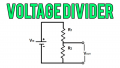
This should be the next lesson.

1674677876153.png


Using Ohm's Law, derive the formula for a voltage divider.

Vout = Vin x R2 / (R1 + R2)

Verify this by measurement for,
R1 = 1kΩ, R2 = 1kΩ
R1 = 10kΩ, R2 = 1kΩ

Repeat this experiment for,
R1 = 1MΩ, R2 = 1MΩ
R1 = 10MΩ, R2 = 1MΩ

Explain, analyze, and discuss why the measurements do not agree with the formula.
 

Thread Starter

rpschultz

Joined Nov 23, 2022
824
Using Ohm's Law, derive the formula for a voltage divider.
Vout = Vin x R2 / (R1 + R2)
Verify this by measurement for,
R1 = 1kΩ, R2 = 1kΩ
R1 = 10kΩ, R2 = 1kΩ
Repeat this experiment for,
R1 = 1MΩ, R2 = 1MΩ
R1 = 10MΩ, R2 = 1MΩ
Explain, analyze, and discuss why the measurements do not agree with the formula.
I'll have to do this myself to better understand, but why wouldn't the measurements agree with the formula?!?
 

WBahn

Joined Mar 31, 2012
32,893
I'll have to do this myself to better understand, but why wouldn't the measurements agree with the formula?!?
A couple of reasons. First, real resistors are never exactly the value that they claim to be. Use to be that "ordinary" resistors had a tolerance of 20% on either side of the nominal value. Today, the "ordinary" resistors are probably 5%.

The second reason is that most DMMs have an input resistance of 10 MΩ when reading voltage, so now you are putting a 10 MΩ resistance in parallel with R2.

The effect will be must greater if you make R2 the 10 MΩ resistor and R1 the 1 MΩ resistor.

If you make both R1 and R2 10 MΩ, you would expect to see an output voltage of Vin/2. But when you put your meter in the circuit you will likely see something closer to Vin/3.
 

Thread Starter

rpschultz

Joined Nov 23, 2022
824
Ah, impedance. Actually the input impedance is 1M, I *think*.

So the 1k-1k or 1k-10k experiment should be reasonably close. But the 1M experiments would be wack. Definitely would be a good discussion, should be thought provoking for those who have never considered impedance in that way.
 

MrChips

Joined Oct 2, 2009
34,839
Sorry, I made some typos. Thanks @WBahn for pointing this out.

I should have given the following values to experiment:

R1 = 1kΩ, R2 = 1kΩ
R1 = 10kΩ, R2 = 1kΩ
R1 = 10kΩ, R2 = 10kΩ
R1 = 1kΩ, R2 = 10kΩ


R1 = 1MΩ, R2 = 1MΩ
R1 = 10MΩ, R2 = 1MΩ
R1 = 10MΩ, R2 = 10MΩ
R1 = 1MΩ, R2 = 10MΩ
 

MrChips

Joined Oct 2, 2009
34,839
The meter is so cheap they dare post the internal resistance in voltage and current mode.
Do the experiment and post your results.
Then we will be able to tell you the internal resistance on voltage range.
 

Thread Starter

rpschultz

Joined Nov 23, 2022
824
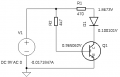
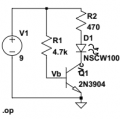
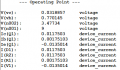
I finally got around to simulating a 2N3904 NPN, like in post #95. This simulation uses actual models (not Eagle defaults) for the Red LED and the 2N3904. Most of it makes sense, 1.77V across LED. But what's up with the negative current?!?

2N3904-graphic.png
 

MrSoftware

Joined Oct 29, 2013
2,273
Not being familiar with your simulator, the negative current may be the result of which way the current probe is connected, assuming it has an orientation.
 
Top