Home school circuit analysis class suggestions needed

Thread Starter

rpschultz

Joined Nov 23, 2022
821
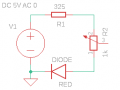
Got back from Puerto Rico late last night. Spent most of the afternoon/evening playing with my son's electronics kit for the class. It's got some pretty cool stuff in it! It's close to THIS KIT, although it has more stuff... including a 6-AA battery pack that plugs in directly to the Darkness Sensor Breadboard and has a 3.3v and 5v tap that's really handy. And there's more stuff I haven't figure out yet. But anyway... for tomorrow's class I put together this Diode-Pot lab that should be a good introduction to my style of hands-on electronics. A lot of review (Ohm's law, diodes), a new topic (pots) and a lot of measurement. It should be fun! Each student has been instructed to bring their kit to class, and I have enough multimeters for everyone... along with extra AA's and specific resistors if they lost theirs. Oh, and I just happened to have a bunch of single and dual pots, perfect for this activity.
 

Attachments

MrChips

Joined Oct 2, 2009
34,834
Just a comment. I know that you might have already prepared your instructions for the class but I find that the value of resistor R1 to be a bit high and that of R2 to be low. The total series resistor can be as low as 100Ω and as high as 5kΩ with a 5V supply.

Lets do the math.
With R1 = 325Ω, the maximum current will be 5V / 325Ω = 15mA
With an LED Vf = 2V, the diode current will be 3V / 325Ω = 9mA

If you use R1 = 100Ω, Imax = 5V / 100Ω = 50mA
In reality, the LED current will be 3V / 100Ω = 30mA
An LED rated for 20mA will survive 30mA.

Now, with R2 = 1kΩ max
LED current = 3V / 1.1kΩ = 2.7mA

With R2 = 5kΩ
LED current = 3V / 5.1kΩ = 0.6mA

You may find that a red LED is still visibly lit with current lower than 1mA.

Edit:
You may also want to expand on the results and the table.
Have the students set the pot to 0%, 25%, 50%, 75%, 100%. Rough eyeball setting is good enough.
Then measure the voltages. Calculate the current. Have the students record the relative LED intensity (Very bright, bright, medium, dim, very dim, etc.)

PS. Note that my values apply only for a supply voltage of 5V. If the supply voltage is other than 5V you have to redo the calculations.
 

Thread Starter

rpschultz

Joined Nov 23, 2022
821
Good points, I can tweak. I like the bright, very bright, dim, etc. column.

yeah 100ohms is too low. I tested it to 100 and it didn’t blow (3/100=30 mA). But I kinda expect some kid to fizzle one out by not installing R1, a good learning experience. If they follow directions they won’t pick 100ohms.

And I know anything more than R2=1k is too much, but it does light up. I only have 5 of each size. 14 kids. They can share, but the difference between 1k and 5k isn’t much, it just gets dimmer quicker.

thanks!
 

MrChips

Joined Oct 2, 2009
34,834
If any kid is going to omit R1 then the LED will blow. You cannot avoid that from happening.

If you are willing to sacrifice an LED then you can demonstrate this once for the entire class.
Remove R1 but leave R2 in place set to 100%.
Slowly turn R2 towards 0% and watch what happens. As you approach 0% the LED will get bright.
At 0% the LED will not suddenly blow out. Let the students observe what is happening and see if they can explain it.

SPOILER: I can give you the answer here if you wish.
 

Thread Starter

rpschultz

Joined Nov 23, 2022
821
I’ve blown LEDs before… it takes 3-4s for it to fry, makes a fizzle sound. Although at higher voltages (9v) it probably would blow/pop faster, Right? It’s like arcing across a capacitor I think?

great suggestion… LEDs are cheap. I’ll demonstrate (slow turning pot) it, and even suggest they can too if they want. I’ve got lots of ‘em!
 

MrChips

Joined Oct 2, 2009
34,834
Ok. It obviously depends on the LED, supply voltage, supply internal resistance, wiring resistance, temperature, etc.

The key factor here is temperature.
As the current increases the LED will get hotter. You might actually notice that the brightness diminishes before the LED finally blows. You might actually be able to save the LED before it blows but its normal brightness will be compromised.

We have also done the opposite in another experiment. We put a glowing LED in liquid nitrogen and watch what happens to the color.
 

MrChips

Joined Oct 2, 2009
34,834
There is a more advanced level to this experiment that is beyond the scope of high school level.

We ask the students to conduct the experiment with ten different values of resistances from 100 to 1000Ω.
Then we get them to plot a graph of diode current versus diode forward voltage.
At this point we introduce the diode equation and get them to practice load line analysis.

1674447294465.png

This is done in a first laboratory experiment in electronics at 2nd, 3rd, and 4th year level university in science and engineering, depending on the program.

Yes, I teach electronics at university level.
 

Thread Starter

rpschultz

Joined Nov 23, 2022
821
Cool stuff!

I guess the point of the lab isn’t necessarily the finer points of LEDs, it’s more a review of ohms law and getting more comfortable with breadboarding. We’ll be doing that a lot.
 

Thread Starter

rpschultz

Joined Nov 23, 2022
821
We ask the students to conduct the experiment with ten different values of resistances from 100 to 1000Ω.
Then we get them to plot a graph of diode current versus diode forward voltage.

View attachment 285841
I am struggling to understand this plot. Diode current vs diode Vf. I think the red trace is R=0.? But I thought the Vf is more/less flat, or close to it. But this plot it varies inversely proportionally. I thought for red it’s like 1.8-2.0V. So the green line makes sense, but the blue and cyan, how can the voltage drop be that big across the diode?
 

MrChips

Joined Oct 2, 2009
34,834
I did not give you the context pertaining to the graph on post #128.

Let's go back to the graph shown here.

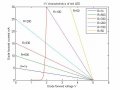
1674452100638.png
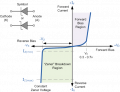
The above graph is a typical (stylized, but not accurate) shape of the I vs V curve of various colored LEDs.
Let us focus on the Red LED.
Yes, Vf is more or less flat @ 2V.
Voltage is on the x-axis. Hence it is flat in the vertical direction.


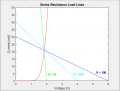
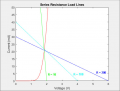
1674452327885.png

On this graph, the red line is the I-V curve for a red LED.
Vf is more or less flat at 2V, in the vertical direction.
The straight lines, blue, cyan, and green are called load lines.

Focus on the blue line alone. This represents the I-V load line of a 200Ω resistor in series with the red LED with a supply voltage of 6V.
A resistor I-V curve would go through the origin (0,0) and have a positive slope. The load line is I vs (Vs - Vr), i.e. with a negative slope.

How do we draw this line?
If the LED were shorted (0V across the LED), the maximum current flowing would be 6V / 200Ω = 30mA.
We have one data point (V = 0V, I = 30mA). (see point on the Current axis.)

If the LED were blown, we would have zero current and the LED anode would be 6V.
We have second data point (V = 6V, I = 0mA). (see point on the Voltage axis.)
We draw a straight line connecting these two data points represented by the blue line. This is called the load line.
The slope of the line is 1/R = 1/200Ω, i.e. I / V = 30mA / 6V.
A lower R would give a steeper slope (ignore the negative slope).
So the question is, how do we determine the LED current with a 200Ω load resistor and 6V supply voltage?
In other words, how do we solve the diode equation for a given load resistor and supply voltage?
The answer is found at the intersection of the LED I-V curve with the resistor load line.
(We had pre-chosen these two values to give an LED operating current of 20mA.)

The blog from which this was taken can be found here:
https://forum.allaboutcircuits.com/ubs/why-you-need-a-series-resistor-when-driving-an-led.1651/
 

Thread Starter

rpschultz

Joined Nov 23, 2022
821
Hmmm. Ok. It's interesting that all 4 lines on that plot intersect at roughly the same spot.

My takeaway from that blog is more voltage is better. My 5v, while convenient, isn't ideal. A 9v supply, would require a higher resistor but provide me with a more consistent and stable current.
 

MrChips

Joined Oct 2, 2009
34,834
Hmmm. Ok. It's interesting that all 4 lines on that plot intersect at roughly the same spot.

My takeaway from that blog is more voltage is better. My 5v, while convenient, isn't ideal. A 9v supply, would require a higher resistor but provide me with a more consistent and stable current.
Yes. That was done by design.
The graph is taken out of context. Read the blog to get the proper context.

Edit: Sorry. I see that you did read the blog. This does not apply to your experiment.
In your experiment, all load lines with different resistances are pinned at current = 0, voltage = 5V. The slopes remain as drawn.
If you wish I can post a new graph if that would make it clearer for you.
 

WBahn

Joined Mar 31, 2012
32,891
Hmmm. Ok. It's interesting that all 4 lines on that plot intersect at roughly the same spot.

My takeaway from that blog is more voltage is better. My 5v, while convenient, isn't ideal. A 9v supply, would require a higher resistor but provide me with a more consistent and stable current.
Mathematically, you can either show them, or give them the problem of showing it themselves, that the change in LED current due either to a change in LED forward voltage or a change in supply voltage goes down as the resistance goes up. This is best done using calculus, but if they aren't there, that's completely fine.

If V_s is the supply voltage, then the resistance, R, needed to get a particular desired current, I_f, through an LED with a forward voltage of V_f is

\(
R \; = \; \frac{V_s - V_f}{I_{f0}}
\)

So, given this resistor, what is the change in I_f if either V_s or V_f change?

\(
I_{f0} + \Delta I_f \; = \; \frac{(V_s+\Delta V_s) - (V_f+\Delta V_f)}{R} \\
I_{f0} + \Delta I_f \; = \; \frac{V_s - V_f}{R} \; + \; \frac{\Delta V_s - \Delta V_f}{R} \\
\Delta I_f \; = \; \frac{\Delta V_s - \Delta V_f}{R}
\)

Thus, for any given variation in either the supply voltage or the LED forward voltage, if we double the resistance, we cut the resulting variation in LED current in half.

If you talk about voltage sources and current sources, this has a very nice tie in to that. An ideal voltage source has zero internal resistance, but an ideal current source has infinite internal resistance. As you increase the voltage supply for the LED circuit, you need a higher and higher resistance, which means that the LED is increasingly seeing a current source instead of the voltage source it primarily sees at lower voltages with lower corresponding resistances.
 

MrChips

Joined Oct 2, 2009
34,834
To complete the picture, here is what your experiment with the students ought to demonstrate.
The intersection of the resistor load lines with the diode I-V curve gives the expected solution for the operating point (current and voltage) of the diode.

LED curve2.jpg
 

MrChips

Joined Oct 2, 2009
34,834
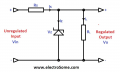
From the I-V curve of a red LED you can see the the diode forward voltage Vf remains fairly constant at 2V for diode currents from 5mA to 30mA.

A red LED would make a reasonably good 2V regulator similar to how a zener diode functions as a voltage regulator.

1674503198189.png


The difference is that the zener behaviour (or avalanche, whichever one of the two occurs) happens when the diode is reversed biased.

1674503099172.png
 

Thread Starter

rpschultz

Joined Nov 23, 2022
821
First class yesterday went pretty well. Most of the boys seemed engaged and curious, some were a bit lost but digging in. It's clear they didn't do much breadboarding last semester, at one point I had to diagram the breadboard on the white board and explain what was connected to what. Most everyone got 1/2-2/3 of the lab done in class, although I could tell a couple boys were just following their neighbor. Toward the end we had a discussion about how to find the current: measuring it vs calculating it. I suggested they should just calculate it since they had measured the voltage and knew the resistance... that was met with a lot of blank stares. ?!? I wrote V=IR on the board and did a quick example calc. A lot of confusion on units, "how do I convert to milliamps, is it 100?". *sigh*. So Ohm's law is not second nature, which I figured it would be after a semester of this stuff. So I'll probably continue this lab next week and supplement the lab with some examples of how to break down the circuit.
POT-diagram.png
 

MrSoftware

Joined Oct 29, 2013
2,273
Maybe start with the super basics. Battery, resistor, LED and TWO multi-meters. Connect the battery, resistor, LED and one of the multi-meters all in series, the multi-meter should be setup in DC current measurement mode. With the second multi-meter have them measure the voltage across the resistor and use that to calculate what the current should be. Their answer should match what the first multi-meter is reading. Keep in mind that inexpensive multi-meters might not be super accurate at small currents, so being close should be considered a match.

When you finally make your way to transistors; just my opinion, but I suspect they're going to struggle with the concept of gain using BJT's. I think it will be easier to just use a MOSFET like an on/off switch, don't get lost in the math, just hit the general concept that the gate is like the on/off switch. Dig into the math, and BJT's, in the future. There will be 1 or 2 kids that get it right away, probably the future engineers of the group, but the vast majority I suspect will take more patience.
 
Last edited:
Top