Home school circuit analysis class suggestions needed

dl324

Joined Mar 30, 2015
18,340
This is complicated.
Once the switch is ON, R1 and Q1 have a voltage drop based on Ic. And D1 has a voltage drop based on its color, 2-3v. And then there’s the whole gain factor, also based on Ic, which goes back to the base current, voltages.
This is probably beyond the class level and my ability to teach it. Although we should be able to simulate it in Eagle spice.
It's simpler if you just design the circuit to guarantee the transistor will be saturated.

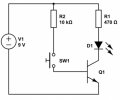
Using values from your schematic. If you assume a voltage drop of 2V for the LED and a saturation voltage of 0V, that leaves 7V across a 470 ohm resistor. That gives you a current of about 15mA. If the voltage drop on the LED is higher, which it will be, and the collector-emitter saturation voltage will be greater than 0V, then the maximum current through the LED will be less than 15mA. If you provide at least 1.5mA of base current, the transistor will be operating in saturation mode.

By assuming worst case values, you can do the calculations in one iteration.

The problem is that the 10k resistor you have on the base will only provide about 0.83mA, so it needs to be smaller. 4.7k would be a safe value (assuming a 5% tolerance resistor). 5.1k would give you 1.6mA, but a resistor on the high range of the tolerance (5.36k) would only give you 1.55mA. That would be cutting it a bit close so we'd choose to drive the base a little harder than necessary to guarantee saturation.
 

MrChips

Joined Oct 2, 2009
34,830
Base-emitter turn-on voltage is something that you learn in school based on the physics of solid state devices.

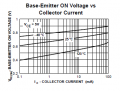
In the chart below you can see that the collector current changes three orders of magnitude from 0.1mA to 100mA when the base-emitter voltage goes from 0.6V to 0.8V at 25°C.

At Ic = 20mA, VBE is about 0.75V.

1674248374740.png
 

dl324

Joined Mar 30, 2015
18,340
It’s starting to make more sense. But why a gain of 10?
It's the rule of thumb we use. If you look at the 2N3904 data you posted, you'll see that the manufacturer used the same value.

We use a higher beta for transistors like BC547 (the datasheet specifies 20), and a lower value for power transistors because their nominal beta is much lower than general purpose transistors.
 

dl324

Joined Mar 30, 2015
18,340
Ok so Vbe is just a given, a few other things I’ve read just assume it’s 0.7v
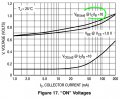
Be careful with making assumptions. The datasheet you posted gives a typical value of 0.65V at a collector current of 10mA, but it could be as high as 0.85V for atypical transistors. It also gives a worst case saturation voltage of 0.2V.

Since the transistor in your circuit would be operating at a higher current, base-emtter and saturation voltages would likely be higher.
 

MrChips

Joined Oct 2, 2009
34,830
It’s starting to make more sense. But why a gain of 10?
No two transistors are the same.
2N3904 is spec'd with a gain of 60 @ 50mA.

You want to design circuits for worst case scenario. Go ahead and design the circuit for a gain of 60. It will work some of the time. If you want the circuit to work every time you derate what is listed in the spec sheet.

The practical way to test this, have the students build the circuit and measure the voltage across R1 and thus be able to calculate the current through R1.

Now have them collect data to plot a graph of collector current Ic vs R2.
 

dl324

Joined Mar 30, 2015
18,340
An interesting exercise would be to use that circuit and vary base current while monitoring the collector-base voltage. That junction will be reverse biased while the transistor is operating in the active region. When it becomes forward biased, the transistor has entered saturation mode.
 

MrChips

Joined Oct 2, 2009
34,830
Current gain of 10 is not a specification.
2N3904 can have a current gain of 300. It depends on the application and circuit configuration.
It does not mean that you can use a gain of 300 in the design.
Using a gain of 10 means that the designer is being very conservative and desires that the circuit works every time in that application.
 

Thread Starter

rpschultz

Joined Nov 23, 2022
821
Ok see if I have it:
7AEAB66E-72DF-4405-B5E0-DB5741F428DD.jpeg
Vbe+Vcb=Vce
Ie=Ib+Ic
Vbe=0.7v
D1 = 2.5v
R2=4k7Ω
Saturated Vce=0v
6.5v across R1, Ic = 14mA
Gain of 10
1.4mA at base
8.3v/4k7=1.8mA=Ib
Gain of at least 10 is 18mA, which is more than needed for LED.

and really, Ic = 14mA, the gain is closer to 100, so plenty of current available.
 
Last edited:

Thread Starter

rpschultz

Joined Nov 23, 2022
821
An interesting exercise would be to use that circuit and vary base current while monitoring the collector-base voltage. That junction will be reverse biased while the transistor is operating in the active region. When it becomes forward biased, the transistor has entered saturation mode.
I like this idea. But I’m not familiar with the terms forward vs reverse biased.

when it’s saturated Vce=0v, since Vbe=0.7v, then Vcb = -0.7v, right? Is this reverse biased?
 
Last edited:

WBahn

Joined Mar 31, 2012
32,890
In a PN-junction diode, current can only flow in one direction. When the voltage applied across it is of the polarity that will cause current to flow, the diode is said to be forward biased. When the voltage applied is the other direction, that is reverse biased and very little current will flow. All of this is, of course, within limits. In an ideal diode, the current flow would be unrestricted as soon as there was any forward bias at all, but in a real diode the current is actually a function of voltage. So, for a silicon diode, it takes about 0.5 V before hardly any current begins to flow, but as the voltage increases the current increases so fast that by the time you get into the 0.8 V range you are generally approaching the diode's current limits. Most diodes that a hobbyist would work with are designed so that the voltage is in the 0.6 V to 0.7 V over the majority of the usual range of currents.

In an NPN transistor, the base-emitter acts like a PN junction diode. However, the current that flows in the very thin base region allows significant current to flow through the reverse-biased collector-base junction and get swept on out to the emitter, resulting in a collector-emitter current that is many times larger than the base-emitter current. The ratio of these two currents is the transistor's beta, which we like to pretend is a constant, but very much is not. Instead, what we do is we design circuits so that they are not very sensitive to the rather large variations in beta, either from one transistor to the next, or as the same transistor is operated over a pretty wide range of conditions.
 

WBahn

Joined Mar 31, 2012
32,890
I like this idea. But I’m not familiar with the terms forward vs reverse biased.

when it’s saturated Vce=0, since Vbe=0.7, then Vcb = -0.7, right? Is this reverse biased?
Do your students a really big favor and indoctrinate them to proper use of units now, before all the bad habits that most of their teachers are going to let them get away with make them resistant.

All physical quantities have both a numerical coefficient and a unit. There's no such thing as a voltage of 0.7. That's like saying that someone's height is 95. Is this person one of the tallest men alive at nearly eight feet, or a much shorter than average five-year old girl at barely over three feet.

And don't just tack units onto the final answer because that's what you think/expect/believe/hope/pray the units are. Treat them like what they are -- part of the value that describes that quantity -- and do the math on them properly from each step to the next.
 

Thread Starter

rpschultz

Joined Nov 23, 2022
821
Do your students a really big favor and indoctrinate them to proper use of units now, before all the bad habits that most of their teachers are going to let them get away with make them resistant.

And don't just tack units onto the final answer because that's what you think/expect/believe/hope/pray the units are. Treat them like what they are -- part of the value that describes that quantity -- and do the math on them properly from each step to the next.
Yes, YES, 1000 times yes! I was a high school physics/math teacher a long time ago, and I preached units. So I get it.
And sorry, I was lazy with my units in that last example.:(
 
Top