Home school circuit analysis class suggestions needed

MrChips

Joined Oct 2, 2009
34,832
Having newcomers use the DMM to measure current is problematic.

It means having to set the DMM to measure current and then breaking the circuit in order to insert the ammeter in series.
Invariably, at some point they will blow the fuse in the meter. (Make sure that you have a lot of spare meter fuses in stock.)

I would stay away from measuring current at this stage until they get a solid understanding on how to measure current.
Instead, I would introduce best practices on how to use the DMM safely.
And that is, after setting the meter range to measure current, resistance, or anything that is not voltage, return the setting to measure voltage.

With old fashioned analog multimeters, we always return the range to the highest AC voltage setting.

For modern DMM, we set the meter to OFF.
 

MrChips

Joined Oct 2, 2009
34,832
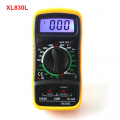
Your link is broken. You mean this XL830L meter.
It uses a 200mA/250V fuse.
When I said "a lot of spare fuses" I mean it, like 50-100 fuses.

1674573784680.png
 

Thread Starter

rpschultz

Joined Nov 23, 2022
821
I tend to agree the class isn’t ready for measuring current. They are still getting comfortable measuring voltage and resistance.

it’s a great idea though, maybe later in the semester.
 

MrSoftware

Joined Oct 29, 2013
2,273
Just put the meter in 10A mode, nothing will blow, your 9V battery (or 1.5V or whatever alkaline battery) can't put out 10A of current even if they dead short it. And no need to "break the circuit", it's in the circuit from the start. Seeing the numbers will make it real and tangible to them. Otherwise it's just abstract "trust me" theory, from their perspective.
 

dl324

Joined Mar 30, 2015
18,341
I tend to agree the class isn’t ready for measuring current.
I'd teach them how to use a resistor to calculate current. If you measure with a meter, you need to think about how it will affect measurements, and impact depends on the range being used.

The same goes for measuring voltage. One time I was taking some measurements on some circuit and the input resistance of the meter was giving me some erroneous readings. I think I was measuring the drain source voltage and got some unexpected readings until I engaged my brain.
 

MrChips

Joined Oct 2, 2009
34,832
Just put the meter in 10A mode, nothing will blow, your 9V battery (or 1.5V or whatever alkaline battery) can't put out 10A of current even if they dead short it. And no need to "break the circuit", it's in the circuit from the start. Seeing the numbers will make it real and tangible to them. Otherwise it's just abstract "trust me" theory, from their perspective.
That is not a workable solution because this meter does not display current lower than 10mA on the 10A range.
 

MrChips

Joined Oct 2, 2009
34,832
I'd teach them how to use a resistor to calculate current. If you measure with a meter, you need to think about how it will affect measurements, and impact depends on the range being used.

The same goes for measuring voltage. One time I was taking some measurements on some circuit and the input resistance of the meter was giving me some erroneous readings. I think I was measuring the drain source voltage and got some unexpected readings until I engaged my brain.
The effect of the meter on current and voltage measurements is an important lesson that usually comes at a later lesson (maybe the second lesson) when covering series and parallel circuits.
 

MrSoftware

Joined Oct 29, 2013
2,273
That is not a workable solution because this meter does not display current lower than 10mA on the 10A range.
So design it to give the LED 30mA. Or use an incandescent bulb that takes a lot more. Or start with the meter in 10A, then turn the knob one click once they verify it's reading under what the smaller setting can handle, they'll need to know how to do this anyway. Lots of possibilities.

The effect of the meter on current and voltage measurements is an important lesson that usually comes at a later lesson (maybe the second lesson) when covering series and parallel circuits.
If you start with the ammeter already in the circuit, you won't have to consider the extra resistance. Measuring the voltage across the resistor, with the ammeter in-circuit, will give you an accurate calculation that should match what the ammeter is displaying. They can also go in reverse; multiply what the ammeter is showing by the resistor and it will equal what the volt meter is showing. When their calculations match both meters, it will be real to them. This is how it would make the most sense to me if I were learning for the first time. Otherwise it's just theory, nothing tangible or real.

With beginners you can't get too lost in the details. Save the effects of adding a meter to the circuit for a later class. For now use circuits that are rough enough that adding the meter won't make a measurable difference, or designs where the effect of the meter is masked, and don't talk about it yet, they'll just get confused.
 

Thread Starter

rpschultz

Joined Nov 23, 2022
821
The kids have a TIP120 Darlington transistor in their kits. Looking at the data sheet, its 2 NPN transistors cascaded together to create higher gain and current, up to 5A. It’s listed as a gain of 2500, but based on previous conversations in this thread, I should conservatively design for a gain of 250 due to the ratios of currents under the C-E saturation voltages.

DDACA051-C48E-4D07-B2B8-44C825175880.jpeg

I was looking at using MOSFETS for higher current, like to use Arduino to power a light bulb. But this Darlington could do that, without the complications of a FET. Right?
 

dl324

Joined Mar 30, 2015
18,341
It’s listed as a gain of 2500, but based on previous conversations in this thread, I should conservatively design for a gain of 250 due to the ratios of currents under the C-E saturation voltages.
The 2500 (I only see a minimum of 1000) value for beta is for active mode operation. The datasheet is telling you to use 250 for saturation mode.

The saturation voltage is specified at 3A.
I was looking at using MOSFETS for higher current, like to use Arduino to power a light bulb. But this Darlington could do that, without the complications of a FET. Right?
By light bulb do you mean line powered or some low voltage DC bulb?
 

WBahn

Joined Mar 31, 2012
32,891
One thing that you will run into very, very quickly as you go up in current is thermal considerations and the need to heat sink your transistors.

There are lots of valuable lessons there. One thing that many, many students seem to have engrained in their mind is that a transistor is a transistor and any place that an NPN transistor is used, any other NPN transistor can be used. The data sheet is just picky little details that don't really matter for what they are doing.

I designed a lab where they had to deliver 5 W to an 8 Ω load using a 30 V supply and a three-state amplifier. I walked through all of the thermal considerations involved and how to read the data sheets. Still had several teams that insisted in using 2N3904 and 2N3906 transistors as their final output transistors. But it didn't take long for them to take thermal considerations seriously when those transistors immediately let out their magic smoke.

But that's not something that your kids are ready for yet. Work with circuits that are well withing the thermal limits of all the parts without any heatsinking. Once they have some comfort there, move up to where thermal effects need to be taken into account. A good thing to help out here is to get an IR thermometer to be able to show them the temperatures at which the surface of their parts are operating.
 

Thread Starter

rpschultz

Joined Nov 23, 2022
821
Haven’t figured that out yet.

probably won’t get to transistors until March, Darlington pairs a few weeks later maybe. Or maybe I’ll skip Darlington and move straight to op amps, I’m not sure.
 

MrChips

Joined Oct 2, 2009
34,832
This is high school level. Postpone FETs, MOSFET, darlingtons, opamps for another time.

Move on to flashing an LED with a 555-timer circuit.
After that a 555-timer tone generator circuit followed by a warbler or siren using two 555 timers.
 

Thread Starter

rpschultz

Joined Nov 23, 2022
821
This is high school level. Postpone FETs, MOSFET, darlingtons, opamps for another time.
Move on to flashing an LED with a 555-timer circuit.
After that a 555-timer tone generator circuit followed by a warbler or siren using two 555 timers.
So spend a 2-3 weeks on basic NPN transistors, then move onto 555 stuff? I was really hoping to teach them how to solder and for each student to solder up some simple circuit as a final project - probably a 555 circuit, they have one in their kit. But man, it all takes time.

Here's the chips they have in their kit:
NE555 Timer circuit
SN54HC08 +And Gate
SNx4HC32 Quad OR Gate
NSx4HC04 Hex Inverter
μA741 general purpose op amp

Here's my rough idea on schedule:
Jan 23 Ohms law and diode lab
Jan 30 Ohms law and diode lab
Feb 6 Arduino with Mr. Chan (another father of student, more of a software guy)
Feb 13 Arduino with Mr. Chan
Feb 20 off
Feb 27 Intro to Eagle schematic & simulation
Mar 6 Transistors
Mar 13 Spring Break.
Mar 20 Transistors
Mar 27 Transistors
Apr 3 555?
Apr 10 Off
Apr 17 555?
Apr 24 555?
May 1
May 8 Project presentation
 
Top