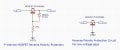
High-side switch / reverse polarity protection

Thread Starter

seanstevens

Joined Sep 22, 2009
323
Have a personal project, a little LoRa 3.3v battery-operated transmitter. My idea was to place a high-side (MIC94070YC6-TR) switch and always enabled on the positive line from the battery so that once the battery was in it was already switched on/standby until a button was pressed to send a command. This I was hoping would also act as a reverse polarity protection. See the circuit snippet below, this works i.e. it powers the transmitter however, when the battery is reversed, it dissipates a lot of power and gets very hot, that was not the plan though.
I dont want to use a diode due to its voltage drop.

Any ideas? The maximum current is 130mA at 3V. Perhaps a PMOSFET?
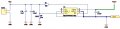
HighSide.jpg
 

DickCappels

Joined Aug 21, 2008
10,661
If I recall correctly, you need a P-channel MOSFET to prevent reverse voltage being applied to your circuit. Take care to get a MOSFET capable of passing the required current with such a low forward gate voltage.
 

crutschow

Joined Mar 14, 2008
38,407
My idea was to place a high-side (MIC94070YC6-TR) switch and always enabled on the positive line from the battery so that once the battery was in it was already switched on/standby until a button was pressed to send a command.
What button?
I don't understand the purpose of the switch as it seems to be on all the time, as soon as power is applied.
Was it just for reverse battery protection?
That, of course, can be done with a logic-level P-MOSFET.
 

Thread Starter

seanstevens

Joined Sep 22, 2009
323
What button?
I don't understand the purpose of the switch as it seems to be on all the time, as soon as power is applied.
Was it just for reverse battery protection?
That, of course, can be done with a logic-level P-MOSFET.
As stated, the circuit above is part of a transmitter (not shown). Since the device is powered and on standby mode (powered), it will just transmit a command when a button is pressed.
Yes, so P-MOSFET was plan B and now it will be have to be plan A.
 

Jon Chandler

Joined Jun 12, 2008
1,571
However, I think you have the P-Mosfet the wrong way around in your diagram, shouldn't the input be fed to the Source and output out of the Drain?
Nope, correct as shown. When the input is positive, the body diode conducts, supplying voltage to the source and allowing the mosfet to turn on. If the polarity is reversed, the diode does not conduct and the mosfet remains off.
 

Thread Starter

seanstevens

Joined Sep 22, 2009
323
So all these are wrong? High side.
I regularly use inrush control using a P-MOSFET as used here and it works great. I dont need inrush control for my project, so I plan to remove the components associated with inrush and just plan to use it as a high-side switch.
Maybe your configuration is for an N-MOSFET?
Maybe I am wrong...
 

crutschow

Joined Mar 14, 2008
38,407
Maybe I am wrong...
Yes, you are.
It's connected opposite of a high-side switch.
A MOSFET conducts equally well in both directions when on, so the P-MOSFET is conducting in its reverse direction when ON and blocks in its normal direction (drain more negative than source) when off.
If you connected the input to the source, then the body-diode would conduct when a reverse voltage is applied, so the reverse voltage wouldn't be blocked.

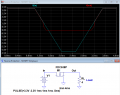
LTspice sim of example circuit below:
The output voltage closely follows the positive input voltage (difference due to the MOSFET's on-resistance) until the voltage goes to near zero, and stays at zero when the input voltage goes negative.
The kink in the output voltage near zero volts is when the body-diode starts carrying the current as Vgs drops below the MOSFET's threshold voltage (here 1.1V).

Edit: It's interesting to note that the body diode (or otherwise an external diode) is required here to start the voltage output rising to the point where the MOSFET can initially turn on.
Without that, Vgs, and thus the output, would stay at zero.


1738859274836.png
 
Last edited:

skstrobel

Joined Nov 29, 2023
28
Note that while a P-MOSFET works well for blocking current flow when a power source is connected backwards, it does not generally work like a diode. It is a switch that gets turned on when (in this application) the body diode passes enough current to create a voltage difference between the gate and source to turn the MOSFET on.

As an example of how this is different than a diode, consider making a diode-OR to combine two power sources such that the one with the higher voltage will supply current to the load. If you use two P-MOSFETs instead of diodes, the voltage on the "downstream" (load) side will turn on _both_ MOSFETs, effectively connecting the batteries in parallel even if one has a much lower voltage, rather than isolating the one with the lower voltage as with diodes.

An alternative for such applications (besides silicon and Schottky diodes) is to use an "ideal diode" controller. They typically use a N-MOSFET and have a charge pump to drive the gate voltage high enough to turn them on. They are designed to turn on only when current will flow in the desired direction. A few part numbers from my notes: LM74700-Q1, LM74720-Q1, LM74721-Q1, LTC4376 (has integrated 7A MOSFET), MPQ5850-AEC1, LM74610-Q1, NID5100, NID5100-Q100. I haven't used any of them; (that hobby project is on hold), so I can't recommend any of them or point to pitfalls.
 
Top