Charge-Pump Based High Side Switch

Thread Starter

emirtnrvr

Joined Mar 9, 2023
8
Hi,

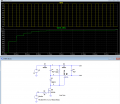
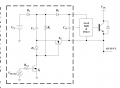
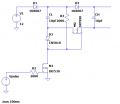
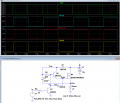
I am trying to design High Side Switch. I design a charge pump it is generating 14V-12V output according to the microcontroller PWM output. (3.3V-0V). You can see the spice simulation below (Blue Vpulse, Green CH Output). Now, I should shift 14V-12V to 14V-0V for switch high side MOSFET. But I couldn't find any solution for it. Can you help me about that Level Shift& Driver Block?

1740096625639.png


1740096707933.png1740096678913.png
 

ronsimpson

Joined Oct 7, 2019
4,645
The 1N4007 is very slow. You need a uF4007 or some other fast recovery diode.
Where did you get schematic-1. I have never seen it done this way.
Please attach your SPICE file.
The way I do it CH charges up to 11V. It appears yours charges to 3V.
 

crutschow

Joined Mar 14, 2008
38,316
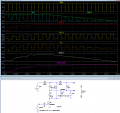
For your amusement, below is the LTspice of a simple bootstrap (charge-pump) circuit with a totem-pole driver to a high-side N-MOSFET, showing the various voltages:
The red trace shows the MOSFET 0-11V gate-source voltage signal.

1740098937582.png
 
Last edited:

Ya’akov

Joined Jan 27, 2019
10,226
Hi,

I am trying to design High Side Switch. I design a charge pump it is generating 14V-12V output according to the microcontroller PWM output. (3.3V-0V). You can see the spice simulation below (Blue Vpulse, Green CH Output). Now, I should shift 14V-12V to 14V-0V for switch high side MOSFET. But I couldn't find any solution for it. Can you help me about that Level Shift& Driver Block?


View attachment 342872


View attachment 342875View attachment 342874
Welcome to AAC.

Is this an assignment for academic credit?
 

crutschow

Joined Mar 14, 2008
38,316
Okay, a few rookie mistakes--

M1 is a standard MOSFET which has a Vgs(th) comparable to your 3.3V control voltage, and requires a 10V signal to fully turn on.
If the signal must be 3.3V, then you need a logic-level type MOSFET with Vgs(th of <2V) that can fully turn on at 3.3V.

R2 is just to prevent signal ringing at the gate and should be no more than 100Ω so the signal rise/fall times are not degraded.

Define the rise/fall times of the Vpulse signal in the sim, as the default in LTspice is a long 10% of the pulse width.

Why did you use two different diode types?
One type should work for all three.

Label the circuit nodes (Label Net, F4) so we can tell what you are plotting [a plot labeled V(n005) does not tell us where that signal is from].

Edit: M2 was connected backwards.

1740187699828.png
 
Last edited:

Ya’akov

Joined Jan 27, 2019
10,226
Yes, but it is a bachelor's level project.
Because of a rule that members may assist with coursework only to the extent of guidance with the student’s own solution, here on AAC all questions related to work that has been assigned for academic credit must be posted in the “Homework Help“ forum.

I know this might not be strictly “Homework“ but it falls under that rubric for purposes of this rule. As a courtesy, I have moved your post to that forum. In the future, please post there directly.

Good luck with your project, and again, welcome to AAC.
 

Thread Starter

emirtnrvr

Joined Mar 9, 2023
8
Okay, a few rookie mistakes--

M1 is a standard MOSFET which has a Vgs(th) comparable to your 3.3V control voltage, and requires a 10V signal to fully turn on.
If the signal must be 3.3V, then you need a logic-level type MOSFET with Vgs(th of <2V) that can fully turn on at 3.3V.

R2 is just to prevent signal ringing at the gate and should be no more than 100Ω so the signal rise/fall times are not degraded.

Define the rise/fall times of the Vpulse signal in the sim, as the default in LTspice is a long 10% of the pulse width.

Why did you use two different diode types?
One type should work for all three.

Label the circuit nodes (Label Net, F4) so we can tell what you are plotting [a plot labeled V(n005) does not tell us where that signal is from].

Edit: M2 was connected backwards.

View attachment 342957
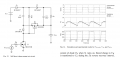
Thanks for your corrections. But still I couldn't get how they switch high side with that circuit. I sent a quote from article.
1740312758300.png
 

Thread Starter

emirtnrvr

Joined Mar 9, 2023
8
Because of a rule that members may assist with coursework only to the extent of guidance with the student’s own solution, here on AAC all questions related to work that has been assigned for academic credit must be posted in the “Homework Help“ forum.

I know this might not be strictly “Homework“ but it falls under that rubric for purposes of this rule. As a courtesy, I have moved your post to that forum. In the future, please post there directly.

Good luck with your project, and again, welcome to AAC.
Thanks. It is not a homework. I am working on academic research as a bachelor's student. But because of the academical purposes it can stay as homework.
 

crutschow

Joined Mar 14, 2008
38,316
But still I couldn't get how they switch high side with that circuit.
Well, its operation is not exactly obvious, but here's my take:
(Below is my sim showing various node voltages as Vdc (green trace) varies from 12V to 0V. I changed the circuit to use all small Schottky diodes and MOSFETs).
  • When S1 is ON, S2 is OFF, and CL charges to Vcc's voltage through D1 and D3 (red trace).
  • When S1 goes OFF, S2 is turned ON (amber trace) by R3 from CL's voltage, causing the bottom of CL to rise to Vdc. The voltage at the top of CL (brown trace) thus goes to (Vdc + Vcc).
  • CL and CH are now also connected in parallel through D2 and S2, causing the two capacitors to equalize their charges,
  • Each cycle transfers more charge from CL to CH until CH is charged to CL's voltage (minus diode drops of course).
The result is that there is a DC voltage (charge) on CH approximately equal to Vcc that floats with, and is independent of, the Vdc voltage, thus CH's voltage can be used to drive a high-side MOSFET from DC to any frequency.

Make sense?

1740332547080.png
 
Last edited:
Top