A Cockfort-Walton type charge pump

Thread Starter

Tutor88

Joined Feb 8, 2023
272
I have been exploring a Cockroft-Walton type charge pump and have been given a circuit by a friend that seems to be a variation on the more traditional layout.

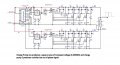
Here is a conventional circuit layout:
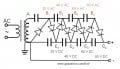
Traditional CW Charge Pump.jpeg


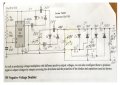
And here is the circuit I was given, and then my interpretation of this expanded to 5 stages.
Alternative Version.jpeg
5 Stage Charge Pump.jpeg
My query is to do with the signal input, which will be a square wave input from an astable and therefore is not + and - signal, as with a sine wave input. What we have instead is a high-frequency 'on-off' connection to ground with a stable 12V supply for the charge pump. So, although this layout seems to be inverted from the traditional layout, it may in fact produce the same result. I will need to change the diodes to say the MUR640, as the one shown is far too low a voltage rating.

So, is there anything here that would suggest that this 5-stage version wouldn’t work?

Thanks
 
Last edited:

Sensacell

Joined Jun 19, 2012
3,768
It will not work.
A charge pump needs an AC source- one that sources AND sinks current.
Your design has only a sink.
The output needs to be a half-bridge with two FET's
 

Thread Starter

Tutor88

Joined Feb 8, 2023
272
Ok, let me draw up some revisions and post later.

Although I’m not clear then how the 555-based 'voltage doubler' circuit in the middle graphic in my first post would be able to work, as this is not a full AC source either but just has a square wave output from 0 to Vcc. The pin 3 output of that 555 goes to one side of the first stage and the 12V supply goes to the top capacitor (C4). The output will be also be 0 - V+ square wave. I'm not looking for an AC output.
 
Last edited:

Thread Starter

Tutor88

Joined Feb 8, 2023
272
Given that I am not trying to achieve an AC output but rather an effective DC through combining two out-of-phase charge pump outputs, please comment on this circuit.

Square wave output charge pump.jpeg
 

sarahMCML

Joined May 11, 2019
695
I have been exploring a Cockroft-Walton type charge pump and have been given a circuit by a friend that seems to be a variation on the more traditional layout.

Here is a conventional circuit layout:

View attachment 362084


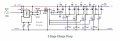
And here is the circuit I was given, and then my interpretation of this expanded to 5 stages.
View attachment 362085
View attachment 362086
My query is to do with the signal input, which will be a square wave input from an astable and therefore is not + and - signal, as with a sine wave input. What we have instead is a high-frequency 'on-off' connection to ground with a stable 12V supply for the charge pump. So, although this layout seems to be inverted from the traditional layout, it may in fact produce the same result. I will need to change the diodes to say the MUR640, as the one shown is far too low a voltage rating.

So, is there anything here that would suggest that this 5-stage version wouldn’t work?

Thanks
Your MOSFET U2 can charge C3 via D2 when it turns on, since it pulls C3's negative end to 0V, but there is nothing to pull that end to +12V when U2 turns off. So it will never discharge into C4 via D3. Ditto for the rest of the chain. The 555's output DOES pull both ways!
 

Thread Starter

Tutor88

Joined Feb 8, 2023
272
As far as I am aware, the output from a 555 is unipolar, so only positive for its square wave. So its output is roughly zero to 1-2V below Vcc. In which case, how is the 'voltage doubler' circuit working?
 

sarahMCML

Joined May 11, 2019
695
The 555's output only needs to switch from a low value to a high one and supply enough current to charge the connected capacitors to be able to "double" the supplied voltage, a true AC voltage isn't necessary.

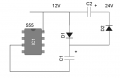
Consider a simple voltage doubler. When the 555's output goes low, the capacitor C1 charges via D1 to almost 12V. When it's output goes high, the negative end of C1 goes to almost 12V, so it's positive end rises above the 12v supply to almost 24V (D1 is reverse biased), and D2 conducts, charging C2 accordingly. This repeats and C1 pumps charge into C2 continuously. No polarity reversal is needed.

V Doubler3.png

Simplified image using part of your your diagram. C2's negative end could just as well be at 0V for a doubler, but would need to be a higher voltage capacitor.
 

Thread Starter

Tutor88

Joined Feb 8, 2023
272
The 555's output only needs to switch from a low value to a high one and supply enough current to charge the connected capacitors to be able to "double" the supplied voltage, a true AC voltage isn't necessary.

Consider a simple voltage doubler. When the 555's output goes low, the capacitor C1 charges via D1 to almost 12V. When it's output goes high, the negative end of C1 goes to almost 12V, so it's positive end rises above the 12v supply to almost 24V (D1 is reverse biased), and D2 conducts, charging C2 accordingly. This repeats and C1 pumps charge into C2 continuously. No polarity reversal is needed.

View attachment 362103

Simplified image using part of your your diagram. C2's negative end could just as well be at 0V for a doubler, but would need to be a higher voltage capacitor.
Thanks, that makes sense. If this mechanism works as you describe then my 5 stage system should also work, since it is based on that voltage doubler circuit, and I don’t need to switch the positive with a FET as the first responder said? Or does that not follow and using the FET switch changes various things?
 

sarahMCML

Joined May 11, 2019
695
Thanks, that makes sense. If this mechanism works as you describe then my 5 stage system should also work, since it is based on that voltage doubler circuit, and I don’t need to switch the positive with a FET as the first responder said? Or does that not follow and using the FET switch changes various things?
As I said in post #5, you don't have anything to pull the negative end of the capacitor positive when your driver turns the MOSFET off. You need to replace your existing driver with a twin output driver, such as a IR2153 (which is self oscillating and has a built in 555 type circuit) or similar driver, and a second MOSFET. Then you will get the correct pull up needed to drive the circuit properly.
 

Thread Starter

Tutor88

Joined Feb 8, 2023
272
As I said in post #5, you don't have anything to pull the negative end of the capacitor positive when your driver turns the MOSFET off. You need to replace your existing driver with a twin output driver, such as a IR2153 (which is self oscillating and has a built in 555 type circuit) or similar driver, and a second MOSFET. Then you will get the correct pull up needed to drive the circuit properly.
I will explore, thanks.
 

Ian0

Joined Aug 7, 2020
13,097
Use a MOSFET gate driver instead of the MOSFET - you can get them with outputs up to 10A. That will give the push-pull signal you need.
 

Thread Starter

Tutor88

Joined Feb 8, 2023
272
Use a MOSFET gate driver instead of the MOSFET - you can get them with outputs up to 10A. That will give the push-pull signal you need.
The TC4420 shown in my 5 stage circuit is already a FET driver. So are you effectively saying get rid of the FET and just use the TC4420?

Depending on the power required I may have to consider using a switching converter instead - probably an off the shelf one or a prepackaged module that I can put on a PCB.
 

Ian0

Joined Aug 7, 2020
13,097
The TC4420 shown in my 5 stage circuit is already a FET driver. So are you effectively saying get rid of the FET and just use the TC4420?

Depending on the power required I may have to consider using a switching converter instead - probably an off the shelf one or a prepackaged module that I can put on a PCB.
Yes.
 

Thread Starter

Tutor88

Joined Feb 8, 2023
272
Given the 'fragility' of using the CW charge pump approach, in terms of enough amperage and sensitivity to EMI, perhaps it would be better to go down the switching DC-DC converter path. My exploration into resonant circuits will require up to around 230VDC with I < 0.2A, so perhaps something like this: https://www.aliexpress.com/item/1005007578181173.html?

Or this one with a 40W (70W peak) output: https://www.aliexpress.com/item/1005004977608549.html?

The sort of units that I would normally purchase from Farnell are very expensive and really out of reach.
 

Thread Starter

Tutor88

Joined Feb 8, 2023
272
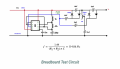
I will also breadboard a simple two stage charge pump of the type I started this thread with (as in the pic below) and see how it behaves - or doesn’t.
Breadboard Test Circuit.png
I will post any useful observations.
 

Thread Starter

Tutor88

Joined Feb 8, 2023
272
A more general query here then: if a CW type of charge pump requires an AC source to work, then can the fact that a square wave can be considered as a sine wave with a very large number of odd numbered harmonics, plus a DC offset, explain why according to some you can get this type of charge pump to work using a square wave input?
 

MisterBill2

Joined Jan 23, 2018
27,182
There are multiple challenges here being addressed separately, as I see it, first, and most obvious, is that the 555 timer omly switches on and off. That means that by itself it can not drive any voltage multiplier circuit that requires both positive and negative current. THAT ALONE is a disqualifying detail. There is also the problem that power out can not be greater than the power in, usually minus some losses. AND the output will be a DC level voltage, although the rise will be a classic "stair-step rise.

AND, ONE MORE TIME!!! The driving voltage source for ALL voltage multipliers of capacitor/diode concept, MUST be able to both source AND sink the required voltage. To do it with a straight DC supply takes a lot of SPDT (form C) switching.
 

Thread Starter

Tutor88

Joined Feb 8, 2023
272
There are multiple challenges here being addressed separately, as I see it, first, and most obvious, is that the 555 timer omly switches on and off. That means that by itself it can not drive any voltage multiplier circuit that requires both positive and negative current. THAT ALONE is a disqualifying detail. There is also the problem that power out can not be greater than the power in, usually minus some losses. AND the output will be a DC level voltage, although the rise will be a classic "stair-step rise.

AND, ONE MORE TIME!!! The driving voltage source for ALL voltage multipliers of capacitor/diode concept, MUST be able to both source AND sink the required voltage. To do it with a straight DC supply takes a lot of SPDT (form C) switching.
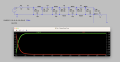
Strange then that a Sim of a charge pump string works with a unipolar series of 5V pulses delivered at 50kHz, at around 65% efficiency (13/(N(4) x 5).

There are plenty of references showing a charge pump working in this way. I have breadboarded it as well to confirm. AC is NOT required.

Sim of Charge Pump C1.png
 
Last edited:
Top